
Your needs, this model
Does it fit your priorities?
What makes the 1587DVS dust route different from the 1587AVS?
Bosch identifies a dust port on the DVS body and describes separate optional hose, port connector and vacuum adapter parts. The AVS instead needs an optional Dust Collection Adapter Kit. Check the exact DVS suffix, port cover and the connection pieces; neither an arbitrary hose fit nor their inclusion in a seller package is documented.
Explore this need in the finder →Does the 1587DVS support vacuum extraction while beveling?
Bosch says the DVS dust cover must be removed when the footplate is angled and that chip-collection efficiency is reduced. This assessment therefore treats the external-vacuum arrangement as level-shoe use. Beveling up to 45 degrees in either direction is documented separately with the blower arrangement.
Explore this need in the finder →Which orbital setting does the 1587DVS manual associate with hardwood?
The manual maps position II to medium-density materials such as harder woods or particleboard. It gives a general wood maximum of 2-3/8 inches but no species-specific hardwood capacity, and it explicitly presents the chart as guidance. Select a suitable blade and test on scrap rather than treating the setting as a cut-quality guarantee.
Explore this need in the finder →Is there a Bosch-documented T-shank example for the 1587DVS?
The family instructions name T101B as compatible with the anti-splinter insert, and Bosch classifies T101B as T-shank. This is one documented example rather than universal T-shank compatibility or proof of U-shank acceptance. Confirm the specific clamp and replacement blade.
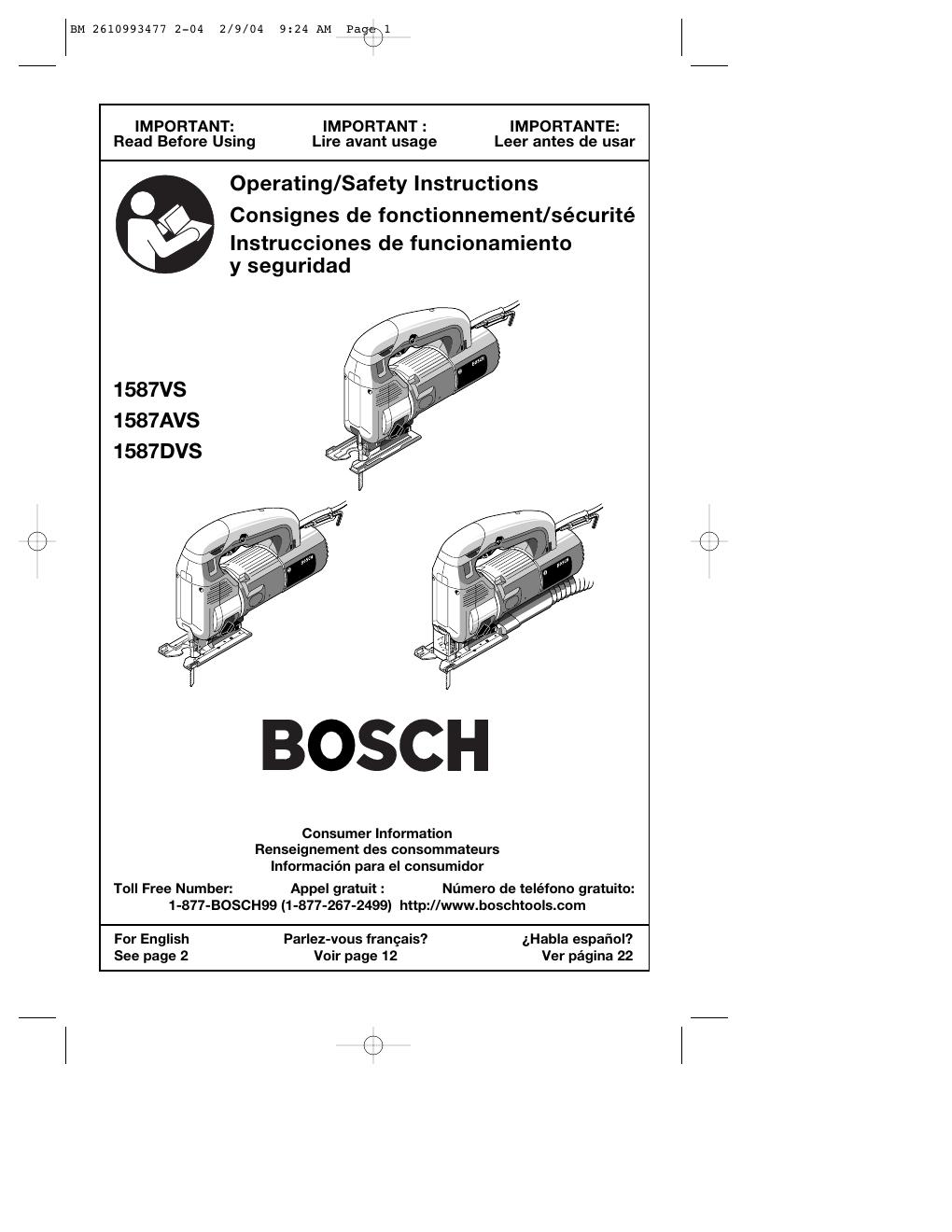
Explore this need in the finder →The Bosch 1587DVS is the earlier top-handle member of the 1587 family with a dust port at the footplate area. Its documented collection setup still needs separate hose and connection pieces, and Bosch says collection efficiency falls when the shoe is angled. This review describes Bosch's 2004 instructions and does not claim a current offer, individual electrical rating or hands-on test. The review image is a Bosch manual illustration of the 1587 family, not a photograph of a seller's tool.
Identify the exact DVS body
Bosch's April 1999 Product Service Department bulletin maps 1587DVS to service-body code 060 1587 839. The same document assigns different codes to 1587VS (060 1587 639) and 1587AVS (060 1587 651). That distinction has a practical consequence: the checked Bosch manual labels the DVS dust port, cover and connector specifically, describes an optional adapter kit for AVS, and does not document a vacuum route for VS.
The Bosch-authored manual cover illustrates all three 1587 variants. It is useful for seeing the family design, but it is not a surviving specimen photo and does not verify another seller's label, condition or package. A Heath Industrial lot book for its November 2025 Pavement Systems sale lists one Bosch 1587DVS jigsaw as lot 22. The event page shows a broad gallery, but no source link ties a specific photograph to that named lot, so none is presented here as an exact DVS specimen. Ask for the full tool suffix and electrical nameplate, then check the actual DVS cover and port. The manual does not establish a single voltage or current rating for every remaining DVS body.
Dust collection has a specific setup and an angle limit
Bosch says the 1587DVS is equipped with a dust port. Its instructions describe attaching an optional hose to a port connector, fitting that connector to the dust port, then using a shop vacuum with an adapter. The manual calls these separate optional accessories. The port is therefore not evidence that a random hose, extractor or seller-supplied attachment fits, and the package image is not proof that the necessary pieces are included. Confirm the connector, hose and adapter combination before relying on the collection route.
Footplate position changes the dust plan. Bosch says the DVS dust cover must be in place for maximum efficiency. When the shoe is tilted, its adjustment screw is behind a sliding cover, and the dust cover has to be removed; Bosch warns that chip-collection efficiency is then reduced. The manual still documents a bevel shoe up to 45 degrees in either direction, with a zero detent and marks at 15 and 45 degrees, but it does not support treating maximum vacuum collection and bevel cutting as one unchanged setup. The document-based vacuum arrangement discussed here keeps the DVS footplate level. Its blower setting is a separate option, not a claim of simultaneous source capture.
For line visibility without the vacuum attachment, the family has a three-position chip blower. It can direct stronger air, medium air or no air to the cutline. That airflow moves chips and is not dust capture. Do not substitute the blower for a shop-vac plan if capturing material at the source is essential.
Speed, orbit and material guidance
The 1587 family combines a variable-speed trigger with a separate preset dial marked A–E. Bosch groups A–B as low stroke, C–D as medium and E as high; no numeric SPM value for each position appears in the checked manual. Do not transfer the 1584 family's dial values to this 1587DVS. Bosch warns that prolonged operation at low speed can raise motor temperature because the internal cooling fan turns more slowly, so the manual advises periodically running at full speed in that case.
The orbital selector has setting 0 for straight motion and I–III for orbital action. Bosch associates 0 with hard materials such as metals or thin sheet; I with softer work where cleaner cutting or delicate scrolling is wanted; II with medium-density stock such as harder woods or particleboard; and III with soft material such as wood or plastic when faster cutting matters. It calls the chart a guideline and recommends a test cut in scrap. Blade choice and feed still govern the result; the selector is not a quality guarantee.
Blade, inserts and published capacities
The manual's top-handle blade-change procedure uses a rotating knob, plunger and roller guide. For installation, Bosch directs the user to set orbital position III, release the knob, place the blade tabs in the plunger, align the back of the blade with the roller guide and turn until the click locks. On an older saw, inspect the parts rather than assuming a tool-free mechanism remains complete. Bosch lists T101B among blades that work with the anti-splinter insert; its current U.S. blade information identifies T101B as T-shank. This is one example, not universal T-shank fit or proof of U-shank acceptance.
The manual says AVS and DVS bodies accept steel and smooth plastic footplate inserts; the steel insert is for general use and the smooth plastic one may help minimize scratches on fine surfaces. The DVS-specific footplate access cover and port appear in the illustration, while the exact contents of a DVS seller's package remain unknown. Bosch's maximum-capacity table lists 2-3/8 inches in wood, 1-1/4 in plastic, 3/4 in aluminum and non-ferrous metal, 3/8 in mild steel and 1/8 in stainless and alloy steel. These are manufacturer maxima, not tested cuts, a species-specific hardwood rating or a safe-use promise; cast iron is not listed.
Buying checks for an earlier tool
Ask the seller to photograph the 1587DVS body mark, nameplate, cord, shoe, dust-port cover and all connection pieces together. Confirm the hose, connector and vacuum adapter by exact part and fit, and ask for a written package inventory. Check the sliding cover and shoe operation, return terms and the actual specimen's electrical rating. No 1587DVS package suffix or current retail offer is established here. No exact-name recall query was run, so recall status is unknown, not cleared; no performance, ownership, testing or customer experience is claimed.
The manual supports an external-vacuum arrangement only with the DVS body's specified connection chain and a level shoe; it does not make this historical model a current finder recommendation. If beveling is important, Bosch's warning about reduced collection at an angle matters more than a generic “dustless” label. This assessment is a reading of the manufacturer's instructions, not a measured comparison with the 1587VS or AVS.
This is a public historical model reference, not an ordinary finder recommendation. For identity checks only, open the fixed Bosch 1587DVS model-reference lookup. It is not evidence of a current offer or a match for your selected needs; verify the exact tool label, nameplate, seller package and condition independently.
Sources and method
- Bosch 1587VS / 1587AVS / 1587DVS Operating/Safety Instructions, BM 2610993477 2-04, Bosch-authored (third-party-hosted); pages 6–11 cover identity, settings, capacities, bevel, DVS dust port and accessory distinctions.
- Bosch Product Service Department roller-guide bulletin, April 1999, third-party-hosted; used for exact service-body codes.
- Bosch JA1002 anti-splinter insert page; its exact compatibility table corroborates the 1587 suffixes; an inconsistent marketing bullet is not used as an identity.
- Bosch T-shank blade-set information, used to classify the manual's T101B example.
Key specifications
Key details at a glance
| Power source | Corded mains power |
|---|---|
| Grip format | Top handle |
| Blade interface | T shank |
| Cut-action settings | 0 / 1 / 2 / 3 |
| Maximum documented bevel | 45° |
| Integrated cutline blower | Yes |
| Optional vacuum-extraction route documented | Yes |
Use the exact model’s instructions for operating limits, supplied equipment and version differences.
Sources for this review
Sources for this assessment
- Bosch 1587VS / 1587AVS / 1587DVS Operating/Safety Instructions, BM 2610993477 2-04
- Bosch Product Service Department roller-guide service bulletin, April 1999 (third-party-hosted copy)
- Bosch JA1002 anti-splinter insert: U.S. compatibility list
- Bosch T-Shank Jig Saw Blade Sets
- Bosch 1587-family Operating/Safety Instructions cover illustration
- Heath Industrial, Pavement Systems, Inc. auction lot book, lot 22
- Heath Industrial, Pavement Systems, Inc. event page and broad photo gallery (normal-browser capture)
Make the next check about your project
Use the finder to combine material, blade interface, grip and operating setup. It matches documented capabilities, not guaranteed results.