
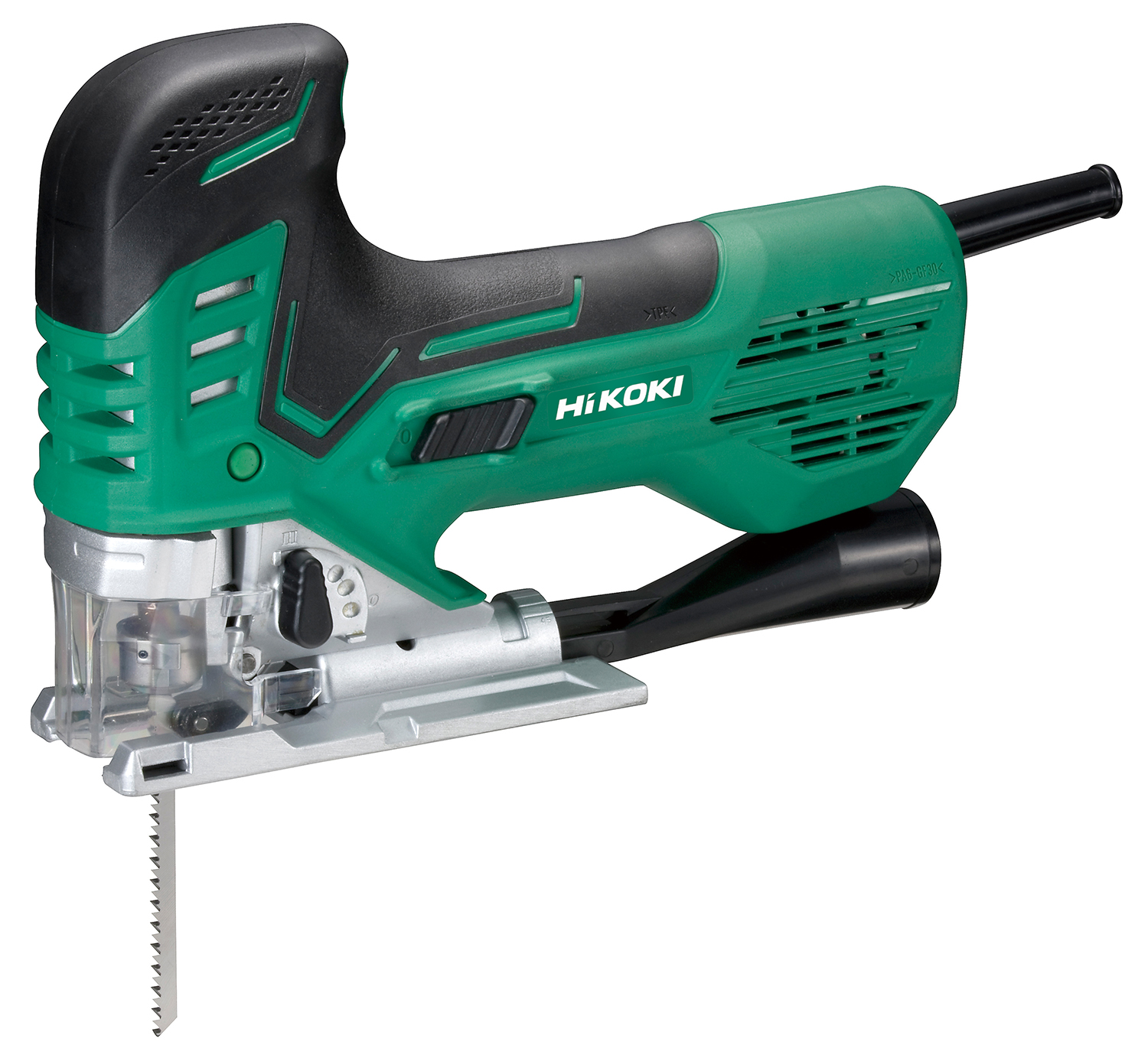
Your needs, this model
Does it fit your priorities?
How does the CJ160VA differ from the CJ160V?
They are separate configurations in the U.S. manual: CJ160V is drawn with a D-handle trigger and stopper, while CJ160VA has a barrel-grip form and its own switch/dial drawing. The shared manual gives both the same 120 V/60 Hz, 7.0 A family specifications and cutting instructions. CJ160VA's international product page/image corroborates the barrel-grip body only; it is not evidence of the U.S. package.
Explore this need in the finder →Is the CJ160VA an eligible purchase-finder result?
No. This site keeps a separate manual-backed review reference so the barrel-grip model is not merged with CJ160V, but no exact U.S. standalone product page, retailer offer or U.S. package list was independently established. Its operating specifications cannot prove current availability, an exact box, seller condition, price or warranty; the matcher therefore excludes it from buying recommendations.
Explore this need in the finder →What are the CJ160VA's documented setup limits?
The U.S. manual lists 0–III orbital adjustment, 120 V/60 Hz and capacities of 160 mm wood, 20 mm aluminum and 10 mm mild steel. The distinct stainless procedure is No. 97 blade, 1.5–2.5 mm plate, position 0 and cutting fluid. Angular cuts require position 0 and are barred with the chip cover or dust collector installed. These are manual specifications, not a performance test, and the reference is not a buying candidate.
Explore this need in the finder →This is a document-based reference for the Metabo HPT CJ160VA barrel-grip configuration, not a hands-on review or a buying recommendation. The U.S. instruction manual names CJ160VA separately from CJ160V and provides a 120 V specification row for both. I use the manual for U.S. operating facts and an official HiKOKI international page/image only to help identify the barrel-grip body; those international materials do not establish a U.S. retail package.
A separate grip and switch arrangement
The manual's first parts diagram draws CJ160V with a D-handle trigger and stopper. Beside it, CJ160VA has the barrel-grip body, its own switch and a speed dial. The page's separate product rendering is useful for recognizing that configuration rather than treating the suffix as a cosmetic variation. Grip is personal, so a photograph or diagram cannot substitute for holding the saw if hand placement is decisive; this review does not make a comfort or control-quality claim.
In the U.S. manual, the shared specification table lists 120 V AC at 60 Hz, 7.0 A, 800–2,800/min no-load speed, 26 mm (1-1/32 inch) stroke and 5.5 lb (2.5 kg) weight for the CJ160V and CJ160VA family. The same table gives 160 mm wood, 20 mm aluminum and 10 mm mild-steel capacities, and a 25 mm minimum radius. These are manufacturer ratings, not capacities I have verified on a sample. The international product page's wattage, voltage, weight presentation and accessory list are not imported into this U.S. fact record.
Action, speed and material boundaries
The U.S. manual shows an orbital selector from 0 through III. Position 0 removes the forward orbital movement; positions I–III add it. It recommends reducing orbit for harder stock and accuracy and increasing orbit for softer lumber or plastic. Speed dial settings 1–5 select standard speeds between 800 and 2,800/min. AUTO is a distinct position, described as 1,400/min at no load and 2,800/min with load, though the manual cautions that actual behavior may not reach or return exactly to those figures for every task.
The manual names various lumber, phenol/vinyl-chloride-type plastics, mild-steel, aluminum and copper plates, as well as a separate stainless-steel procedure. At speed settings 1–2, it warns against wood thicker than 8 mm or metal thicker than 1 mm. That low-speed warning is not the maximum cutting depth. For metal, it directs speed dial scales 3–4, orbital position 0 or I and cutting fluid. For stainless steel specifically, it requires the separate No. 97 blade, 1.5–2.5 mm plate, orbit position 0 and cutting fluid. That instruction does not establish cast-iron suitability or a universal hard-metal capability.
Bevel and dust collection need different arrangements
The manual describes a base that swivels up to 45 degrees on either side in 15-degree increments. It instructs the user to select position 0 for angular cuts. The same manual says not to make angular cuts when the chip cover or dust collector is fitted. External collection is possible through a dust-collection adapter, a connecting adapter and a separate cleaner; the shared accessory section lists a dust-collection adapter, but it does not identify which items were packed with a standalone CJ160VA sold in the United States. A collector-equipped square-cut setup and a bare-shoe bevel setup should be treated as different operating arrangements.
The checked U.S. sources do not establish a built-in blower for the CJ160VA. The international HiKOKI page describes blower function, a soft barrel-grip and an optional dust-extractor adapter for its marketed configuration, but country-specific products may differ. I have not used that overseas feature list to populate U.S. matching fields. The blade shank is also not confirmed in the U.S. manual; check an exact unit and blade instead of assuming that a numbered blade or a retailer title proves compatibility.
Why this is a reference, not a shortlist result
The U.S. manual gives unusually helpful evidence for the existence of a separate 120 V CJ160VA configuration, its controls and operating limits. But the research set did not find an exact U.S. standalone product page, exact U.S. retail offer, package list or reliable evidence of what a U.S. seller includes. The Lowe's page retrieved for the distinct CJ160V does not establish a CJ160VA retail record. Nor does an official international photo establish the supply rating or contents of a U.S. unit. To avoid suggesting that a documented model is available to buy, the CJ160VA is retained as a separate reference-only page and excluded from the site's matching shortlist.
This distinction also prevents a common suffix mistake. CJ160V and CJ160VA share a manual and much of their stated cutting specification, but the documented control and grip formats differ. A shared manual is not proof that an offered unit has the other model's handle, trigger or carton. The CJ160V has an exact U.S. tool card and retailer-model record; those facts are not automatically transferred to CJ160VA.
What a reader can take from the documents
For identifying a CJ160VA, the useful cues are its barrel-grip shape and separate switch/dial layout. For understanding operating boundaries, the common U.S. manual gives the 0–III action selector, 120 V/7.0 A family specifications, material capacity figures, the No. 97 stainless method and the collector-versus-bevel exclusion. None of these make a claim about speed, accuracy, comfort, cut edge or durability in use.
Until an exact U.S. sales/package bridge is available, compare this page with the CJ160V review for configuration understanding only. The fixed CJ160VA model-reference lookup is an exact-model search aid, not a recommendation to buy or verification of a U.S. retail offer. Do not assume the international photo depicts the contents of a U.S. box. If you encounter a candidate, independently verify the complete model marking, nameplate, seller's written inventory, service documentation, condition and return terms before making a decision. The reference preserves a distinct, source-supported configuration without turning an incomplete retail record into a product offer.
Key specifications
Key details at a glance
| Power source | Corded mains power |
|---|---|
| Grip format | Barrel grip |
| Motor type | Single-phase series-commutator motor |
| Cut-action settings | 0 / 1 / 2 / 3 |
| Maximum documented speed | 2800 SPM |
| Maximum documented bevel | 45° |
| Optional vacuum-extraction route documented | Yes |
| Rated motor current | 7 A |
| Stroke length | 1.03 in |
Use the exact model’s instructions for operating limits, supplied equipment and version differences.
Sources for this review
Sources for this assessment
- Metabo HPT U.S. CJ160V / CJ160VA instruction manual
- Official HiKOKI CJ160VA international product page (body-reference evidence only)
- Official HiKOKI CJ160VA international product image
- Metabo HPT U.S. saw catalogue filtered to Jig Saw (2026-10-30 capture)
- Metabo HPT U.S. individual-tool warranty list (checked 2026-10-31)
- CPSC bounded exact-name CJ160VA recall query

Make the next check about your project
Use the finder to combine material, blade interface, grip and operating setup. It matches documented capabilities, not guaranteed results.