
Your needs, this model
Does it fit your priorities?
Does the 1581AVS use a quick-change blade clamp?
No tool-less clamp is documented. Bosch's manual instructs the owner to use the supplied screwdriver through the top plunger hole, loosen the internal blade screw, seat the blade tabs and tighten the screw again. It names T101B as one blade that works with the anti-splinter insert; U-shank acceptance is not established.
Explore this need in the finder →Which orbital setting does Bosch suggest for harder wood?
For medium-density material such as harder woods or particle board, the 1581AVS manual suggests position II. It describes position I for softer work when cleaner cutting or delicate scrolling matters and position III for soft materials such as wood or plastic when faster cutting is preferred. Bosch calls this a guideline and advises testing on scrap.
Explore this need in the finder →Can the 1581AVS be treated as a bevel-capable cutline-blower setup?
Bosch documents a three-position chip blower and a footplate that tilts up to 45 degrees in either direction. The manual does not document an external-vacuum route for this model, so do not substitute a vacuum compatibility assumption for the built-in blower.
Explore this need in the finder →The Bosch 1581AVS is an earlier, corded top-handle jigsaw documented in Bosch’s 2004 operating manual. Its defining setup is a variable-speed trigger, preset dial, lock-on control, four orbital positions, a three-position chip blower and a footplate that tilts up to 45 degrees in either direction. The manual names a Bosch T101B blade for its anti-splinter insert, but describes a screw-secured blade change rather than a tool-less clamp. The exact retail package, electrical nameplate and current offer are not established by the reviewed sources.
Keep the exact AVS body distinct
Bosch’s U.S.-hosted Operating/Safety Instructions identify this tool as the 1581AVS. That is more precise than the un-suffixed “1581” compatibility shorthand appearing on Bosch accessory pages. The 1581 family also appears with other suffixes in historical parts material, and those records do not establish that every version shares the AVS controls or operating details. This assessment therefore covers only the model named on the 1581AVS manual, not a generic 1581-series listing, a 1581VS or a 1581DVS.
The manual depicts a top handle and identifies a trigger, a lock-on button, a trigger preset-speed dial, an orbital selector, a chip-blower lever and a roller guide. Squeezing the trigger starts the saw; the preset dial limits the selected speed range, and the lock-on button allows continuous running at maximum RPM. Bosch labels the dial’s A–B area low, C–D medium and E high, but the manual does not give a model-specific strokes-per-minute range. Treat advertised speed numbers on a particular used listing as something to verify against that unit’s nameplate and documentation.
Blade changes are a hands-on setup task
Bosch’s procedure calls for placing the orbital selector at position III, reaching through the top of the plunger with the supplied screwdriver, loosening the internal blade screw, seating the blade tabs and tightening the screw again. That is a different workflow from a modern tool-less quick-change clamp: allow time for a secure blade change and do not assume a seller has included the original screwdriver or other accessories.
The same 1581AVS manual says its anti-splinter insert only works with ground-side blades, naming Bosch T101B among its examples. Bosch’s current blade-set page classifies T101B as a T-shank blade, so T-shank use is supported for this model. The reviewed manual does not say whether U-shank blades are accepted, nor does it establish that every T-shank blade fits every condition of an older plunger. Confirm the blade and exact tool label before relying on a compatibility claim; the manual also advises a test cut in scrap for a new material or blade.
Use the orbit chart as guidance, not a finish promise
The selector has four settings. Bosch’s chart recommends setting 0 for hard materials such as metals and thin sheet; setting I for softer materials when a cleaner cut or delicate scrolling matters; setting II for medium-density material such as harder woods or particle board; and setting III for soft material such as wood or plastic when faster cutting is more important than a clean edge. Bosch presents these as guidelines and asks users to test on scrap. It also says blade choice, feed rate and material affect the useful speed, and warns that prolonged low-speed operation can heat the motor because the internal cooling fan turns more slowly.
The manual’s “maximum capacities” table lists 2-3/8 inches in wood, 1-1/4 inches in plastic, 3/4 inch in aluminum, 3/4 inch in non-ferrous metal, 3/8 inch in mild steel, and 1/8 inch in stainless and alloy steel. These are manufacturer-published limits for the 1581AVS manual, not a promise that a particular blade, stock, work support or worn specimen will make a suitable cut at those depths. The evidence does not provide a species-specific hardwood capacity or a quality threshold.
Blower and bevel are separate from dust extraction
Bosch describes a three-position chip blower that can direct no air, medium airflow or the strongest airflow toward the cut line. The manual points to the stronger setting for wood and similar material; a cutline blower is not the same thing as vacuum collection. The reviewed model-specific instructions do not document a compatible external-vacuum arrangement, so this assessment does not count the 1581AVS as a vacuum-connected setup.
The footplate can tilt up to 45 degrees in either direction. Bosch identifies firm detents at 45 degrees, marks at 15 and 30 degrees, and says intermediate angles can be set with a protractor. Adjustment involves loosening a screw with an Allen wrench, sliding the footplate and tightening it after positioning. This is useful bevel range, but not a quick preset: check the scale and re-secure the shoe before cutting. The manual also explains that moving the footplate to its flush-cut position allows only 90-degree cuts and prevents use of the optional cutting guide.
What a used offer still needs to establish
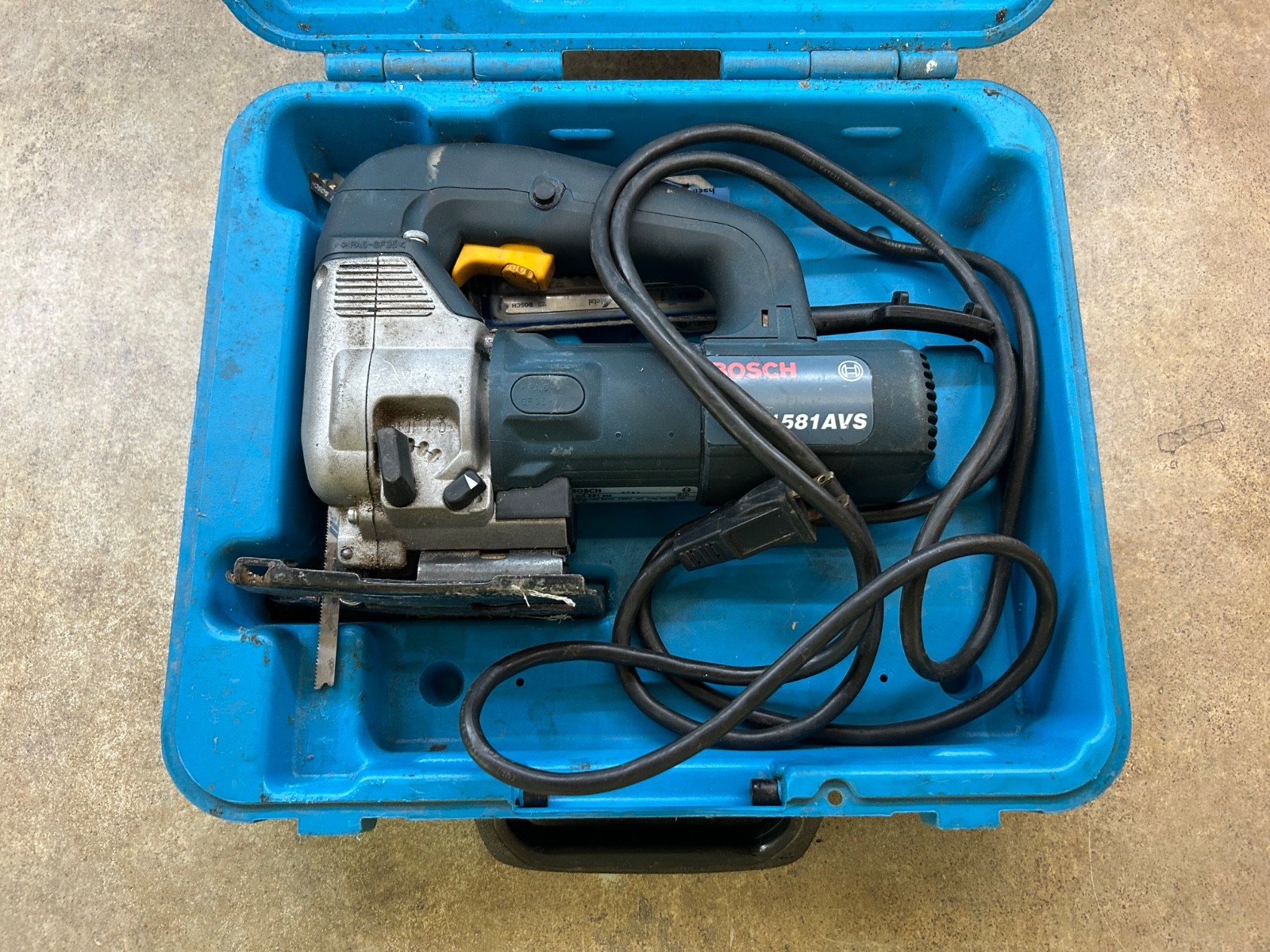
A seller’s specimen photo used here shows a body labelled 1581AVS in a case, but one image does not establish an original kit suffix, complete package, working order or present condition. The U.S. manual itself does not settle the electrical rating for every offer; Bosch instructs the owner to compare the outlet with the individual nameplate. Before purchase, match the tool label to 1581AVS, confirm the nameplate and cord condition, check the trigger and lock-on operation with the seller, and ask for a written list of blades, case and accessories actually included. Inspect the shoe adjustment, roller guide and blade clamp on the unit rather than assuming an old tool has been serviced or that parts remain available.
Bosch’s 2007 catalog also identifies a historical 1581AVSK top-handle configuration with a carrying case. A Bosch parts-list copy associates that package name with the 1581AVS body number 0601581666, which supports treating AVSK as a package variant rather than another saw-body review. This establishes a named case package in those sources, not a complete inventory for another seller’s box; the exact AVSK package photo is still unverified, and the pictured AVS body in a case does not prove it is an AVSK carton.
The 1581AVS is most relevant when a buyer specifically wants a corded top-handle Bosch body with a variable-speed trigger, orbit selection and bevel shoe, and is comfortable with its screw-based blade procedure. Someone requiring a confirmed U-shank interface, external vacuum connection, current-model status or exact package contents should not infer those from this record; use the finder’s documented constraints and check another model’s own evidence.
This is a source-based assessment, not a hands-on review. No ownership, test cuts, measured accuracy, vibration, durability, seller condition, present stock or price is claimed. The exact-name CPSC query saved for 1581AVS returned an empty result; that limited lookup is not comprehensive recall clearance.
Sources and method
- Bosch 1581AVS Operating/Safety Instructions (the exact-model manual, including controls, blade procedure, material guidance, capacities, blower, bevel and flush-cut instructions).
- Bosch T-Shank Jig Saw Blade Sets (identifies T101B as one of the T-shank blade models).
- Bosch JA1002 Anti-Splintering Insert (manufacturer compatibility list includes 1581AVS; accessory evidence, not package contents).
- Bosch U.S. Jig Saws category (current captured category scope does not list this older body).
Key specifications
Key details at a glance
| Power source | Corded mains power |
|---|---|
| Grip format | Top handle |
| Blade interface | T shank |
| Cut-action settings | 0 / 1 / 2 / 3 |
| Maximum documented bevel | 45° |
| Integrated cutline blower | Yes |
Use the exact model’s instructions for operating limits, supplied equipment and version differences.
Sources for this review
Sources for this assessment
- Bosch 1581AVS Operating/Safety Instructions
- Bosch T-Shank Jig Saw Blade Sets
- Bosch JA1002 Anti-Splintering Insert
- Bosch U.S. Jig Saws category snapshot
- CPSC exact-name product lookup for 1581AVS (bounded query)
- Seller listing for an exact-model 1581AVS specimen photo
- Bosch 4100DG-09 Saw & Benchtop Tools & Accessories Catalog, printed p.55
- Bosch 1581AVSK parts-list copy; 0601581666 / 1581AVS identity
Make the next check about your project
Use the finder to combine material, blade interface, grip and operating setup. It matches documented capabilities, not guaranteed results.