
Your needs, this model
Does it fit your priorities?
How can I tell the Bosch 1582 apart from the related 1582VS and 1582DVS?
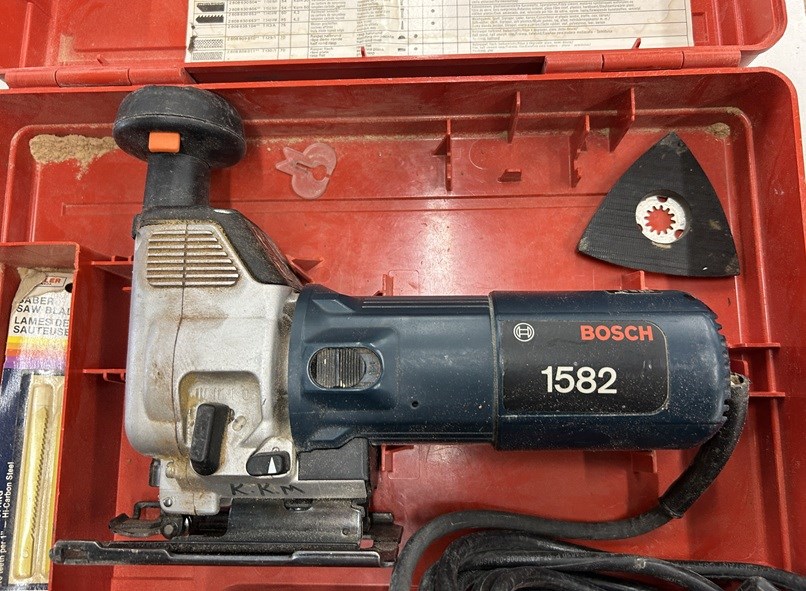
The 1999 Bosch service bulletin assigns separate body codes: 060 1582 234 for 1582, 060 1582 534 for 1582VS and 060 1582 934 for 1582DVS. A saved used-specimen photo visibly reads 1582, but neither that photo nor the code bulletin identifies the contents of another offer. Check the exact body label; do not transfer the VS rear speed-control or DVS dust-extraction claims to the unsuffixed saw.
Explore this need in the finder →Is there a documented T-shank blade example for the Bosch 1582?
The 1582-family instructions name Bosch T101B in the anti-splinter setup, and Bosch's U.S. blade listing classifies T101B as T-shank. That supports this named example, not every T-shank blade or U-shank acceptance. Confirm the model marking and follow the exact saw and blade instructions before fitting a blade.
Explore this need in the finder →What wood-cutting setup is documented for the unsuffixed Bosch 1582?
The Bosch family instructions describe straight and orbital action and general wood work. They do not justify assigning the base 1582 the 1582VS/DVS rear speed control or a suffix-specific speed range. I do not assign this body a species-specific wood limit, cut depth, dust route or bevel figure from the available rendering.
Explore this need in the finder →The unsuffixed Bosch 1582 is a distinct earlier jigsaw body, not the 1582VS or the extraction-equipped 1582DVS. Bosch's family instructions support straight and orbital general-wood arrangements and name a T101B blade for an anti-splinter setup; Bosch classifies that blade as T-shank. Exact speed, capacity, electrical nameplate, dust route, bevel rating and package contents remain unverified for this base model.
Start with the full model marking
Bosch's 1999 Product Service Department bulletin gives separate body codes for three similar names: 060 1582 234 for the unsuffixed 1582, 060 1582 534 for the 1582VS, and 060 1582 934 for the 1582DVS. That is a useful identity boundary, not a package list or an assurance that a particular listing is a complete Bosch retail set. Bosch's U.S. JA1002 accessory page also names the plain “1582” model string, but the accessory compatibility entry does not supply the saw's specifications.
The photograph used for this review is a closed Canadian auction specimen. Its body label visibly reads BOSCH 1582, which makes it useful for identifying the pictured base model. The image shows a cord and a barrel-style body with a separate upper knob, but it says nothing about a different seller's item, condition, nameplate, package suffix, or whether the pictured case and other objects were originally included.
Do not borrow the VS or DVS control claims
The shared family instructions describe a front slide on/off switch across the 1582, 1582VS and 1582DVS models. In a separate passage, however, the manual names a rear speed-control switch on the 1582VS and 1582DVS; it does not include the plain 1582 in that statement. I therefore do not assign the unsuffixed model a variable-speed control, dial range or strokes-per-minute value based on its relatives. The exact tool's controls should be compared with a model-marked manual before use.
This distinction matters when an old listing uses a family photo or a loose “1582” title. The Bosch code bulletin separates those bodies, while the control language separates their documented configurations. A 1582VS speed number cannot be treated as a base-1582 specification just because the models share instructions.
One T-shank example, not every blade
In the anti-splintering instructions, Bosch names the T101B blade. Bosch's U.S. blade catalogue classifies T101B within its T-shank family, so that named setup is one supported T-shank example for the 1582-family instructions. It is not proof that every T-shank blade will seat correctly in every surviving clamp, nor does it establish U-shank compatibility.
For replacement blades, verify the entire model label and follow the saw's blade-change instructions together with the blade maker's compatibility notes. Do not infer the contents of a used seller box from the manual's example blade. This assessment records no included blade or count.
Use the manual at the level it supports
The 1582-family instructions describe straight and orbital action and general wood work. I use those two broad arrangements, not an exact count of orbit settings or a species-specific wood rating for the plain 1582. The targeted pages available in the rendered manual view do not let me assign every specification-table entry cleanly to this unsuffixed model. A 1582VS or 1582DVS setting, capacity, speed or electrical figure should not be imported into the base model by family association.
For a real cut, the correct blade, stock, support, feed and setup still matter. The source record does not establish a maximum wood depth, softwood/hardwood split, metal or plastic capacity, stroke length, measured cut quality or performance outcome. “General wood” here means the manual-supported broad task category; it is not a promise that a particular workpiece is suitable.
Dust collection, beveling and supply remain open
The manual specifically identifies the external dust-extraction connection through the footplate on the 1582DVS. It does not support transferring that feature to the unsuffixed 1582. The three-position integrated chip blower is described for the 1582VS, not for this base model in the evidence reviewed here; a cutline blower is not a vacuum collector in any case. I leave both dust routes unknown for the plain 1582.
Likewise, I do not attach a bevel maximum or an adjustable-shoe claim to the base 1582 from a neighboring specification row. The specimen photo is not clear enough to verify a bevel scale or its condition. The visible cord supports describing the pictured configuration as corded, but no base-model electrical nameplate value was established. Read the individual rating plate and confirm it is appropriate for the available supply before connecting a particular tool.
Buying an earlier body means checking the individual tool
The auction listing and exact label image support the identity of one used body; they do not establish current stock or a U.S. offer, seller condition, working order, accessories, or package contents. Before relying on an offer, request a clear body-label and rating-plate photo, identify the switch and blade clamp, and ask for an itemized list of the actual included parts. Inspect the cord, switch, shoe, handle and clamp on the specific tool. No hands-on inspection or test was performed for this assessment.
A bounded CPSC product-name lookup for “Bosch 1582” returned an empty JSON array. That narrow query is not comprehensive recall clearance, and the body should not be considered cleared by this result. The 1582 makes the most sense as an evidence-limited reference for someone willing to consider an earlier corded barrel-grip design, a documented T101B/T-shank example and broad straight or orbital wood use. It is not a substitute for the 1582VS when a documented rear speed control is required, or the 1582DVS when external extraction is the priority.
This is a document- and image-based assessment, not a hands-on review. I did not own, test or measure the tool, and do not claim a cut result, durability, current price, stock, customer experience or seller-unit condition.
Sources and method
- Bosch 1582-family Operating Instructions (Bosch-authored scan viewed on a third-party host; targeted pages reviewed for the family switch, blade example, straight/orbital and dust-model distinction. Direct document-URL retrieval returned HTML, not the PDF.)
- Bosch JA1002 Anti-Splintering Insert (official U.S. accessory compatibility page naming the plain 1582 model string; not a saw specification source).
- Bosch Product Service Department, Roller Guide Service bulletin (April 1999) (Bosch-authored bulletin viewed through a third-party page; separate 1582, 1582VS and 1582DVS body codes).
- Bosch T-Shank Jig Saw Blade Sets (identifies T101B within the T-shank family).
- MachineryMax closed Bosch 1582 auction listing (one used Canadian specimen; the visible body label supports image identity only, not package contents or condition).
- CPSC exact-name Bosch 1582 query (bounded result, not comprehensive recall clearance).
Key specifications
Key details at a glance
| Power source | Corded mains power |
|---|---|
| Grip format | Barrel grip |
| Blade interface | T shank |
Use the exact model’s instructions for operating limits, supplied equipment and version differences.
Sources for this review
Sources for this assessment
- Bosch JA1002 Anti-Splintering Insert compatibility page
- Bosch Product Service Department, Roller Guide Service bulletin (April 1999; third-party-hosted view)
- Bosch 1582-family Operating Instructions (third-party-hosted scan)
- Bosch T-Shank Jig Saw Blade Sets
- Closed MachineryMax Bosch 1582 used-specimen auction listing and image
- CPSC exact-name lookup for Bosch 1582 (bounded query)
Make the next check about your project
Use the finder to combine material, blade interface, grip and operating setup. It matches documented capabilities, not guaranteed results.