
Your needs, this model
Does it fit your priorities?
Does the Bosch 1582VS support a documented T-shank blade, and how is it changed?
Bosch's 1582-family instructions describe the orange CLIC release and a hand-turned knob for the blade change. The same instructions name T101B for an anti-splinter setup; Bosch classifies T101B as a T-shank blade. This confirms one T-shank example, not universal T-shank or U-shank acceptance. Check the exact model label and the blade instructions for the individual tool.
Explore this need in the finder →Which 1582VS setup is documented for wood?
Bosch documents straight action and four orbital positions. Its instructions suggest more orbital action when faster wood cutting is wanted and less for a cleaner cut; the 1582VS rear speed control is marked 1–6 and the manual specification row gives 500–3,100 strokes per minute. These are manufacturer settings, not a cut-quality guarantee. I keep the material match at general wood because the accessible table does not reliably align every species and capacity to the 1582VS row.
Explore this need in the finder →Does the 1582VS offer a vacuum connection and bevel cut in one arrangement?
The 1582-family manual names the external dust-extraction connection on the separate 1582DVS, not the 1582VS. The 1582VS specification row lists an adjustable footplate and the manufacturer scan lists bevel cuts up to 45 degrees, while the manual describes a three-position chip blower for keeping the cut line clear. Do not count the blower as vacuum collection or transfer the DVS connection to the VS body.
Explore this need in the finder →The Bosch 1582VS is an earlier corded barrel-grip jigsaw documented in Bosch's 1582-family instructions. Its rear speed control, four orbital positions, three-position chip blower and 45-degree bevel specification make it more specific than an unsuffixed 1582 listing, but not interchangeable with the 1582DVS dust-extraction variant. Bosch names T101B for an anti-splinter setup; the exact package, unit nameplate and seller condition still need checking.
Confirm the suffix and body before comparing
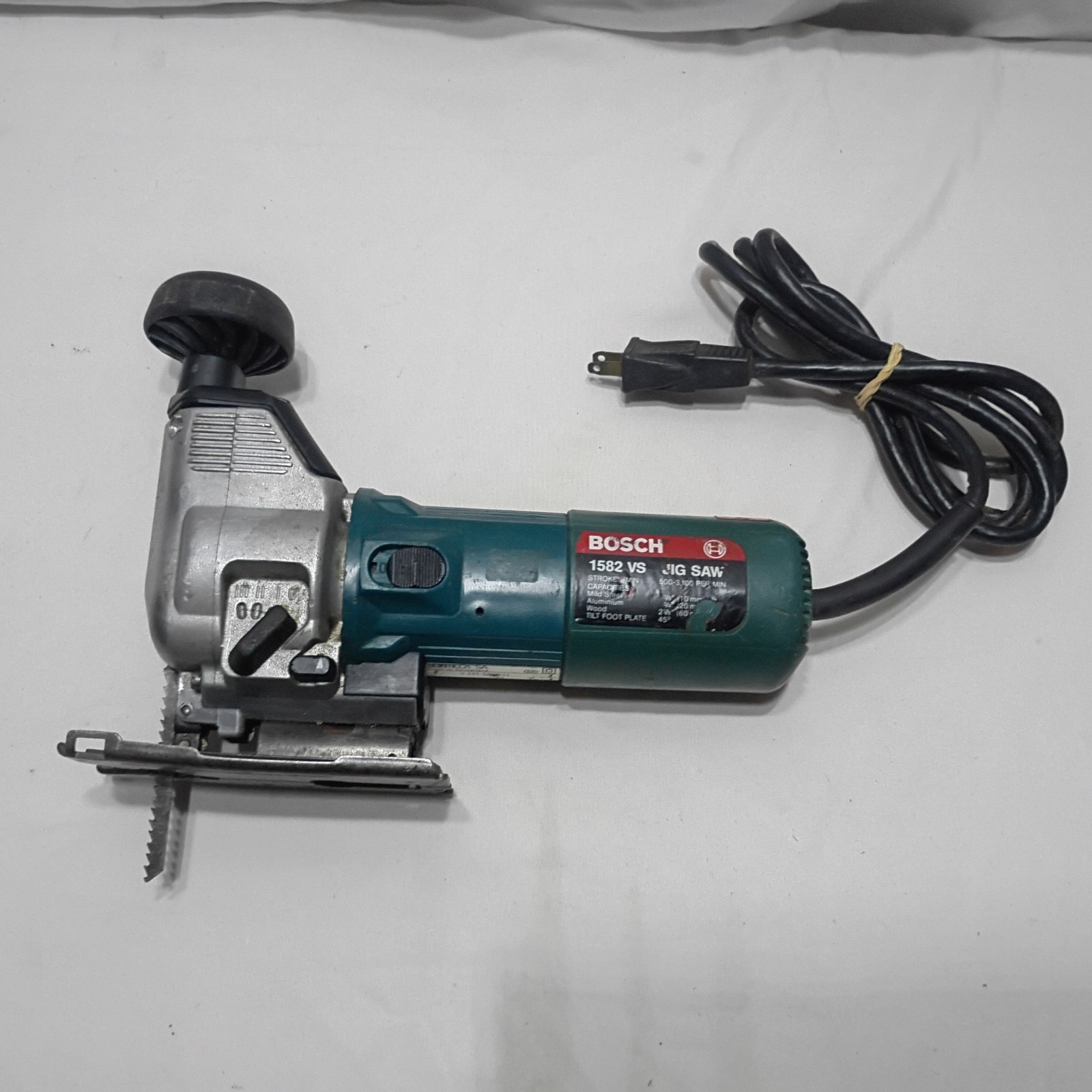
Bosch's 1999 Product Service Department bulletin lists 1582VS as body code 060 1582 534, separately from unsuffixed 1582 (060 1582 234) and 1582DVS (060 1582 934). The family instructions also distinguish an external dust-extraction connection on the DVS model. A listing that says only “Bosch 1582” or advertises vacuum capability should not be treated as this 1582VS assessment. The pictured seller specimen's side label reads 1582 VS, but a single used tool photo does not verify the item in another offer.
The manual groups the three 1582 models for their front slide on/off control. For 1582VS, it describes a separate rear speed control; the specification row gives 500–3,100 strokes per minute, and the visible dial is marked 1 through 6. That dial's markings are not SPM values. The manual's electrical table lists 115 V AC and advises checking the tool's nameplate against the available supply, so confirm the particular unit rather than relying on the age or suffix alone.
Barrel grip, rotating knob and the blade interface
The 1582VS uses a barrel-style body with a removable, rotating knob handle. That format places the hand around the motor housing rather than on a raised top handle; it does not guarantee a preferred feel or better control for every person. The Bosch instructions describe a CLIC blade-change sequence: release the orange control and turn the clamp knob by hand. It is a distinct procedure from a screw-secured clamp and from newer blade ejection systems, so read the full model instructions before fitting a replacement blade.
For one interface example, the 1582-family manual names the Bosch T101B blade in instructions for its anti-splinter device. Bosch's U.S. blade-set page classifies T101B as a T-shank blade. That supports a T-shank answer for this model, but does not prove that every T-shank blade, every condition of an older clamp, or any U-shank blade will fit. Match the exact blade and body label, then verify seating and retention using the manual.
Speed, orbital action and what the chart does not settle
Bosch describes four orbital positions and advises reducing orbit for harder material or when a cleaner cut matters, with more orbit for faster wood cutting. The variable-speed control gives a separate adjustment, and the manual notes that lower speed can suit harder materials while higher speed is used for wood. Those are manufacturer setup directions, not independent cut tests or promises about edge quality. Blade selection, stock, support and feed still affect the result.
I keep the matcher's material field at general wood. The accessible manual scan includes a model specification table, but some capacity columns lose their alignment in its text view; I do not assign the 1582VS a wood, plastic or metal cut-depth limit from that rendering. The manual discusses metal-specific blade/speed and cutting-fluid guidance, but its accessible table does not let me cleanly reconcile every material figure to this exact row. This article therefore does not turn that broad guidance into a verified soft-metal compatibility claim, nor does it infer a hardwood or softwood rating.
Blower, vacuum and bevel are not interchangeable features
The 1582VS instructions describe a three-position chip blower for clearing debris from the cut line. A blower helps keep the line visible; it is not dust capture. Bosch specifically names a dust-extraction connection on the separate 1582DVS, not the VS body, so I do not mark an external-vacuum plan for the 1582VS. Do not transfer the DVS hose/connection from a family photo or seller headline.
The manual's specification table lists an adjustable footplate and a 45-degree bevel limit for the 1582VS entry. Some bevel-adjustment instructions name the 1582 and 1582DVS rather than the VS, so verify the footplate and locking arrangement on the exact saw before relying on a bevel setup. The reviewed evidence supports bevel capability as listed, not a promise about a worn shoe, a particular bevel detent or a completed cut. The matcher treats the blower and bevel as available together, while treating vacuum extraction as unknown for this exact body.
Buying an earlier tool means checking the actual example
The seller-listing photograph is useful only as an identity specimen: the label reads BOSCH 1582 VS, with a cord, barrel housing and separate knob handle visible. It does not establish a standard package, working order, current availability or condition. Historical Bosch promotional material describes a package with assorted blades and accessories, but that is not a parts list for every used offer; no included blade, case, screwdriver or adapter is asserted here.
Before considering an offer, request a clear label and nameplate photo, verify the voltage and cord, and ask for a written inventory of the actual accessories. Check that the slide switch, rear speed control, orange release, hand-turn clamp, shoe lock and blower are present and appear intact; no hands-on inspection or functional test was performed for this review. Confirm the blade maker's instructions and do not assume vacuum compatibility, U-shank fit or package contents from the model's family resemblance.
The 1582VS fits a narrow profile: someone explicitly including earlier models who wants a corded barrel-grip body, documented T101B/T-shank example, selectable orbit and a built-in cutline blower. It is not a stand-in for the 1582DVS when external extraction is essential. A numeric speed range or bevel maximum does not imply cutting capacity, present stock, seller reliability or performance of an individual old tool.
This is a source-based assessment, not a hands-on review. No ownership, test cuts, measured accuracy, durability, vibration, customer experience, current price or stock is claimed. The saved CPSC exact-name query for Bosch 1582VS returned an empty array; that bounded lookup is not comprehensive recall clearance.
Sources and method
- Bosch 1582-family Operating Instructions (manufacturer-authored manual scan viewed on a third-party host; targeted instructions and the 1582VS specification row were reviewed; direct local page fetches returned 403 challenges).
- Bosch T-Shank Jig Saw Blade Sets (classifies the named T101B example as T-shank).
- Bosch JA1002 Anti-Splintering Insert (manufacturer compatibility page; used as a model lead and not as complete saw specifications).
- Bosch Product Service Department, Roller Guide Service bulletin (April 1999) (third-party-hosted view used for separate 1582-family body-code strings).
Key specifications
Key details at a glance
| Power source | Corded mains power |
|---|---|
| Grip format | Barrel grip |
| Blade interface | T shank |
| Cut-action settings | 0 / 1 / 2 / 3 |
| Maximum documented speed | 3100 SPM |
| Maximum documented bevel | 45° |
| Integrated cutline blower | Yes |
Use the exact model’s instructions for operating limits, supplied equipment and version differences.
Sources for this review
Sources for this assessment
- Bosch 1582-family Operating Instructions (third-party-hosted scan)
- Bosch T-Shank Jig Saw Blade Sets
- Bosch JA1002 Anti-Splintering Insert
- Bosch Product Service Department, 1999 Roller Guide Service bulletin (third-party-hosted scan)
- CPSC exact-name lookup for Bosch 1582VS (bounded query)
- Seller listing for an exact-model 1582VS specimen photo
Make the next check about your project
Use the finder to combine material, blade interface, grip and operating setup. It matches documented capabilities, not guaranteed results.