
Your needs, this model
Does it fit your priorities?
What do I need to connect a vacuum to the Bosch 1584DVS?
The Bosch family manual labels the footplate dust port as 1584DVS-specific. It describes attaching an optional vacuum hose to a dust-port connector, connecting the connector to the port, then joining the hose to a shop vacuum with an optional hose/vacuum adapter. That is a documented arrangement, not proof those separate parts are in a seller's box or fit an arbitrary extractor.
Explore this need in the finder →Can the Bosch 1584DVS keep its dust cover on while beveling?
No: the manual says the DVS dust cover must be removed when the footplate is angled, and chip-collection efficiency will be reduced. The level-shoe extraction plan and the bevel-capable blower plan are therefore separate. That limitation applies to the documented 1584DVS arrangement; do not turn a port and bevel shoe into a simultaneous vacuum/bevel promise.
Explore this need in the finder →Which Bosch 1584DVS orbital position is documented for hardwood?
The shared Bosch chart maps position II to medium-density material such as harder woods or particleboard. It is a guideline, not a species-specific capacity or finish guarantee, and Bosch recommends testing scrap. Position I is for cleaner or delicate soft-material work, while III is for soft material such as wood or plastic when faster cutting is preferred.
Explore this need in the finder →What blade-shank evidence applies to the 1584DVS?
The Bosch 1584 family manual identifies T101B as an example compatible with the anti-splinter insert, and Bosch classifies the T101B as T-shank. This supports a named T-shank example only; it does not prove universal T-shank fit or U-shank acceptance. The actual replacement blade still needs to match the tool's clamp and instructions.
Explore this need in the finder →The Bosch 1584DVS is an earlier corded barrel-grip jigsaw whose defining documented difference is the dust port at the footplate. Bosch's April 1999 service bulletin assigns it body code 060 1584 839, separate from the 1584VS and 1584AVS. The 2004 Bosch family instructions label the integrated port, dust cover and connector as 1584DVS parts. This is a manual-based assessment of that model identity and operating arrangement, not a claim that the tool was tested, is currently sold by Bosch, or arrives with a complete extraction kit.
Familiar 1584 controls, with a DVS-specific port
The family manual describes a side slide switch, six-position preset speed dial, four-position orbital selector and a three-position chip blower. Bosch gives 500 SPM at dial position 1 and 3,100 at position 6, calling positions 3 and 4 medium without publishing the precise rate at each. Its action chart recommends straight setting 0 for hard materials such as metal or thin sheet, setting I for cleaner or delicate work in softer materials, II for medium-density stock such as harder woods or particleboard, and III for soft materials such as wood or plastic when faster cutting is preferred. The guide is not a performance promise; Bosch recommends a scrap test, and the right blade and feed matter.
The manual prints maximum capacities of 2-3/8 inches in wood, 1-1/4 in plastic, 3/4 in aluminum and non-ferrous metal, 3/8 in mild steel, and 1/8 in stainless and alloy steel. These manufacturer figures are not a tested depth, a species-specific hardwood limit, or proof that a particular older specimen is in working order. Cast iron is not listed. The footplate tilts up to 45 degrees left or right and is marked at 15 and 45 degrees, with a zero detent. On DVS the adjustment screw is beneath a sliding cover, a small suffix-specific detail that can be missed when relying on family shorthand.
How the DVS vacuum arrangement works
Unlike the 1584VS, the 1584DVS has a built-in dust-port location on the shoe. But the port is only one link in the extraction chain. Bosch's instructions describe attaching an optional vacuum hose to an optional dust-port connector, fitting that connector to the DVS port, and connecting the hose to a shop vacuum through an optional hose/vacuum adapter. The manual lists the hose and adapter among optional accessories; it does not say they are part of every 1584DVS package, give a universal hose diameter, or rate the amount of dust captured. Verify the exact connector, hose and extractor with the actual tool.
The name “DVS” or the presence of a port should not be read as a sealed or self-contained dustless system. Bosch says the dust cover should be in place for maximum collection. It also says that an angled footplate requires removing that cover and reduces chip-collection efficiency. Accordingly, this assessment treats vacuum extraction as a level-shoe operating plan and keeps the bevel-capable blower arrangement separate. The matcher does not combine external vacuum with an essential bevel requirement. That conservative boundary reflects the manual's instructions; it is not a claim that bevel cutting itself is unavailable or that no custom arrangement can exist.
Orbit, blade example, and the separate blower
Bosch's chart assigns position II to medium-density material such as harder woods or particleboard and position III to soft material such as wood or plastic. For a cleaner soft-material cut or delicate scrolling, it names position I. Setting 0 is the straight-action selection for hard material, not an orbital wood setting. These source recommendations help explain how the controls relate; the manual does not publish a hardwood species rating, and it advises making a test cut in scrap.
The three-position chip blower is another distinct option for keeping the line clear. Its purpose is to move chips away, not to capture them. Do not assume the blower and the DVS vacuum connection are the same dust route or operate together just because both are on the body. Bosch's family manual identifies T101B as a blade compatible with the anti-splinter insert, and Bosch labels that model T-shank. That is a named blade example, not blanket T-shank fit or proof of U-shank acceptance. The manual's top twist-lock procedure and the actual clamp should guide a blade choice.
Identify the exact used body and contents
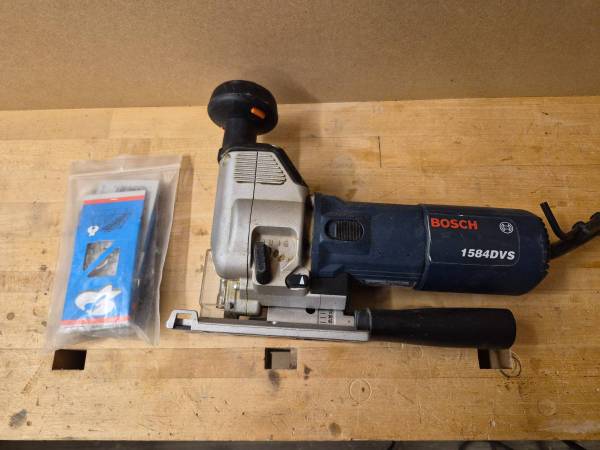
The original seller photo included in this review shows a visible 1584DVS body label, cord, shoe and the DVS dust-port cover/connector area. The post describes the saw as a Bosch barrel-grip 1584 DVS and mentions extra bases; those are one seller's listing details, not standard package contents, condition verification or a current availability claim. It is not a Bosch manufacturer image. No 1584DVS package suffix or complete retail carton list was established here, and the separate 1584AVSK case/accessories are not transferable to this body.
For an individual offer, ask for a clear model label and electrical nameplate photo, then check the plug, cord, shoe, selector, cover, port and blade-clamp parts. If extraction is the reason for choosing this suffix, request photos of the actual connector and adapters and confirm their fit before relying on the setup. Check the actual package inventory, seller terms and return policy; no price, seller condition, serviceability or current stock is asserted. No exact-name recall query was run, so the recall status remains unknown.
Bottom line
The 1584DVS earns a separate review because its integrated dust port changes the setup decision. It is the 1584-family option here with a manufacturer-documented port, but external extraction still depends on optional parts and the manual's bevel restriction. A buyer who can keep the shoe level and verify the complete hose/adapter route may value that documented distinction; someone who needs to bevel while collecting should not treat the port and shoe as freely combinable. All operation and capacity statements above come from Bosch's instructions, not hands-on use or performance testing.
Key specifications
Key details at a glance
| Power source | Corded mains power |
|---|---|
| Grip format | Barrel grip |
| Blade interface | T shank |
| Cut-action settings | 0 / 1 / 2 / 3 |
| Maximum documented speed | 3100 SPM |
| Maximum documented bevel | 45° |
| Integrated cutline blower | Yes |
| Optional vacuum-extraction route documented | Yes |
Use the exact model’s instructions for operating limits, supplied equipment and version differences.
Sources for this review
Sources for this assessment
- Bosch 1584VS / 1584AVS / 1584DVS Operating/Safety Instructions, BM 2610993482 2-04
- Bosch Product Service Department roller-guide service bulletin, April 1999 (third-party-hosted copy)
- Bosch JA1002 Anti-Splinter Insert: U.S. compatibility list
- Bosch T-Shank Jig Saw Blade Sets
- Exact-model Bosch 1584DVS seller specimen post and gallery
Make the next check about your project
Use the finder to combine material, blade interface, grip and operating setup. It matches documented capabilities, not guaranteed results.