
Your needs, this model
Does it fit your priorities?
How does the 1587VS differ from the 1587AVS and 1587DVS for dust collection?
The Bosch 1587 family instructions describe a built-in dust port for the DVS and a separate optional Dust Collection Adapter Kit for the AVS. They do not document a vacuum route for the 1587VS. Its three-position blower moves chips away from the line but is not dust extraction; verify the suffix on the saw before buying attachments.
Explore this need in the finder →What orbital setting does Bosch suggest for harder wood on the 1587VS?
The shared 1587 manual maps orbital position II to medium-density materials such as harder woods or particleboard. Bosch calls that chart a guideline and advises a scrap test. Its separate capacity table lists 2-3/8 inches for wood overall; that is not a species-specific hardwood rating or a tested finish result.
Explore this need in the finder →Does Bosch document a T-shank blade for the 1587VS?
The Bosch family manual names T101B as a blade that works with its anti-splinter insert, and Bosch's U.S. blade information classifies T101B as T-shank. This is one supported example, not proof that every T-shank blade fits or that U-shank blades are accepted. Check the actual clamp and the exact replacement blade.
Explore this need in the finder →Can the 1587VS use a vacuum while making a bevel cut?
The 1587VS manual does not document a vacuum route for this suffix, so this assessment does not match it to external collection, at level or on a bevel. Bosch documents a blower on the family and a bevel shoe up to 45 degrees in either direction. The blower clears chips but does not collect dust.
Explore this need in the finder →The Bosch 1587VS is an earlier corded top-handle jigsaw, distinct from the 1587AVS and 1587DVS bodies even though one Bosch manual covers all three. The 1587VS gets a variable-speed trigger, separate A–E preset dial, four orbital positions, three-position chip blower and bevel shoe. The checked manual does not document a vacuum-extraction route for this suffix. This is a document-based assessment, not a tool test or current-stock claim.
Keep the suffix with the body
Bosch's Product Service Department bulletin assigns code 060 1587 639 to 1587VS, 060 1587 651 to 1587AVS and 060 1587 839 to 1587DVS. Bosch's current U.S. accessory table also lists the three suffixes separately. The table has an unrelated 1587AVD typo in one marketing bullet, while its actual model-use table lists 1587AVS; the Bosch family manual and service bulletin say AVS as well. That inconsistency is not a reason to rename this VS body or inherit a feature from a neighbor.
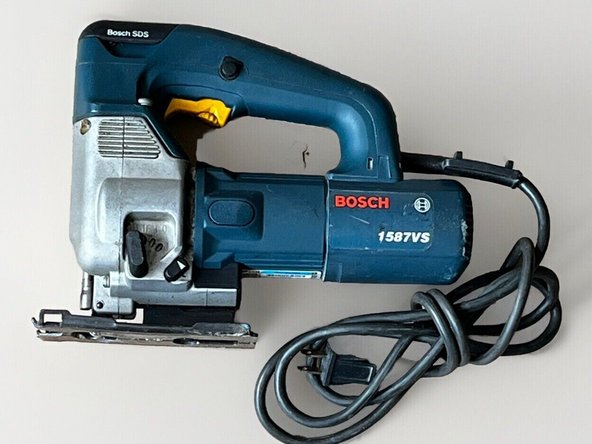
The exact 1587VS specimen image is a repair-reference photo with the model label visible. It establishes a pictured tool identity and top-handle form, not the condition or package of an offer elsewhere. Ask a seller to show the full label and nameplate: the family manual does not establish one supply voltage or current for every surviving specimen, and this review does not borrow a rating from an AVS listing.
Trigger speed and orbital action are separate controls
The 1587 uses a trigger whose speed varies with pressure, plus a dial that caps the selected maximum. Bosch's A–E dial chart calls A–B low stroke, C–D medium and E high; it does not give an SPM figure for each band in this manual. In particular, the 1584 family's numeric six-position chart cannot be imported to the 1587VS. Bosch also notes that lengthy low-speed operation can raise motor temperature because the internal cooling fan turns more slowly, and advises occasionally running at full speed in that situation. Those are operating instructions, not an endurance test.
A second lever chooses straight setting 0 or orbital positions I–III. Bosch associates setting 0 with hard materials such as metals or thin sheet; I with softer stock when cleaner cutting or delicate scrolling matters; II with medium-density stock such as harder woods or particleboard; and III with soft materials such as wood or plastic when speed is preferred. The manual calls its chart a guideline and asks for a scrap test. Blade geometry, feed and the actual condition of an older tool still matter; the orbit label alone does not promise a finish.
Blower, shoe, and the missing vacuum route
The three-position chip blower redirects air to clear chips from the cutline or turns the flow off. It can help keep a pencil line visible, but it moves debris rather than capturing dust. Bosch assigns the family dust port to the DVS suffix and a separate optional Dust Collection Adapter Kit to the AVS suffix. I found no 1587VS vacuum setup in the checked manual, so the VS should not be treated as equivalent to either sibling for an external extractor. This is a limit of the reviewed documentation, not proof that no custom attachment could ever be made.
The footplate is documented to tilt up to 45 degrees in either direction. The manual shows a firm zero-degree detent, additional marks at 15 and 45 degrees, and use of the supplied 5 mm Allen wrench for adjustment; intermediate angles may be set with a protractor. Retighten the shoe after adjustment and confirm its position rather than assuming the marks are a fine-angle lock. For a dust-sensitive workspace, a blower is not a substitute for source capture or protective measures.
Blade fit and published capacities
Bosch's family manual describes a top blade-change knob: set the selector to position III for installation, release the clamp by raising and turning the knob, place the blade in the plunger and roller guide, then turn until the click indicates it is locked. The instructions call for the blade to sit squarely in the guide. A used tool should be checked for a complete, moving clamp and guide before purchase; this review does not claim that the mechanism on a specific specimen works.
The manual names T101B as a blade that works with its anti-splinter insert, and Bosch classifies T101B as T-shank. That is one documented example, not universal compatibility with every T-shank blade and not proof that U-shank blades fit. Bosch's table lists maximum capacities of 2-3/8 inches in wood, 1-1/4 in plastic, 3/4 in aluminum and non-ferrous metal, 3/8 in mild steel, and 1/8 in stainless and alloy steel. These are published maxima; they are not a hardwood-specific limit, a safe depth for every blade, or my measured result. Cast iron is not listed.
What a buyer still needs to verify
The Bosch manual has no exact 1587VS seller-carton inventory, so a case, blade, plastic base insert or accessory should not be assumed. Inspect the body suffix, the plug and cord, the nameplate, the shoe, the selector and the blade-change components. Ask for a written list of what is actually included and check return terms. No exact-name recall search was run for 1587VS, so its recall status is unknown rather than cleared. There is no current price, availability or seller-condition conclusion here.
The Bosch 1587VS is a plausible reference when the desired arrangement is specifically top-handle, corded, adjustable by trigger and preset dial, and equipped with a blower and bevel shoe. Its dividing line from the AVS and DVS matters most if vacuum extraction is essential. No ownership, hands-on use, cut measurement, lab test or customer experience is claimed.
Sources and method
- Bosch 1587VS / 1587AVS / 1587DVS Operating/Safety Instructions, BM 2610993477 2-04, Bosch-authored (third-party-hosted); pages 6–11 cover controls, material capacities, bevel, dust and included-equipment distinctions.
- Bosch Product Service Department roller-guide bulletin, April 1999, third-party-hosted; used for exact body-code distinctions.
- Bosch JA1002 anti-splinter insert page; its compatibility table is an exact-suffix cross-check, not a jigsaw catalogue or package record.
- Bosch T-shank blade-set information; classifies T101B as T-shank.
- iFixit 1587VS repair-reference page; image identifies one specimen, not its performance or seller package.
Key specifications
Key details at a glance
| Power source | Corded mains power |
|---|---|
| Grip format | Top handle |
| Blade interface | T shank |
| Cut-action settings | 0 / 1 / 2 / 3 |
| Maximum documented bevel | 45° |
| Integrated cutline blower | Yes |
Use the exact model’s instructions for operating limits, supplied equipment and version differences.
Sources for this review
Sources for this assessment
- Bosch 1587VS / 1587AVS / 1587DVS Operating/Safety Instructions, BM 2610993477 2-04
- Bosch Product Service Department roller-guide service bulletin, April 1999 (third-party-hosted copy)
- Bosch JA1002 anti-splinter insert: U.S. compatibility list
- Bosch T-Shank Jig Saw Blade Sets
- iFixit Bosch 1587VS specimen reference page
Make the next check about your project
Use the finder to combine material, blade interface, grip and operating setup. It matches documented capabilities, not guaranteed results.