
Your needs, this model
Does it fit your priorities?
How does the 1590EVS switch and speed control differ from the 1591EVS?
The 1590EVS uses a trigger to start/stop and a separate lock-on button; the six-number dial sets the speed range. The 1591EVS instead uses a side slide switch that locks on. Both share the manual’s 500–2,800 SPM range, but the hand position and switching layout are distinct.
Explore this need in the finder →What orbit does Bosch suggest for hardwood versus soft material?
The 1590EVS manual suggests position 2 for medium-density work such as harder woods or particle board, position 3 for faster cutting in soft materials such as wood or plastic, and position 1 when cleaner soft-material cutting or delicate scrolling matters. The chart is a guideline and calls for test cuts on scrap; it is not a species-specific quality guarantee.
Explore this need in the finder →Can the external-vacuum setup be treated as a beveling setup?
Not in this assessment. Bosch describes an optional adapter tube and dust shroud for extraction, requires the shroud with a connected vacuum, and says to remove the shroud if fitted before changing the footplate angle. The source does not establish one simultaneously supported vacuum-and-bevel arrangement, so use the finder’s vacuum and bevel constraints as separate setups.
Explore this need in the finder →The Bosch 1590EVS is an earlier U.S. corded top-handle jigsaw with a speed-controlled trigger, a separate six-number speed dial and a trigger lock-on button. It is distinct from the barrel-grip 1591EVS, not a case suffix of that model. Bosch documents a T-shank plunger for the 1590EVSK catalog configuration; its older manual gives the operating instructions for the 1590EVS body. A 2012/2013 Bosch catalog mirror conflicts with that manual on several capacity figures, so this assessment does not turn either table into a universal cutting limit.
Top handle and trigger are the defining difference
Bosch's shared 1590EVS/1591EVS manual specifies 120 V, 6.4 A, a one-inch stroke and a no-load range of 500–2,800 strokes per minute. On the 1590EVS, squeeze or release the trigger to start or stop; the separate lock-on button permits continuous operation. A six-number dial sets the speed range. The related 1591EVS puts a slide on/off switch at the side of its motor housing instead, with the switch locking in the on position. Bosch's 2007 product catalog names the 1590EVSK as a top-handle jig saw and the 1591EVSK as a barrel-grip model, so these are two distinct body/control configurations.
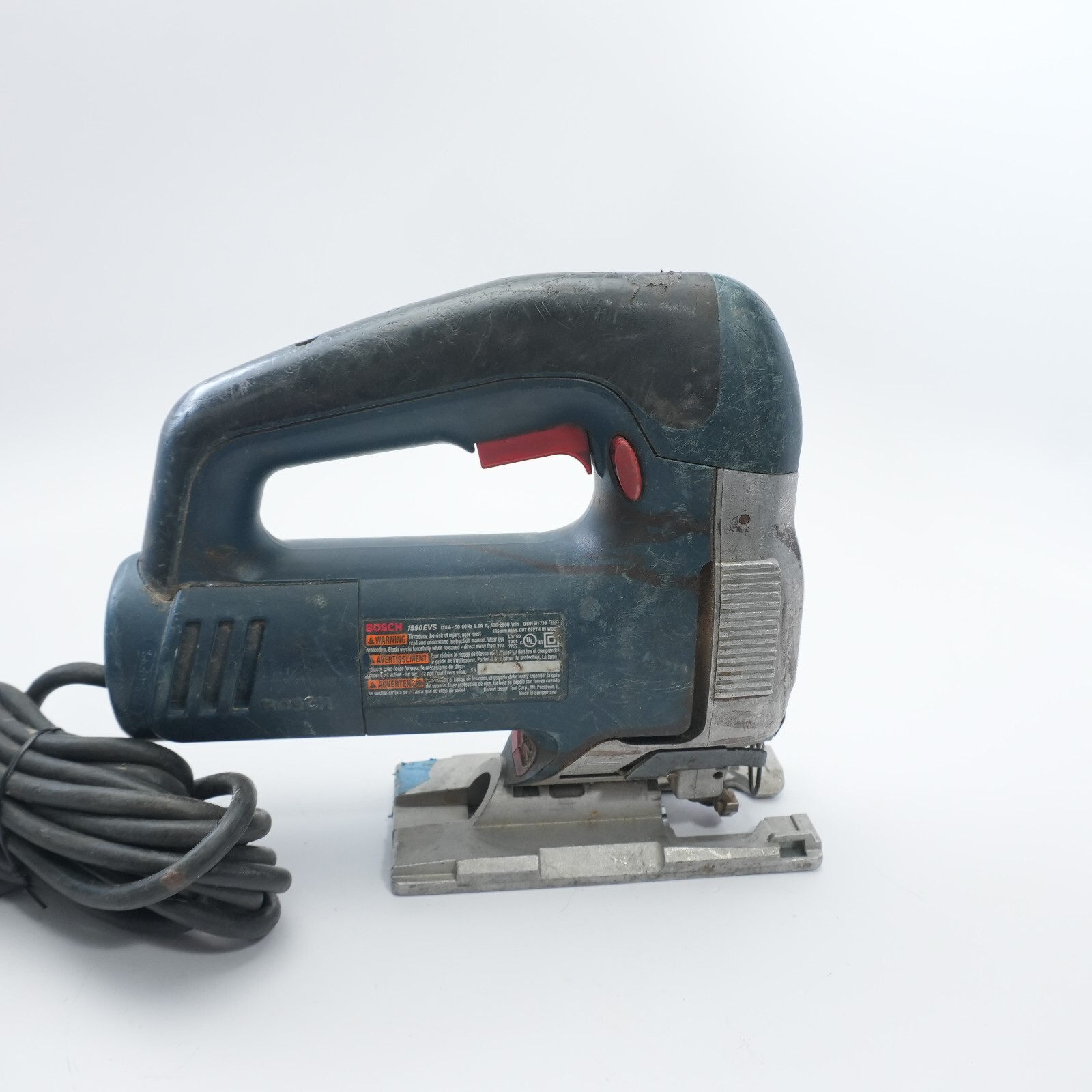
The manual describes constant-response circuitry and precision-control guides, but those are feature descriptions, not measured claims about speed under load, accuracy or vibration. The product photo shown with this assessment is a seller-listed 1590EVS specimen; it documents what that used body looks like, not its present condition, working order or included package.
Blade and action choices need a suitable stock
The 2007 Bosch saw catalog describes the 1590EVSK's plunger as T-shank. That is useful evidence for a T-shank blade on the 1590 body, but it does not establish compatibility with every blade, nor does it state whether U-shank blades are accepted. Choose a blade for the material and cut, and confirm the exact tool label and blade instructions before buying a replacement. Bosch's 2004 manual calls the blade change “One Touch” and describes an ejector lever; it does not name a shank family.
The orbital selector has four positions. Bosch's chart is guidance, not a promised finish or speed: position 0 is for hard materials such as metals or thin sheet; position 1 is suggested for softer material when a cleaner cut or delicate scrolling matters; position 2 is for medium-density material such as harder woods or particle board; and position 3 is for soft material such as wood or plastic when faster cutting matters more than a clean cut. The manual asks the user to make a test cut on scrap first. It also warns that extended operation at low speed can raise motor temperature. The included speed range and action selector do not remove the need for a proper blade, supported workholding and safe material-specific technique.
Capacity figures are not settled across the source set
The manual's shared 1590EVS/1591EVS table lists 5-3/8 inches in wood, 3/4 inch in aluminum, 3/8 inch in steel and 1/8 inch in stainless steel. A later Bosch 2012/2013 catalog lists the 1590EVSL package at 5-5/16 inches in wood, 7/8 inch in aluminum and 3/8 inch in mild steel; the 1591EVSL entry says it has the same specifications. The sources do not identify a production revision, nameplate or reason for the wood and aluminum differences. I therefore leave a single maximum capacity out of the finder rather than choosing whichever number seems more convenient. Check the exact model and matching manual before relying on a depth claim, and do not treat published maxima as a prediction of cut quality.
Blower, vacuum and bevel are separate setups
The two-position chip blower can move chips away from the cut line; it is not a dust extractor. Bosch says to switch it on for wood, plastic and similar dusty materials, and off for metal, cooling agents or a dust-collection accessory. The manual shows an optional vacuum-adapter tube and dust shroud and cautions that the adapter must be used with the shroud when connected to a vacuum. The 2012/2013 catalog lists the separate JA1005 dust kit as compatible with the 1590EVS and 1591EVS series. Bosch's present JA1010 page lists a different, optional circular/parallel cutting guide and names the 1590EVS specifically; neither accessory is part of a generic body-only package.
The footplate tilts up to 45 degrees in either direction. If a dust shroud is fitted, Bosch says to remove it before adjusting the footplate. That is why this review does not promise a simultaneous external-vacuum-and-bevel setup in the finder. Set the footplate using the manual, then check the exact accessory instructions rather than assuming every attachment can stay installed through every adjustment.
Check the suffix before comparing packages
The 1590EVSK is the case-included configuration; Bosch's manual specifies a carrying case only for the K models. The later 1590EVSL catalog entry instead lists a carrying case identified as L-BOXX-2 with insert, three assorted blades, a non-marring overshoe and an anti-splinter insert. It lists dust-collection attachments separately. These suffixes describe different packages around the 1590EVS body, not different handle controls. The source evidence does not establish that a seller's used item contains every original accessory or that a case is intact.
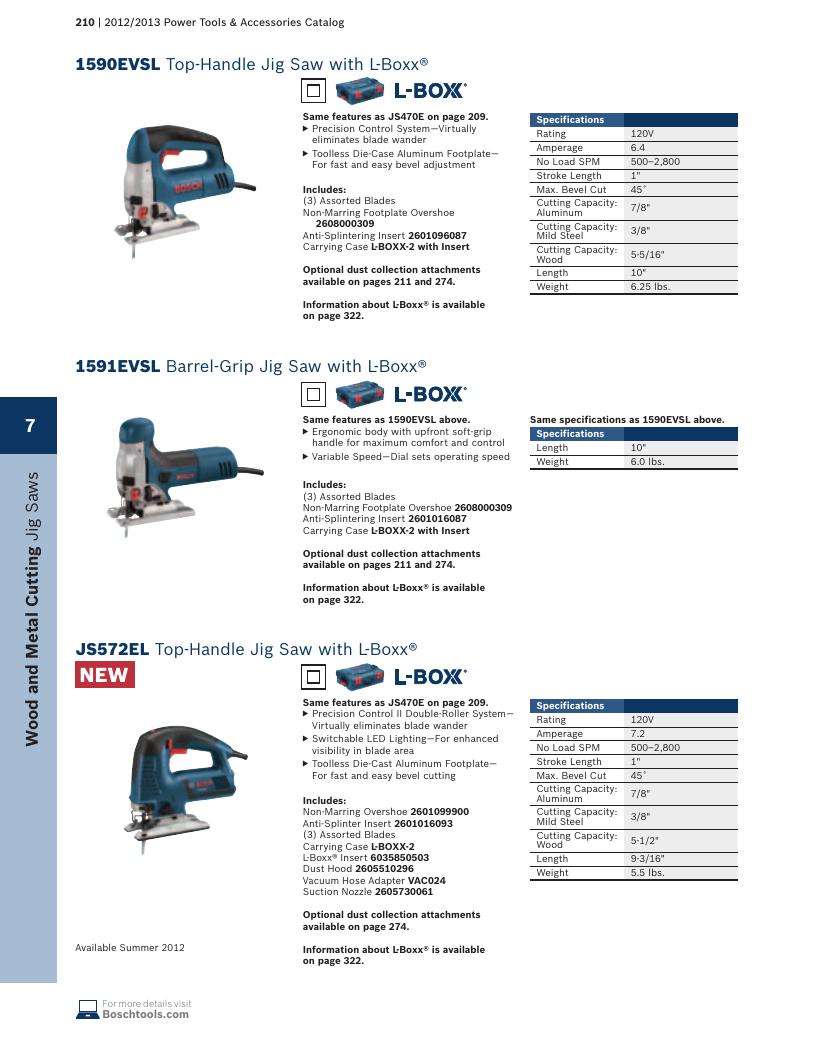
This manufacturer-catalog image is associated with the exact 1590EVSL entry, but its pictured scope is the saw body; the L-BOXX symbol and contents list are not a photograph of the case or kit. Check the suffix and the seller's actual written contents before treating a used offer as a complete set.
The 1590EVS is an earlier model reference: it is absent from Bosch's captured current jigsaw categories, while Bosch's 2024 service-price program still names the EVSK model. A service-list entry is not proof of new production, parts supply, warranty eligibility or current retailer stock. For a used offer, compare the nameplate and exact suffix, inspect the written package list and check return terms and condition with the seller.
Who should keep it on a shortlist
This configuration is most relevant when the corded top-handle layout and trigger-based speed control are specifically preferred, and the documented T-shank option matters. If a barrel grip and side slide switch are preferable, compare the separate 1591EVS assessment rather than treating it as a kit variation. If a current-reference saw or confirmed capacity threshold is essential, the 1590EVS evidence does not settle that request.
This is an evidence-based feature and compatibility assessment, not a hands-on review. No ownership, test cuts, measured accuracy, vibration, runtime, current price, seller stock or used-unit condition is claimed. The exact-name CPSC search saved for 1590EVS returned no records; that narrow query is not comprehensive recall clearance.
Sources and method
- Bosch 1590EVS/1591EVS Operating/Safety Instructions (shared model-specific specifications, controls, action guide, blower, extraction and bevel instructions).
- Bosch Saw & Benchtop Tools & Accessories Catalog (2007 catalog entry for 1590EVSK and its T-shank plunger; hosted by iFixit, whose readable catalog excerpt is partial).
- Bosch 2012/2013 Power Tools & Accessories Catalog (page 210 package listing and capacity figures; full catalog copy hosted by a third-party distributor).
- Bosch JA1010 Jig Saw Circular and Parallel Cutting Guide (current compatibility list and accessory description).
- Bosch 2024 service program (service listing only, not retail availability evidence).
Key specifications
Key details at a glance
| Power source | Corded mains power |
|---|---|
| Grip format | Top handle |
| Blade interface | T shank |
| Cut-action settings | 0 / 1 / 2 / 3 |
| Maximum documented speed | 2800 SPM |
| Maximum documented bevel | 45° |
| Blade listed in package | Yes |
| Integrated cutline blower | Yes |
| Optional vacuum-extraction route documented | Yes |
| Rated motor current | 6.4 A |
| Stroke length | 1 in |
Use the exact model’s instructions for operating limits, supplied equipment and version differences.
Sources for this review
Sources for this assessment
- Bosch 1590EVS/1591EVS Operating/Safety Instructions
- Bosch Saw & Benchtop Tools & Accessories Catalog (2007 readable excerpt)
- Bosch 2012/2013 Power Tools & Accessories Catalog (third-party-hosted complete PDF copy)
- Bosch JA1010 Jig Saw Circular and Parallel Cutting Guide
- Bosch service program dated 2024-04-10 (repair-price listing)
- Bosch US Jig Saws category snapshot
- Bosch US Cordless Jig Saws category snapshot
- CPSC exact product-name lookup for 1590EVS (no records returned; bounded query only)
- Seller listing photo for exact model-labeled 1590EVS specimen
Make the next check about your project
Use the finder to combine material, blade interface, grip and operating setup. It matches documented capabilities, not guaranteed results.