
Your needs, this model
Does it fit your priorities?
What should I know about orbital settings for hardwood on the JS260?
Bosch’s JS260 manual assigns setting II to medium-density material such as harder wood or particleboard. It describes setting III for softer woods and plastics when speed matters more than finish, setting I for cleaner soft-material work or delicate scrolling, and setting 0 for metals or thin sheet. Bosch calls the chart a guideline and recommends trying scrap, so identify the actual species and blade rather than treating generic “wood” as a single setting.
Explore this need in the finder →Will the JS260 take U-shank blades?
No. Bosch identifies the JS260 clamp as T-shank-only and expressly says it does not accept U-shank blades. The product page lists one T-shank blade in the package; check the shape and type of any blades you already own before assuming they fit.
Explore this need in the finder →Can I connect a vacuum to the JS260 for dust extraction?
Bosch does not list an optional dust-extraction arrangement for the JS260. Its built-in blower is always on and moves chips away from the line rather than collecting them. The separate JA1010 circular/parallel guide page excludes JS260; do not assume the JS365 JA1009 dust kit fits this model.
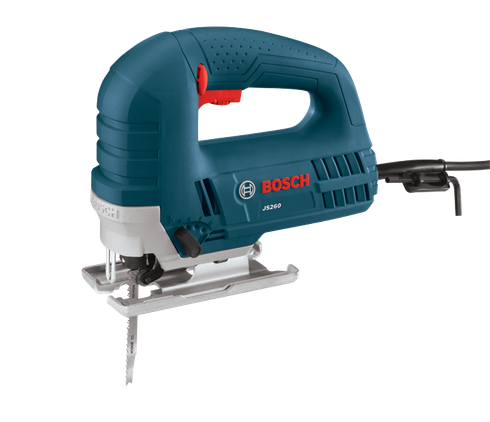
Explore this need in the finder →The Bosch JS260 is the smaller of two closely related corded, top-handle Bosch saws in this comparison. Bosch’s current US page identifies it as a 120-volt, 6.0-amp model with a 3/4-inch stroke and a published 2-11/16-inch softwood capacity. It is not a JS365 with a different case: its stroke, shoe construction, blower control, extraction compatibility and package differ. This source-based assessment makes no hands-on, cut-quality or vibration claim.
Controls and cut action
The top handle contains a trigger and lock-on button. A separate six-number dial sets the maximum stroke rate, while trigger pressure varies speed within that range. Bosch lists 500–3,100 strokes per minute and describes the plunge design as low-vibration; that is the maker’s claim, not an independent measurement.
A four-position selector changes the blade path. Bosch’s JS260 manual says position 0 is the straight-action choice for hard material such as metal or thin sheet. Position I is described for cleaner work in softer material or delicate scrolling; II is for medium-density material such as harder wood or particleboard; III is for softer materials such as wood and plastics when speed matters more than a clean cut. The manual calls the chart a guideline and recommends first trying scrap. That makes “wood” too broad to treat as an orbital guarantee: select a setting for the actual material and blade rather than assuming every wood species belongs in the same mode.
Blade fit and capacity figures
The clamp is for T-shank blades only; Bosch explicitly excludes U-shank blades. The product page lists one T-shank blade, so check an existing assortment by shank shape rather than brand alone. Use the model’s blade-clamp instructions when changing a blade.
The current US product table lists 2-11/16 inches for softwood, 3/8 inch for aluminum and 3/16 inch for mild steel. Those are manufacturer-listed capacities, not verified cut results. The linked model manual says to refer to the tool nameplate for specifications rather than repeating those capacities in its own table. Before treating a number as a hard limit, check the exact tool’s nameplate and manual revision. No specific thickness for ceramic, cast iron or another unlisted material is inferred here.
Dust, bevels and edge finish
The JS260 has an always-on chip blower: it moves chips off the line but does not capture them. Unlike the JS365, it has no blower switch. Bosch says dust collection is not provided, and its JA1010 circular/parallel guide page expressly excludes the JS260. Do not assume the built-in blower substitutes for a vacuum.
The steel footplate can be tilted up to 45 degrees in either direction. The manual identifies 45-degree detents and marks at 15 and 30 degrees; it says to secure the shoe after setting the angle. Bosch lists an anti-splinter insert in the JS260 package. The manual explains that insert use depends on a suitable blade style, so it is not a universal promise of a chip-free edge. Blade tooth geometry, backing support, feed, and the face that matters to the finished part all still affect tear-out. Make a trial cut in scrap when appearance is important.
Where it differs from the JS365
The JS365 is also a 120-volt top-handle model with a speed-controlled trigger, separate maximum-speed dial, T-shank-only clamp, orbital selector and 45-degree bevel range. Its specification changes are meaningful: Bosch lists a 6.5-amp motor, a 1-inch stroke, 3-1/2-inch softwood capacity, and larger aluminum and mild-steel figures. Its footplate is die-cast aluminum with a steel insert rather than the JS260’s heavy-gauge steel plate. The JS365 also has a switchable blower, supports the separate JA1009 dust-extraction kit, and is listed with a hard case; the JS260 page lists a carrying bag. Neither machine’s package list includes its separate dust-extraction kit. These are documented differences, not a prediction that the JS365 will cut a particular workpiece faster or more cleanly.
Package checks and best-fit use
Bosch lists the JS260 saw, anti-splinter insert, one T-shank blade, bevel wrench and carrying bag. It does not list the JS365’s hard case, the JS365-only JA1009 extraction kit, or the JA1010 guide. Check the exact model number on the offer and confirm the seller’s included equipment; retailer bundles can differ from Bosch’s standard list. Bosch’s current listing establishes a current reference model, not a promise of stock, price or a particular seller package.
The JS260 is a plausible shortlist choice when the required combination is a corded top handle, adjustable trigger-and-dial speed control, T-shank blades, four cut-action positions, a beveling shoe and a carry bag. It is a poorer fit when dust capture is essential, when the work depends on the JA1010 guide, when U-shank blades are required, or when a cordless tool is non-negotiable. For those needs, compare an explicitly compatible model or attachment rather than stretching the JS260’s listing beyond what Bosch documents.
Sources and assessment limits
This assessment uses Bosch’s current US JS260 product page, the JS260 operating and safety manual, the separate blade-clamp instructions, the JA1010 compatibility page, and Bosch’s JS365 page for the comparison. The exact-name CPSC lookup returned no JS260 records on the check date; that bounded search is not a guarantee against later notices or alternate-name indexing. No ownership, test cut, measurement, retailer availability, price, rating or ASIN is represented.
Key specifications
Key details at a glance
| Power source | Corded mains power |
|---|---|
| Grip format | Top handle |
| Blade interface | T-shank only |
| Cut-action settings | 0 / 1 / 2 / 3 |
| Maximum documented speed | 3100 SPM |
| Maximum documented bevel | 45° |
| Battery included | No |
| Charger included | No |
| Blade listed in package | Yes |
| Carry bag listed in package | Yes |
| Integrated cutline blower | Yes |
| Optional vacuum-extraction route documented | No |
| Rated motor current | 6 A |
| Stroke length | 0.75 in |
| Maximum listed cutting capacity | 2.69 in |
| Hard case listed in package | No |
Use the exact model’s instructions for operating limits, supplied equipment and version differences.
Sources for this review
Sources for this assessment
- Bosch US Jig Saws category — current two-page capture
- Bosch JS260 6.0 Amp Top-Handle Jig Saw — exact US product page
- Bosch JS260 Operating/Safety Instructions
- Bosch JS260 blade clamp instructions
- Bosch JA1010 jig saw circular and parallel cutting guide — compatibility
- Bosch JS365 6.5 Amp Top-Handle Jig Saw — exact US product page, comparison
- CPSC exact ProductName query: JS260
Make the next check about your project
Use the finder to combine material, blade interface, grip and operating setup. It matches documented capabilities, not guaranteed results.