
Your needs, this model
Does it fit your priorities?
What control layout does the JS470E use, and how is it different from the JS470EB?
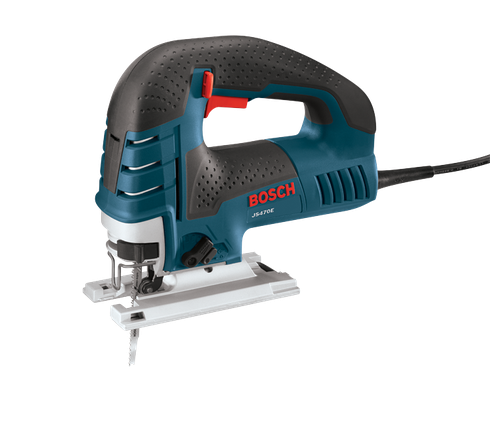
Bosch identifies the JS470E as a top-handle model. Its manual labels a variable-speed controlled trigger and lock-on button for the E; the separate speed dial sets the maximum speed. The JS470EB is a distinct barrel-grip configuration with a variable-speed dial and slide on/off switch, so compare the actual handle and switch arrangement rather than treating the suffix as a case or finish change.
Explore this need in the finder →Which orbit position does Bosch suggest for metal, harder wood, and softwood?
Bosch's JS470E/EB manual places metals and thin sheet at setting 0, the straight-action position. Its chart suggests setting II for medium-density material such as harder woods and setting III for soft materials such as wood or plastic when faster cutting matters more than a clean cut; setting I is the cleaner-cutting choice for soft materials. Bosch calls the chart a guideline and says to make a test cut in scrap, so select a suitable blade and verify the setup for the workpiece.
Explore this need in the finder →Does the JS470E include vacuum collection, or only a cutline blower?
The saw's built-in two-position chip blower helps keep the cut line visible; Bosch's manual says switch it off for metals and when dust collection is used. The manual identifies a separately sold extraction kit, and Bosch's current JA1007 page says that kit works with JS470E and JS470EB. The saw package list does not include the vacuum attachment. The manual also says to remove the dust shroud if used before adjusting the footplate angle, so do not assume the collection hood can remain installed during bevel setup.
Explore this need in the finder →The Bosch JS470E is a corded 7.0-amp top-handle jigsaw with a trigger-based variable-speed control, a separate maximum-speed dial, and a T-shank-only blade clamp. Its meaningful distinction from the similarly named JS470EB is not a kit suffix: the E is the top-handle model, while the EB is a barrel-grip tool with a dial and slide switch.
Top handle, trigger and speed dial
Bosch identifies the JS470E as a 120V, 7.0A saw. The product page lists a no-load range of 500–3,100 strokes per minute and a one-inch stroke. In Bosch’s manual, the E’s switch is a variable-speed controlled trigger with a lock-on button; a separate dial limits the maximum speed. That two-control arrangement is central to choosing this version. The JS470EB uses a different barrel-grip body, a variable-speed dial and a slide on/off switch. If you want a particular hand position or a particular way of starting and regulating the saw, verify the exact model suffix rather than comparing the shared JS470 family name alone.
Bosch also lists Constant Response circuitry, but this review has not measured speed under load, vibration or cutting accuracy. The feature description should not be read as a test result. The one-inch stroke, current and no-load speed are manufacturer specifications, not predictions of how quickly a particular blade will cut your material.
Blade interface and choosing the action
The manual specifies Bosch T-shank blades and explicitly says the JS470 does not accept U-shank blades. A T-shank-only clamp is a useful filter if your existing blades matter, but it does not establish that any particular T-shank blade is right for every material or curve. Bosch lists one T-shank blade in the package. For vulnerable faces, the included JA1013 anti-splinter insert is more conditional than the box list alone suggests: Bosch’s manual says it only works with blades whose sides are ground and names examples. Check the blade and insert combination before planning around that accessory.
The selector offers setting 0 for straight motion and three orbital positions. Bosch’s chart recommends setting 0 for hard materials such as metals or thin sheet; setting I for cleaner cutting in soft materials or delicate scrolling; setting II for medium-density material such as harder woods or particle board; and setting III for soft wood or plastic when faster cutting matters more than a clean cut. The manual labels that chart a guideline and asks for a test cut in scrap. That is a more useful way to think about the four positions than treating the highest setting as a universal speed upgrade. Use a suitable blade and let the manual’s material-specific guidance shape the starting point.
Blower, vacuum and bevel setup
The built-in, two-position chip blower moves chips away from the cut line; it is not dust collection. Bosch says to switch the blower off when working with metals or when dust collection is used. A separate extraction hood and tube can connect the saw to a suitable Bosch hose or adapter. Bosch’s current JA1007 accessory page expressly lists both JS470E and JS470EB as compatible and identifies a hood, tube and VAC024 adapter in that accessory kit. The saw’s included-items list does not include the extraction kit.
There is one detail worth checking before ordering the accessory: the joint instruction manual calls its extraction kit “JS1007,” while Bosch’s current accessory page uses “JA1007.” The accessory page names the exact saws, so it supports the current JA1007 compatibility claim; the identifier difference is not silently treated as proof that every similarly named kit is interchangeable. Bosch’s manual also says to remove the dust shroud, if used, before adjusting the shoe angle. It documents bevel cuts up to 45 degrees in either direction, with firm detents at 0 and 45 degrees and additional marks at 15, 22.5 and 30. The sources do not establish whether an extraction hood may stay attached during a bevel cut, so set and verify the shoe before relying on that combination.
Package and an important capacity conflict
Bosch’s current US page lists the JS470E saw, a non-marring overshoe, an anti-splinter insert, a T-shank blade, bevel wrench and carrying case. It is a corded saw, not a battery platform purchase, and the optional extraction attachment is a separate item. Check the exact part number—3601E13010—and the seller’s included-items list if a particular case or accessory is important.
I am not using Bosch’s listed maximum cutting depths as settled selection limits because the current product page and its linked manual disagree. The web page reports 5-7/8 inches in soft wood, 7/8 inch in aluminum and 3/8 inch in mild steel; the 2020 manual table reports 3-1/2 inches in wood, 13/16 inch in aluminum and 5/16 inch in mild steel. The sources available for this review do not bridge that difference to a specific production revision or nameplate. Check the exact saw’s rating plate and matching manual instead of treating one table as universally applicable.
Who this version may suit
The JS470E belongs on a shortlist when a corded top-handle layout, trigger-based speed control, T-shank blades and a documented material/action selector fit the job. Its related EB model is a real alternative if a barrel-grip body and dial-plus-slide-switch arrangement are preferred, not a different package of the same handle. Both pages list the same family-level stroke and speed range, but their grips and controls are different enough to assess separately.
The tradeoffs are practical: the cord requires an outlet and careful routing, the U-shank interface is unsupported, vacuum extraction needs another compatible attachment, and the published depth figures conflict. This assessment is based on Bosch’s US product pages and instructions, not personal ownership or test cuts. It cannot verify comfort, cut finish, blade life or loaded performance in your material.
Key specifications
Key details at a glance
| Power source | Corded mains power |
|---|---|
| Grip format | Top handle |
| Blade interface | T-shank only |
| Cut-action settings | 0 / 1 / 2 / 3 |
| Maximum documented speed | 3100 SPM |
| Maximum documented bevel | 45° |
| Battery included | No |
| Charger included | No |
| Blade listed in package | Yes |
| Carry bag listed in package | No |
| Integrated cutline blower | Yes |
| Optional vacuum-extraction route documented | Yes |
| Rated motor current | 7 A |
| Stroke length | 1 in |
| Hard case listed in package | Yes |
Use the exact model’s instructions for operating limits, supplied equipment and version differences.
Sources for this review
Sources for this assessment
- Bosch US Jig Saws category
- Bosch US Cordless Jig Saws category
- Bosch JS470E 7.0 Amp Top-Handle Jig Saw
- Bosch JS470E / JS470EB Operating/Safety Instructions
- Bosch JA1007 Jig Saw Dust Extraction Kit
- CPSC Recalls API exact-product-name query: JS470E
- CPSC Recalls API exact-product-name query: JS470EB
- CPSC Recalls API manufacturer-name query: Bosch
Make the next check about your project
Use the finder to combine material, blade interface, grip and operating setup. It matches documented capabilities, not guaranteed results.