
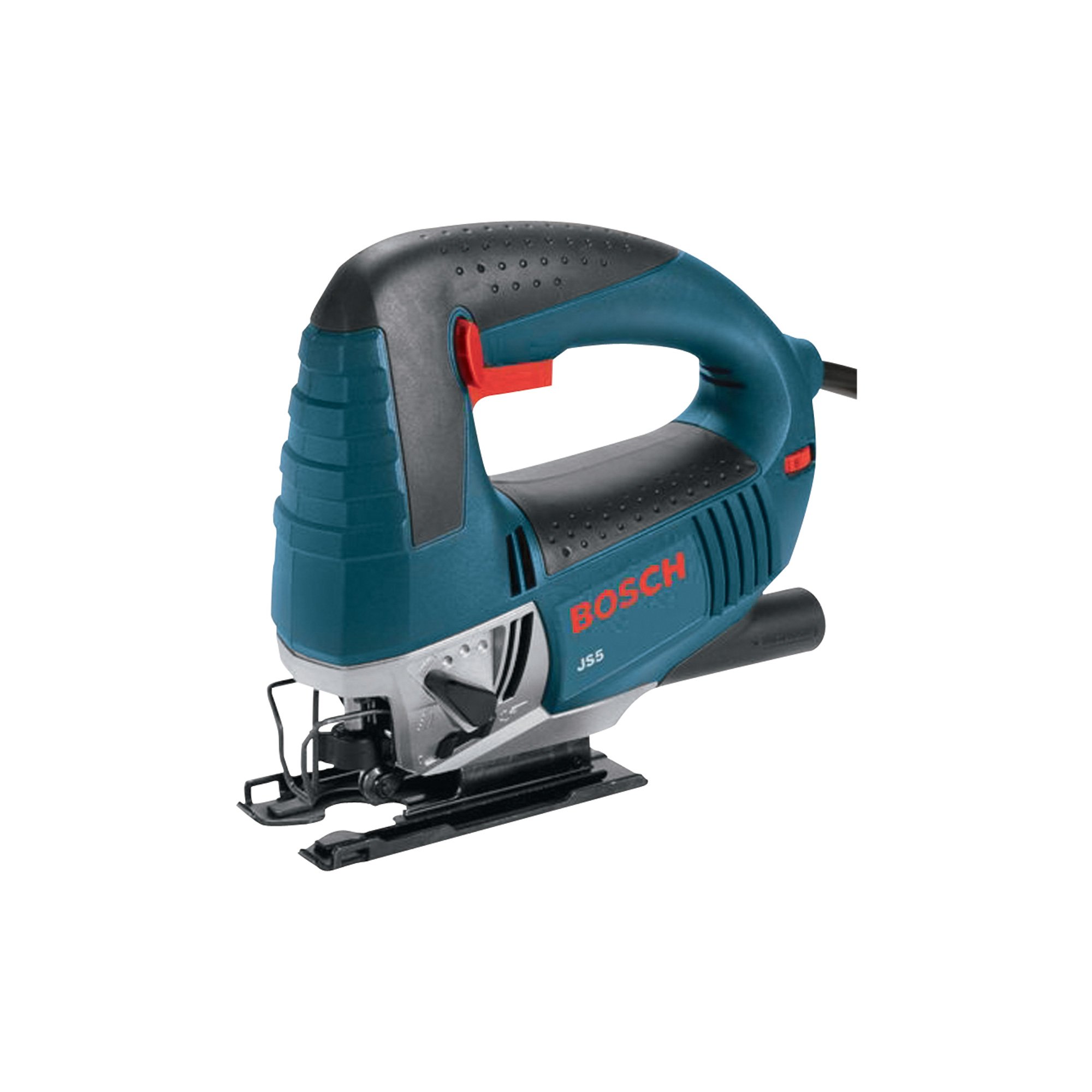
Your needs, this model
Does it fit your priorities?
Does the JS5 accept T-shank or U-shank blades?
The Bosch manual documents a One-Touch tool-less clamp and a T101B example for its anti-splinter insert, but it does not name the clamp standard. Neither T- nor U-shank fit is established in this assessment, so check the exact clamp and blade before relying on either finder choice.
Explore this need in the finder →Can I use the optional JS5 vacuum route and a bevel in the same setup?
The manual documents an optional vacuum hose and separately allows shoe tilt up to 45 degrees in either direction, but it does not state how extraction behaves with an angled shoe. This assessment matches the hose with the shoe level and keeps the documented blower/bevel setup separate; it does not say beveling is physically impossible with a hose attached.
Explore this need in the finder →Which orbit setting does Bosch suggest for harder wood?
Position 2 is Bosch’s guidance for medium-density stock such as harder woods or particleboard. The chart is not a species-specific capacity or finish promise; use an appropriate blade and make a test cut in scrap.
Explore this need in the finder →Why is the JS5 stroke length left blank?
The exact Bosch JS5 manual lists 7/8 inch, while the dated Bosch catalog lists 1 inch. The sources conflict, so this assessment records both claims and uses neither as the resolved matching value.
Explore this need in the finder →The Bosch JS5 is an earlier corded top-handle jigsaw documented in Bosch’s 2007 instructions and catalog. Its sources describe a 5.7 A, 120 V tool with variable speed, four orbital positions, a two-position chip blower, a one-touch blade clamp, an optional vacuum-hose connection and a shoe that bevels up to 45 degrees. One important specification disagrees: the manual lists a 7/8-inch stroke, while the Bosch catalog says 1 inch. This assessment leaves stroke length unresolved and is not a hands-on review or current-availability recommendation.
Identify the JS5, not the adjacent saws
Bosch’s dated 2007 U.S. catalog calls the JS5 an “Orbital Jigsaw.” The same catalog section continues onto a page that also begins a separate Power Hand Saws category, where Bosch lists 1640VS and 1640VSK as Finecut power handsaws. Those adjacent items are not JS5 variants or additional jigsaw models. This assessment covers the JS5 jigsaw only, and it does not imply that every Bosch historical jigsaw has now been enumerated.
The illustrated Bosch-authored instructions identify a rubberized top handle, trigger, lock-on button, variable-speed dial, four-position orbit selector, chip-blower switch, roller guide, dust port and footplate. They specify 120 V, 50–60 Hz, 5.7 A and a no-load range of 500–3,100 strokes per minute. These are manufacturer values for the named manual, not measurements made on a surviving tool. The photographed JS5 specimen shows its Bosch and JS5 markings, handle, cord and shoe; it does not show a case or establish the contents or condition of another offer.
Check the blade and the clamp before buying
The manual describes Bosch’s One-Touch tool-less clamp: a blade is inserted until it latches, with its back guided by the roller; pressing the ejector releases it. That is a documented quick-change arrangement, but the reviewed instructions do not establish whether the clamp accepts T-shank blades, U-shank blades, or both. Bosch names T101B among blades that work with the anti-splinter insert, but that insert example is not enough to turn the JS5’s shank field into a compatibility promise. The finder therefore does not match this model to a required T- or U-shank interface. Ask to see the exact tool clamp and confirm the intended blade against the unit’s manual before purchase.
Match the orbit to the material, then test scrap
Bosch’s four-position chart is a guide rather than a finish guarantee. Position 0 is the straight setting, associated with hard materials such as metal or thin sheet. Position 1 is for softer material when cleaner cutting or delicate scrolling is preferred. Position 2 is for medium-density material such as harder wood or particleboard. Position 3 is for softer materials such as wood or plastic when faster cutting matters more than a clean edge. Bosch says blade choice and feed rate also matter, and recommends a test cut in scrap. Its speed dial has six numbered settings, grouped as low stroke at 1–2, medium at 3–4 and high at 5–6; it gives no fixed speed for a particular material. Bosch warns that running for extended periods at low speed can raise motor temperature as its cooling fan turns more slowly.
The manual’s capacity table gives maxima of 3-9/16 inches in wood, 3/4 inch in aluminum and 3/8 inch in steel. These are published limits, not tested performance, a species-specific hardwood rating or a guarantee for an old tool and arbitrary blade. The 2007 catalog separately lists a 1-inch stroke, conflicting with the 7/8 inch in the model-specific instructions. Until the difference is resolved by a more specific Bosch source, this review and finder store no stroke-length value. Do not use either disputed figure as evidence of cut quality.
Blower, vacuum and bevel are different arrangements
The switchable blower has two positions. Bosch says to use it for wood, plastic and similar materials that generate sawdust, and switch it off for metal work or when the dust-collection accessory is being used. The manual also identifies a dust port and says an optional vacuum hose can connect it to a shop vacuum. A blower that moves chips is not the same thing as vacuum extraction, and the hose is not documented as included in the JS5 package.
The footplate can be tilted up to 45 degrees in either direction. Bosch identifies detents at 45 degrees and marks at 15 and 30 degrees; other angles can be set with a protractor, then secured by tightening the shoe screw. Because the instructions do not spell out a combined vacuum-and-bevel operating arrangement, the finder treats the optional-hose vacuum setup with the shoe level. It separately matches a blower-and-bevel setup. That is a conservative evidence boundary, not a statement that the shoe physically cannot tilt while a hose is attached. The manual further says that flush-cut repositioning permits only 90-degree cuts and prevents use of the optional cutting guide.
Package, seller and condition checks
Bosch’s 2007 catalog lists a carrying bag, blade and Allen key with the JS5. That dated catalog record helps distinguish the package described in that source, but it does not confirm that any present seller has the bag, a particular blade, or all original items. The shank of the catalog’s included blade is not identified here. Compare the exact suffix and written inventory, and inspect the cord, lock-on, speed dial, blade clamp, roller, blower switch and shoe on the individual tool. No current stock, price, working condition, recall clearance or seller return policy is established by this assessment.
The JS5 is relevant to a buyer who explicitly accepts an earlier corded tool and wants a top-handle body with documented orbit choice, bevel and separate chip-blowing or vacuum options. It is not the right evidence-backed answer for someone requiring a confirmed blade-shank standard, a resolved stroke figure or a guaranteed included vacuum hose. The exact-name recall lookup was not run, and no ownership, cutting test, measured vibration, durability judgment or customer-experience claim is made.
Sources and method
- Bosch JS5 Operating/Safety Instructions, BM 2609932576 11-07, printed pp.6–9 (Bosch-authored manual hosted by ManualsLib); used for identity, nameplate ratings, capacity figures, controls, blade interface limits, dust connection, orbit guidance, blower and bevel instructions.
- Bosch 4100DG-09 Saw & Benchtop Tools & Accessories Catalog, printed p.56 (Bosch-authored 2007 catalog hosted by ManualsLib); identifies JS5 as a jigsaw, lists package items and a 1-inch stroke, and separates neighboring Finecut power handsaws.
- Bosch 4100DG-09 catalog copy and section guide (third-party-hosted source copy); used alongside the readable catalog section to delimit pages 54–56, not to claim a complete Bosch historical inventory.
- Northern Tool JS5 listing and specimen image; a retailer identity/photo source only. The retailer page says its item is no longer available there; that does not establish broader market availability.
This is an evidence-based product assessment, not a firsthand review. Source specifications, capacities and package descriptions are not presented as independent testing.
Key specifications
Key details at a glance
| Power source | Corded mains power |
|---|---|
| Grip format | Top handle |
| Cut-action settings | 0 / 1 / 2 / 3 |
| Maximum documented speed | 3100 SPM |
| Maximum documented bevel | 45° |
| Battery included | No |
| Charger included | No |
| Blade listed in package | Yes |
| Carry bag listed in package | Yes |
| Integrated cutline blower | Yes |
| Optional vacuum-extraction route documented | Yes |
| Rated motor current | 5.7 A |
| Hard case listed in package | No |
Use the exact model’s instructions for operating limits, supplied equipment and version differences.
Sources for this review
Sources for this assessment
Make the next check about your project
Use the finder to combine material, blade interface, grip and operating setup. It matches documented capabilities, not guaranteed results.