
Your needs, this model
Does it fit your priorities?
Can I use orbital action for metal or hardwood with the DW317K?
No. DEWALT's DW317 manual says never to cut metal or hardwood in orbital mode. Use straight action for those materials, choose a material-specific blade, and follow the manual's speed guidance; it calls for high speed on soft metals and lower speed on hard metals, cast iron, tile, plastics, and laminate.
Explore this need in the finder →Does the DW317K support a vacuum-dust setup while beveling?
The checked DW317K product page and manual do not document an integrated blower, an external-vacuum adapter, or a compatible dust-collection route. Do not assume a vacuum arrangement or promise beveling with a dust accessory; confirm an exact accessory and the shoe setup with DEWALT before relying on it.
Explore this need in the finder →Will the blades I already own fit the DW317K?
The sources describe a keyless lever-action clamp and a blade installation process, but do not explicitly specify a T-shank or U-shank standard for this model. DEWALT lists T-shank blades among related accessories, which does not alone prove the DW317K clamp accepts them. Check the exact DW317 instructions or model support before buying blades.
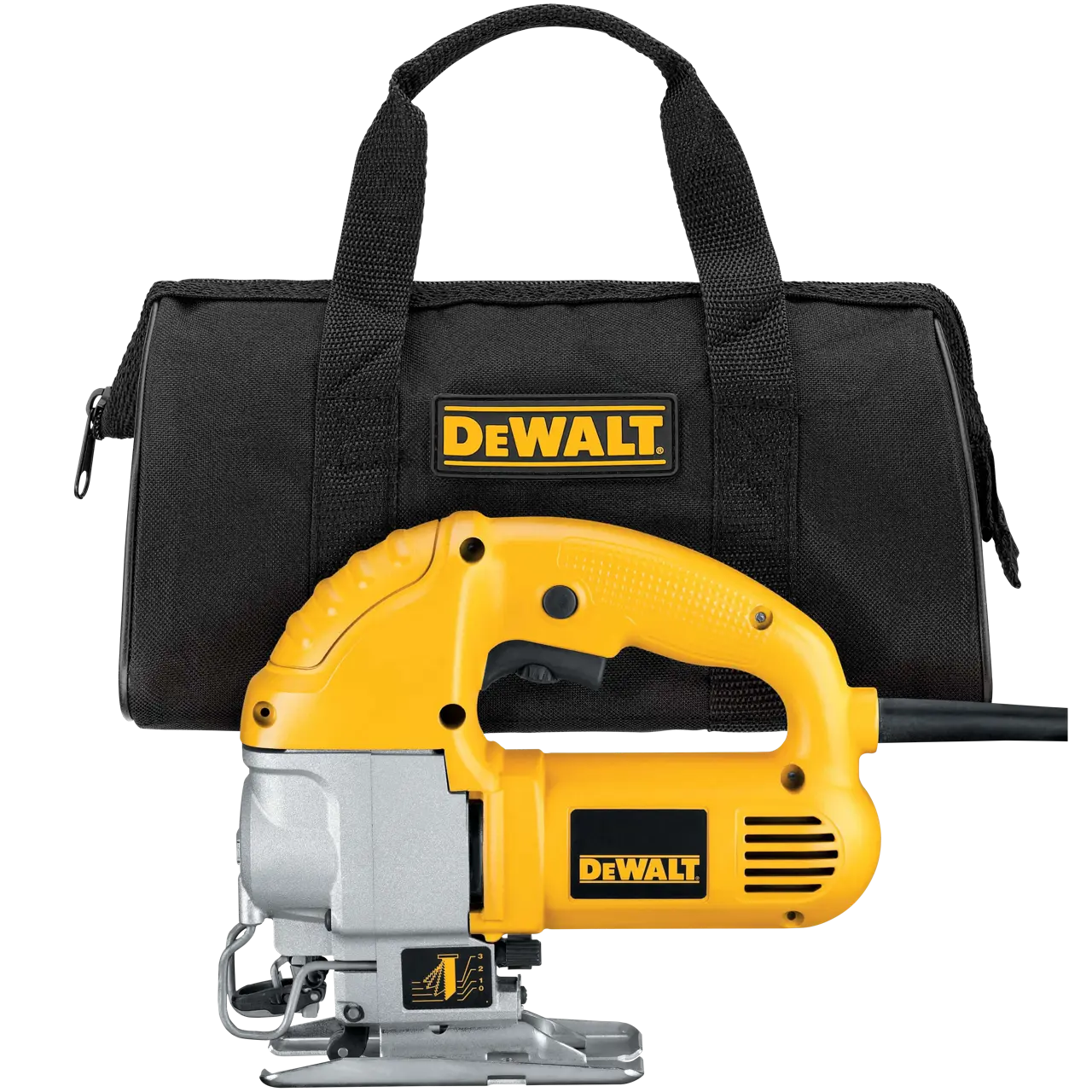
Explore this need in the finder →This is a source-based assessment, not a hands-on test. DEWALT's US listing identifies the DW317K as a 5.5-amp corded variable-speed jigsaw, and the included-items section names the saw and a contractor bag. Its useful distinction is the way speed and stroke motion can be adjusted separately: the trigger controls the running speed while a dial caps it. The package may suit a fixed workshop or repair bench where a cord is acceptable, but several everyday compatibility details remain less explicit than the headline features.
Speed is set with both the trigger and dial
DEWALT lists a brushed motor, a maximum speed of 3,100 strokes per minute, a keyless lever-action blade clamp, and four cutting-action positions. The DW317 manual explains that its dial sets a maximum in an approximately 500-to-3,100-SPM range; pressing the trigger farther raises speed up to that limit. A trigger lock can hold the switch on for continuous operation. That gives the operator more than one way to control the cut, but the lock-on is also a reason to check the switch before plugging the saw in: the manual warns that it starts immediately if left locked on.
The manual calls settings 0, 1, 2, and 3 four cutting actions. Zero is the straight up-and-down stroke; the other three add progressively more aggressive orbital motion. DEWALT says orbital action is quicker but leaves a rougher cut, is intended for softer materials such as wood or plastic, and must not be used for metal or hardwood. For a general “wood” job where the species is not known, straight action is the safer match; select orbital only for softwood or plastic, use a suitable blade, and make a scrap cut before committing to a visible edge.
Material changes the speed and blade plan
The manual gives a more practical material guide than a single capacity number. It recommends a finer blade for ferrous metals and a coarser blade for non-ferrous metals, high speed for soft metals such as aluminum, copper, brass, mild steel, galvanized pipe, and sheet metal, and lower speed for plastics, tile, laminate, hard metals, and cast iron. These are operating directions, not a promise that one included blade handles every item on that list. The cited package contents list a contractor bag and the DW317 saw, but do not list a blade; check the exact offer rather than assuming a blade or accessory is in the box.
The manual describes a keyless clamp and gives a blade-insertion procedure, but the checked DW317 product page and manual do not state the accepted shank standard. DEWALT's product page links T-shank blades among related accessories, which is not the same as an explicit compatibility statement. If your existing blades must fit, verify the shank against the exact tool instructions or model support before buying. I leave the blade-shank matcher field unknown rather than transferring compatibility from a neighboring DEWALT saw.
The shoe and bevel setup reward a slower adjustment
DEWALT's product page describes bevel detents at 0 and 45 degrees and a range up to 45 degrees. The manual explains adjustment by loosening the shoe screw, rotating the shoe, and tightening it firmly; it does not give the same quick-change picture as the keyless blade clamp. Treat beveling as a setup step to verify and secure, not as a tool-free switch. The manual also describes a reversible, double-ended shoe: a wider opening is for general and bevel cuts, while a narrow slot is intended only for hollow-ground blades and acts as an anti-splintering feature, particularly on plywood. That special slot is not a universal substitute for choosing the right blade or supporting the work.
Package, power, and evidence limits
The DW317K is a corded, brushed 5.5-amp tool; there is no battery-platform purchase to add, but the work area needs a suitable outlet and safe cord routing. DEWALT currently lists a three-year limited warranty on the page, subject to the manufacturer's current terms. The sources checked here do not establish a cut-depth figure, a documented dust blower or vacuum adapter, or a precise accepted blade-shank type. A missing specification is not proof that a feature is absent, so those items should be checked in the instructions for the exact type number or with DEWALT support.
Do not confuse the DW317K with the DW331K just because both are corded DEWALT models. The US category lists the latter as a 6.5-amp kit, but its current product page also reports 230 volts in the voltage field. That unresolved source/version mismatch means the amp label alone is not enough to make a US-market comparison. Confirm the rating plate and exact regional version before treating it as an alternative.
Who this assessment can help
The DW317K is a plausible shortlist candidate if you want a corded saw with a speed dial, a variable trigger, and straight/orbital choice for a mix of workshop cuts. It is a poor fit if cordless portability is essential, if the exact blade shank must be known before purchase, or if a documented dust-extraction setup is a requirement. For broad wood work, start with straight action; reserve orbital for softer material and keep it off metal and hardwood. Confirm the exact package, manual type, blade fit, and electrical rating before use.
This assessment follows the DEWALT US category and exact DW317K product page, the manufacturer-linked Type 2 manual, and a date-bounded CPSC recall query. It does not claim ownership, test cuts, measured speed under load, personal use, or current price and stock. Follow the safety manual, support the workpiece, keep both hands clear of the blade path, and match speed and blade to the material.
Sources checked 2026-10-28: DEWALT US Jig Saws category, the DEWALT DW317K product page, the DEWALT DW317K Type 2 instruction manual, and the CPSC DW317 query.
Key specifications
Key details at a glance
| Power source | Corded mains power |
|---|---|
| Grip format | Top handle |
| Motor type | Brushed |
| Brushless motor | No |
| Cut-action settings | 0 / 1 / 2 / 3 |
| Maximum documented speed | 3100 SPM |
| Maximum documented bevel | 45° |
| Battery included | No |
| Charger included | No |
| Carry bag listed in package | Yes |
Use the exact model’s instructions for operating limits, supplied equipment and version differences.
Sources for this review
Sources for this assessment
Make the next check about your project
Use the finder to combine material, blade interface, grip and operating setup. It matches documented capabilities, not guaranteed results.