
Your needs, this model
Does it fit your priorities?
Is the U.S. DW331K really a 120 V saw when DEWALT's product page says 230V?
DEWALT's U.S. catalog lists item DW331K as a 6.5 A, 120V AC, 50/60 Hz jig-saw kit. Its Type 10 and Type 11 North-American DW331 manuals also specify 120 V AC, 6.5 A and tell the user to match the actual tool's nameplate. The exact U.S. product page still has a conflicting 230V data field, so this assessment uses the manufacturer's item-numbered U.S. catalog and North-American manuals but does not claim to have inspected a physical kit. Check the individual saw label and exact U.S. offer before powering it; a plug adapter does not change voltage.
Explore this need in the finder →Can the DW331K connect to a shop vacuum, or does it only clear the cut line?
The manual describes an integrated chip blower that moves debris away from the cutting area and instructs the operator to turn it off for metal cuts so cutting fluid is not blown away. The checked exact U.S. page and DW331 manuals do not establish a compatible external-vacuum adapter, hose size, or bevel behavior with an extractor. Do not treat the blower as dust collection or assume a vacuum connection; verify an exact DEWALT accessory and setup first.
Explore this need in the finder →When should I keep orbital action off on the DW331K?
DEWALT's Type 10 and Type 11 North-American manuals define position 0 as straight and positions 1–3 as orbital, with stronger orbit as the setting increases. They describe orbital action as faster but less smooth for soft materials such as wood or plastic and explicitly say never to use it on metal or hardwood. Keep metal and hardwood on the straight setting, choose a blade for the stock, and follow the manual rather than expecting a particular edge quality.
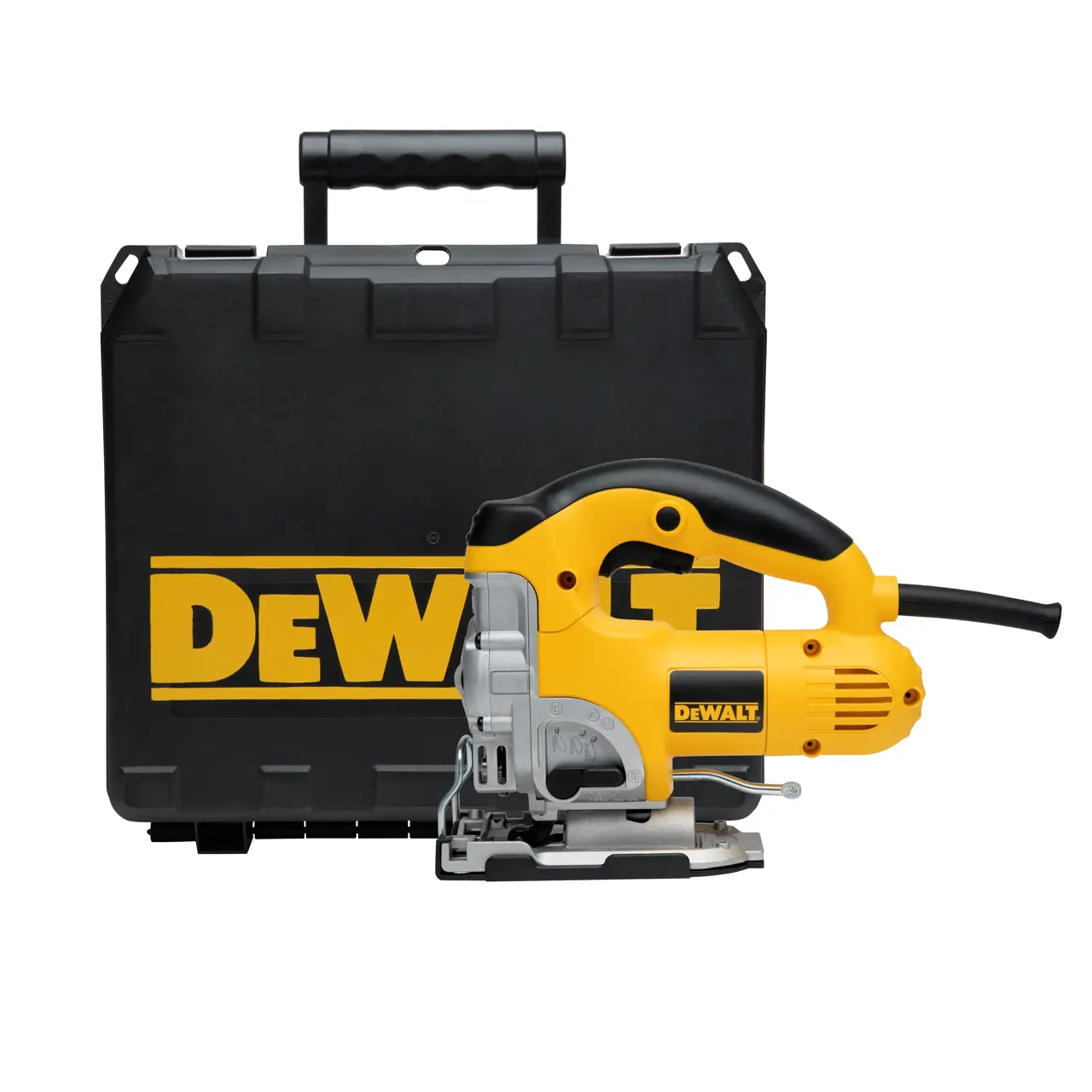
Explore this need in the finder →The DEWALT DW331K is a corded top-handle jigsaw sold as a kit around the DW331 saw. Its paper strengths are specific: a separate speed dial and trigger, a T-shank-only clamp, four action positions, a line-clearing blower, and a bevel shoe. The most important caveat is not a performance claim but an information conflict: the exact U.S. product page says 230V, while DEWALT's U.S. item-numbered catalog and North-American DW331 manuals identify this U.S. kit as 120 V AC. This review follows the manufacturer U.S. catalog and manuals for U.S.-market fit, but a buyer should check the actual saw's nameplate before use.
Power and package require a model-label check
DEWALT's U.S. catalog prints DW331K beside “120V AC, 50/60 Hz” and a 6.5-amp motor. The exact Type 10 manual linked from the DW331K U.S. page and the saved North-American Type 11 manual both specify 120 V AC, 6.5 A and 702 W for the DW331. They say the supply must agree with the nameplate. This supports a 120 V assessment of the observed U.S. SKU, but does not replace inspecting an individual unit. The current page's 230V field remains contradictory; a plug adapter does not change voltage.
The same DEWALT U.S. page names a box kit, an anti-splinter base and one DW331 jig saw. Its listed contents do not name a blade, so the particular seller's box should be checked rather than assuming the blade shown in a general illustration is included. This is a kit package, not the cordless DCS331B: the letters overlap, but the latter is a separate 20V MAX battery saw and cannot be treated as a battery-powered version of this corded assessment.
A T-shank clamp and two-part speed control
For blade compatibility, the Type 10 and Type 11 manuals are unusually explicit: this saw uses only T-shank jigsaw blades. The keyless lever releases the blade, and the rear of the blade sits in the guide-roller groove. That is useful if a shop already stocks T-shank blades; it is a restriction if the intended blade is U-shank. Follow the blade maker's material and thickness guidance. The checked U.S. sources do not establish a numerical cut-depth limit, and the 13.5-by-14.5-by-4.5-inch dimensions on the online page refer to the assembled package, not the saw body.
The speed dial sets a maximum rate of approximately 500 to 3,100 strokes per minute; the trigger varies speed up to that ceiling. A lock button enables continuous running. This is separate ceiling and trigger control, not evidence that a particular speed is held under load. The checked U.S. page and manuals do not give a verified stroke length.
Choose straight or orbital action for the stock
Position 0 is straight cutting; positions 1, 2 and 3 add orbital motion, with the manual describing greater aggressiveness as the setting rises. DEWALT says orbit can cut soft materials such as wood or plastic faster, with a less-smooth edge. Its rule is clear: never cut metal or hardwood in orbital action. For wood, start with the manual's higher-speed recommendation and the blade guidance for the actual stock. For plastic, tile, laminate, hard metal or cast iron, the manual calls for lower speed. Metal work also brings material-specific advice: use a finer blade for ferrous stock and a coarser one for non-ferrous stock; high speed is recommended for soft metals such as aluminum, copper, brass and mild steel. Those are instructions to consider, not a promise of capacity or finish.
The blower clears debris; it is not dust capture
The integrated blower moves debris away from the cut line and can be switched off. For metal, the manual says to turn it off so cutting fluid is not blown away. A cutline blower is not an external dust extractor. The reviewed sources do not establish a compatible vacuum adapter, hose diameter, or vacuum-plus-bevel setup. If dust capture is essential, confirm an exact accessory before purchasing; no vacuum match is borrowed from another saw.
Bevel adjustment and finish accessories
The shoe has a 0-degree positive stop and left- or right-side bevel positions to 15, 30 or 45 degrees; the manual also allows a manual stop between 0 and 45 degrees. A keyless lever loosens and relocks the shoe. The removable no-mar cover is intended for easily scratched laminate, veneer or painted surfaces. The anti-splinter insert is intended to reduce tear-out, especially on veneer, laminate and finished surfaces; the manual places it in the no-mar cover or, if that cover is not used, in the shoe. Do not use the insert with the model-specific DT2074 flush-cut blade; DEWALT's manual says that blade is for DW331 and DC330 saws and requires the shoe at the 0-degree stop. That optional accessory is not established as part of the DW331K package.
Who should consider this assessment
The DW331K suits a buyer who prefers a corded top handle, already has or wants T-shank blades, values a separate dial-and-trigger speed setup, and has a use for straight and appropriately limited orbital cuts. The kit box and included anti-splinter base are documented. The tradeoffs are meaningful: it needs a mains cord, the exact U.S. page has a voltage data conflict, no blade is named in its included-items list, and external-vacuum compatibility is unconfirmed. Compared with DEWALT's 5.5 A DW317K, the DW331K adds a documented T-shank-only interface and integrated blower, while both manuals still require material-aware action and the DW317K blade standard remains undocumented. This is a comparison of published features, not a claim that one makes better cuts. Match the exact SKU, voltage label, included contents, blade and return terms to the task before choosing a seller.
Key specifications
Key details at a glance
| Power source | Corded mains power |
|---|---|
| Grip format | Top handle |
| Motor type | Brushed |
| Brushless motor | No |
| Blade interface | T-shank only |
| Cut-action settings | 0 / 1 / 2 / 3 |
| Maximum documented speed | 3100 SPM |
| Maximum documented bevel | 45° |
| Battery included | No |
| Charger included | No |
| Integrated cutline blower | Yes |
| Rated motor current | 6.5 A |
Use the exact model’s instructions for operating limits, supplied equipment and version differences.
Sources for this review
Sources for this assessment
- DEWALT Jig Saws US category
- DEWALT DW331K 6.5 Amp Jig Saw Kit exact U.S. product page
- DEWALT U.S. product catalog, page 15, DW331K kit specifications
- DEWALT DW331 Type 10 instruction manual, exact U.S. product page link
- DEWALT DW331 Type 11 North-American instruction manual
- CPSC exact-product-name query for DW331K
Make the next check about your project
Use the finder to combine material, blade interface, grip and operating setup. It matches documented capabilities, not guaranteed results.