
Your needs, this model
Does it fit your priorities?
Does the PSB 300 EQ match a corded top handle T-shank softwood-orbital requirement?
Yes for the documented setup. The official TRION manual names wood and recommends pendulum positions 1–3 for both soft and hard wood; its 1,000–2,900 SPM range and 720 W figure come from Festool's U.S. catalog. The PSB 300 EQ is the top handle version, and the catalog package lists two T-shank wood blades. No cut finish or thickness result is implied.
Explore this need in the finder →Can the PSB 300 EQ use ceramic with straight cutting?
The manual names ceramic tile and specifies pendulum setting 0. It gives no ceramic capacity; its separate 120 mm wood, 20 mm non-ferrous-metal and 10 mm steel maxima should not be transferred to tile. Use a purpose-suitable blade and follow the exact tile/blade guidance.
Explore this need in the finder →Can the PSB 300 EQ keep beveling with an external vacuum connected?
The manual separately describes up to 45-degree base adjustment and a 27 mm extraction route, but the checked source does not clearly establish the combined arrangement. The finder conservatively requires one documented operating plan; this is an evidence boundary, not proof the combination is physically impossible. Confirm the exact instructions and adapters before relying on both.
Explore this need in the finder →This review assesses the earlier-reference Festool TRION PSB 300 EQ, U.S. catalog item 576049. It shares the PS 300 EQ's corded 720 W platform and cutting ranges, but its D-handle, pushbutton switch and lock button make it a separate operating configuration rather than a cosmetic variant.
Choose the D-handle controls for their layout, not a promised result
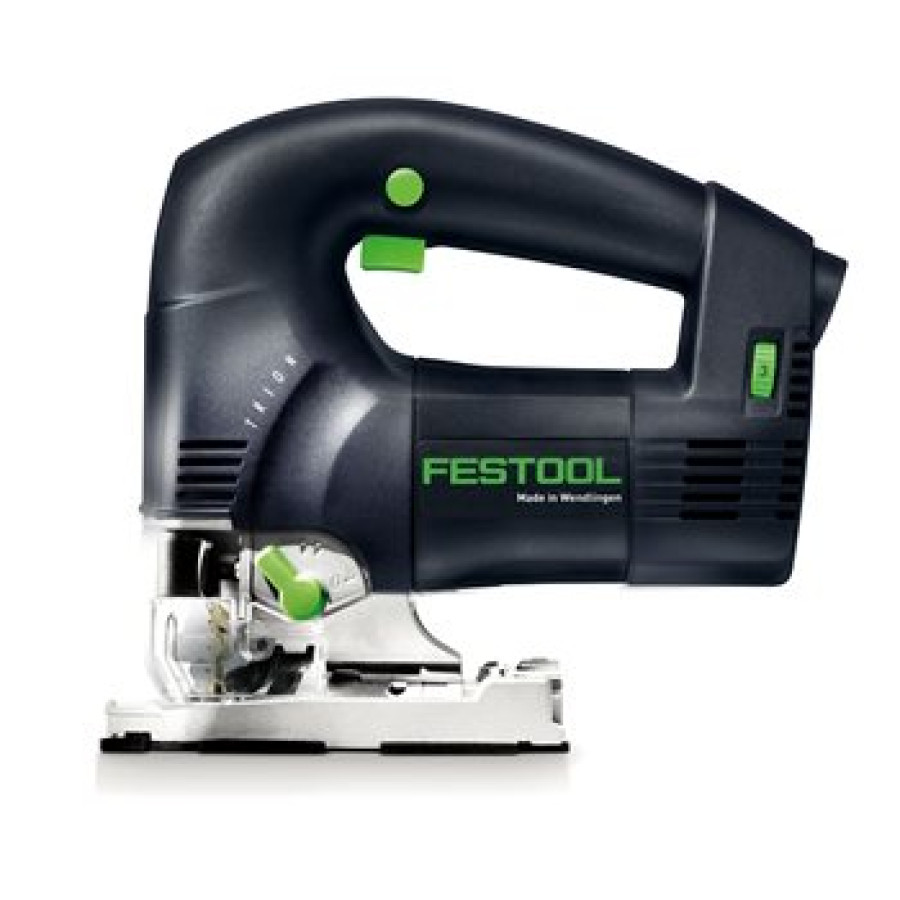
The PSB 300 EQ uses a top/D-handle body and a pushbutton with a separate lock button for continuous running. The barrel-grip PS 300 EQ has a latching slide switch instead. Those distinctions are directly supported in the U.S. TRION manual; they do not prove that one grip is more comfortable or easier to guide for every hand. Consider access around the handle and whether you prefer the PSB's switch sequence, then check the exact saw before purchase.
The U.S. catalog lists 720 W, a 26 mm stroke, four pendulum settings (0–3) and a no-load range of 1,000–2,900 strokes per minute. Setting 0 gives straight action; the other positions add pendulum movement. Festool's material guidance assigns positions 1–3 to both hard and soft wood, 1–2 to plywood and plastic, 0–2 to non-ferrous metal, 0–1 to steel and position 0 to ceramic tile. A single “orbital” label therefore should not imply one setting for every stock.
Material guidance has limits beyond the headline depth
The published maximums are 120 mm in wood, 20 mm in aluminum and 10 mm in steel. They are not a universal depth rating: the manual ties work to a suitable blade, and it does not give a ceramic thickness, cast-iron capacity or finish guarantee. The speed chart separately places wood near the faster end, plastic and non-ferrous metal across mid-to-high settings, and steel lower. Treat these as manufacturer starting guidance, not as a test result or a substitute for the blade instructions.
Festool's catalog lists item 576049 with two T-shank wood blades, chip catcher, splinterguard, Plug-It power cord, dust port and SYS3 M 187 Systainer. The U.S. catalog and dealer guide also show an older 561455 identifier for a related PSB package; the official guide links that older retail item to the 576049 generation. The image used on this page comes from a retailer's 561455 listing, so it supports the recognizable D-handle body only; it is not proof of the 576049 box contents. Verify model number, case and accessories from the actual offer.
Vacuum collection and bevel should be checked as a pair
The manual describes a 27 mm dust-extraction adapter and a directed blow-off function that operates with an extractor. That is not the same as a standalone built-in cutline blower: the conditional blow-off does not capture dust without an external collector. Connect the appropriate adapter and extractor only after confirming the precise interface and supplied parts.
The adjustable base supports bevel work up to 45 degrees. The sources checked for this assessment do not clearly confirm that the dust-extraction arrangement and bevel setting can be used together on the PSB. Consequently the documented finder arrangements keep them separate; this is an evidence boundary, not a claim that the saw is physically incapable of the combination. For ceramic, the manual specifies position 0, so the supported ceramic plan is straight action only.
Check the exact corded package and nameplate
The reviewed manual directs users to the rating plate for exact electrical information and does not supply an explicit voltage in its technical table. This assessment therefore does not infer a 120 V rating just because the model is sold in a U.S. catalog. Check the nameplate before plugging in. The model's Plug-It cord is included in the listed catalog configuration, but confirm the exact box, cord and extraction pieces with the seller.
The 2021/2024 U.S. catalogs record this TRION model; the checked 2026 catalog segment covers cordless CARVEX models, accessories and blades rather than the PSB 300 EQ. “Earlier reference” describes the available source trail, not an official discontinuation notice or a promise about current offers. If comparing it with the PS 300 EQ, focus on the documented handle and switch: the shared motor, stroke and material guidance should not be used to transfer an unverified control or package claim. No price, stock, testing, ownership or customer-review result is asserted.
Key specifications
Key details at a glance
| Power source | Corded mains power |
|---|---|
| Blade interface | T shank |
| Cut-action settings | 0 / 1 / 2 / 3 |
| Maximum documented speed | 2900 SPM |
| Maximum documented bevel | 45° |
| Battery included | No |
| Charger included | No |
| Blade listed in package | Yes |
| Optional vacuum-extraction route documented | Yes |
| Stroke length | 1.02 in |
| Maximum listed cutting capacity | 4.72 in |
| Hard case listed in package | Yes |
Use the exact model’s instructions for operating limits, supplied equipment and version differences.
Sources for this review
Sources for this assessment
- Festool TRION PS 300 / PSB 300 EQ U.S. manual, retained mirrored PDF
- 2021 Festool USA catalog, TRION model/package pages 104–105
- 2022 Festool U.S. dealer guide, page 21 and predecessor-number table
- 2024 Festool English U.S. catalog, pages 118–119
- 2026 Festool English U.S./Canada catalog, inspected pages 120–127
- Everwood exact predecessor-model retailer page for PSB 300 EQ item 561455 (image identity only)
Make the next check about your project
Use the finder to combine material, blade interface, grip and operating setup. It matches documented capabilities, not guaranteed results.