
Your needs, this model
Does it fit your priorities?
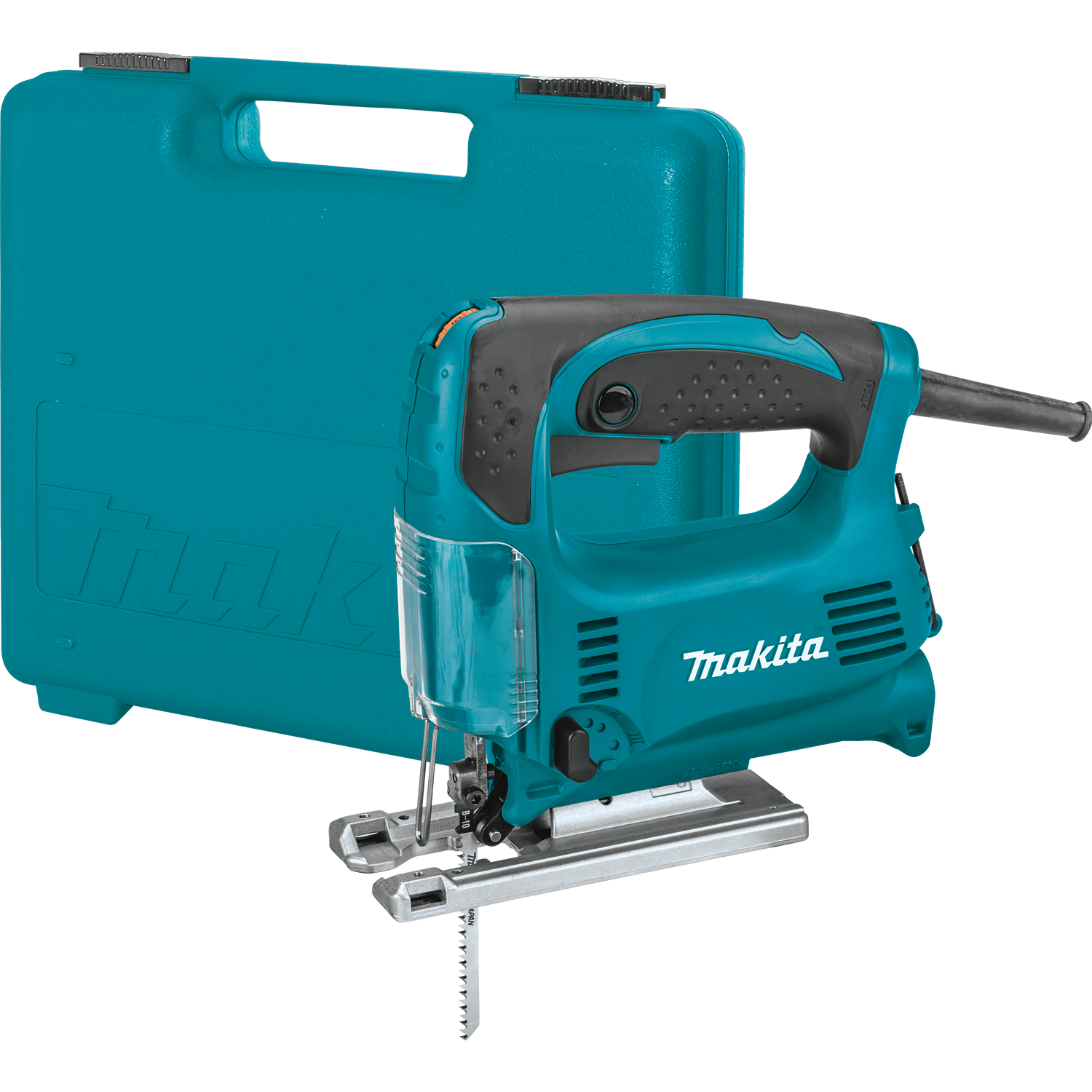
What is included with the exact 4329K package?
Makita’s exact 4329K page lists one 4-1/8-inch 9-TPI blade (792529-7-1), a hex wrench and hard tool case. It does not list a vacuum hose or dust nozzle. Check the box and seller listing for the exact suffix and contents.
Explore this need in the finder →Which orbital settings does Makita associate with hardwood and soft-metal work?
The linked manual calls I small orbit for hardwood, aluminum and mild steel, II medium orbit for wood/plywood and faster aluminum/mild-steel work, and III faster wood/plywood. These are maker recommendations; match the blade and material and do not treat them as measured performance.
Explore this need in the finder →Can I connect a vacuum and bevel at the same time?
Makita describes a rear-port vacuum route but its manual says dust extraction cannot be performed during bevel cuts. The exact kit page does not list the hose or nozzle, so confirm the vacuum connection separately and choose between extraction and beveling for the documented setup.
Explore this need in the finder →This assessment is based on Makita USA’s exact 4329K product page and the instruction manual linked there, not a hands-on test. The 4329K is a corded, top-handle jigsaw supplied as a case-included package. Its documented strengths are straightforward: a compact, lighter-duty specification, adjustable speed and orbital action, plus both a line shield and a rear vacuum port. Its compromises are equally important: it uses a wrench-operated blade clamp, lists lower cutting capacities than Makita’s 4350FCT/4351FCT pair, and does not include the hose or nozzle needed for vacuum extraction. Makita’s 4329K page identifies the exact model and package.
What the 4329K specification actually says
Makita lists a 3.9-amp motor, 500–3,100 strokes per minute, an 11/16-inch stroke, and maximum 90-degree capacities of 2-9/16 inches in wood and 1/4 inch in steel. The published net weight is 4.2 pounds. These are manufacturer specifications, not measured cut depths or evidence of how quickly this saw will cut a particular board. In this group, it is the more compact specification rather than a substitute for the deeper published wood capacity of the 4350FCT or 4351FCT.
The K suffix matters for the box: the exact page lists one 4-1/8-inch, 9-TPI blade (792529-7-1), a hex wrench and hard tool case. It does not list batteries or a charger, and this model is corded. Check the package label and seller listing rather than treating another 4329-family configuration as automatically identical.
Speed and orbital action are separate choices
The manual describes a six-position variable-speed dial from 500 to 3,100 SPM and a trigger switch with a lock-on button. The dial sets the speed range; the trigger starts the tool and provides control, while the lock supports continuous operation. The cutting-action lever has four positions: 0 is straight up-and-down motion, while I, II and III add progressively more orbital motion. They are not four orbital settings.
Makita’s manual suggests straight action for clean wood and plywood cuts and for mild steel, stainless steel and plastics. Its small-orbit position is listed for mild steel, aluminum and hardwood; medium orbit covers wood and plywood and faster aluminum or mild-steel work; large orbit is for faster wood and plywood cutting. Those charts are starting guidance that the manual says can vary with workpiece type and thickness. Use a blade specified for the stock, support the work, and do not treat the capacity number as a guaranteed result. The manual’s older “B type” blade wording deserves attention: the exact US product page calls the interface T-tang and lists a B-10-series blade. Confirm the replacement blade’s Makita model marking and manual fit rather than relying only on a generic shank label.
Dust, bevels and blade changes
This is not an integrated-blower model. Makita describes a through-body dust port, a clear dust cover and vacuum use; its manual explains inserting the vacuum hose at the rear of the tool. That is a dust-extraction route, not a promise that the work area will be dust-free. The exact 4329K package list does not include a vacuum hose or dust nozzle, so account for those separately and confirm the actual hose connection before buying. The clear cover is described as helping keep chips from flying during vertical cutting; it is not a dust collector by itself.
The cast-aluminum base can be adjusted from 0 to 45 degrees in either direction with the supplied wrench. The manual says to raise the dust cover before beveling and specifically notes that dust extraction cannot be used while making bevel cuts. That makes the vacuum and bevel requests mutually exclusive in one operating arrangement. The blade clamp also requires the supplied hex wrench, unlike the tool-less clamps on the FCT models. If frequent blade changes are a priority, that is a real difference to weigh against this saw’s smaller listed body and package.
Who should consider this package?
The 4329K is a plausible fit for someone seeking a corded top-handle tool for ordinary trim, plywood or curved work within its listed capacities, who is comfortable with a wrench-operated blade change and wants a carry case in the specified package. It also has documented orbital settings for hardwood and certain metal jobs when paired with the right blade and speed. It is not a reason to select a saw by amp rating alone: blade choice, feed, stock support, and the manual’s mode guidance still govern the cut.
Choose the 4350FCT or 4351FCT for a larger published wood capacity, one-inch stroke, tool-less blade changes and built-in cutline blower; choose between those by grip format. Neither should be assumed to include the same accessories as the 4329K. Conversely, the 4329K should not be described as having the FCT models’ light, electronic speed control or blower. The manufacturer’s current-reference page does not establish stock or seller terms. Confirm the exact 4329K suffix, included case and blade, replacement-blade marking, and any separately purchased vacuum fittings before deciding.
Limits of this assessment: no ownership, cutting test, noise measurement or durability test is claimed. The listed capacity and speed are manufacturer data; the orbital and dust guidance above follows the linked instruction manual.
Key specifications
Key details at a glance
| Power source | Corded mains power |
|---|---|
| Grip format | Top handle |
| Motor type | Brushed |
| Brushless motor | No |
| Blade interface | T shank |
| Cut-action settings | 0 / 1 / 2 / 3 |
| Maximum documented speed | 3100 SPM |
| Maximum documented bevel | 45° |
| Battery included | No |
| Charger included | No |
| Blade listed in package | Yes |
| Rated motor current | 3.9 A |
| Stroke length | 0.69 in |
| Hard case listed in package | Yes |
Use the exact model’s instructions for operating limits, supplied equipment and version differences.
Sources for this review
Sources for this assessment
Make the next check about your project
Use the finder to combine material, blade interface, grip and operating setup. It matches documented capabilities, not guaranteed results.