
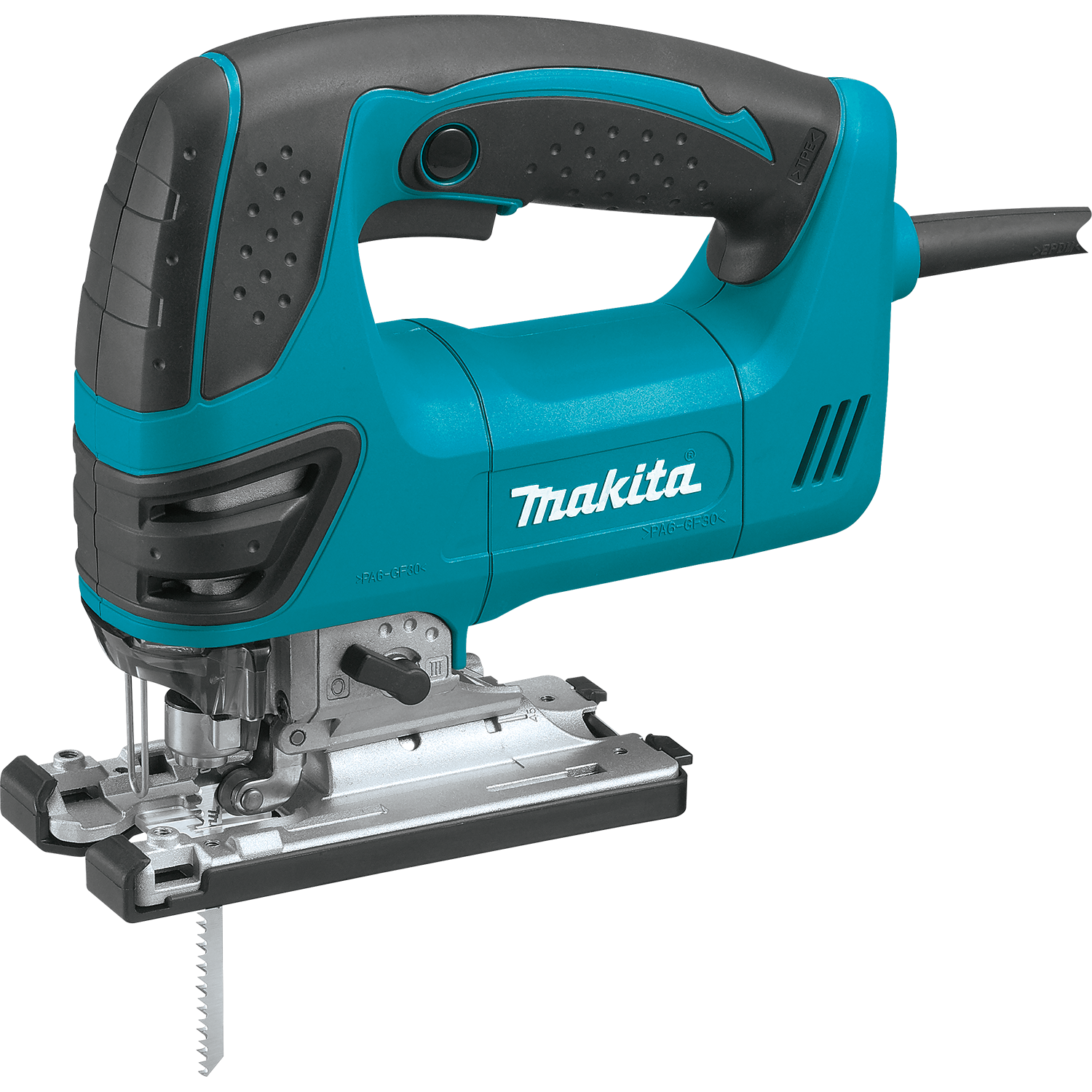
Your needs, this model
Does it fit your priorities?
How does the 4350FCT differ from the 4351FCT?
The 4350FCT is top-handle with a trigger and lock-on button; the 4351FCT is barrel-grip with a slide switch. Their published stroke, speed and capacity figures are close, but handle position and control layout differ. Grip preference requires handling the actual tool.
Explore this need in the finder →Which settings are documented for hardwood or aluminum?
The linked manual lists position I (small orbit) for hardwood, aluminum and mild steel; position II is for wood/plywood and faster aluminum or mild-steel cutting. Position 0 is straight action. Follow the blade instructions and manual for the actual stock; these are not test results.
Explore this need in the finder →Does the built-in blower collect dust or include a vacuum nozzle?
No. Makita describes a blower that clears the cut line. The manual recommends an optional base-mounted dust nozzle connected to a vacuum, and the exact package list does not include that nozzle or hose. The manual also says the anti-splinter insert cannot be used during bevel cuts.
Explore this need in the finder →This is a source-based assessment of the Makita 4350FCT, not a hands-on review. Makita’s US page identifies it as a corded, top-handle jigsaw with a one-inch stroke, tool-less blade change and a package that includes six blades, an anti-splintering insert, cover plate, wrench and tool case. Its defining combination is a wider published cut-capacity envelope than the 4329K, electronic speed control, and a built-in cutline blower. The drawbacks to keep in view are its corded format, 5.7-pound listed weight, and dust accessories that are not all in the box. The exact 4350FCT page is the source for the model-specific package and specifications.
Capacity and package are not performance tests
The product page lists a 6.3-amp motor, 800–2,800 SPM, a one-inch stroke, and maximum 90-degree capacities of 5-5/16 inches in wood, 3/8 inch in steel and 25/32 inch in aluminum. It lists 5.7 pounds net and a 9-1/4-inch overall length. These are maker specifications, not independent cut tests: they do not establish that every blade, material, feed rate or setup will reach the stated maximum cleanly. The linked manual also cautions that the suitable speed depends on workpiece type and thickness.
The package list is unusually useful to check before ordering: two each of three blade models (including HCS and HSS types), an anti-splinter insert, a cover plate, a hex wrench and case. Makita’s page identifies the included blades as T-shank. The battery-and-charger question does not apply because this is corded. Confirm the exact model number and contents in the seller’s current box; a related or used listing may omit accessories.
Choose the action for the material
The 4350FCT manual describes positions 0 through III: position 0 is straight action; I is small orbital; II is medium orbital; III is large orbital. This distinction is more practical than the phrase “orbital settings” on a product card. Makita’s chart associates straight motion with clean wood/plywood cuts and with mild steel, stainless steel and plastics. It lists small orbit for mild steel, aluminum and hardwood; medium orbit for wood and plywood and faster aluminum or mild-steel cutting; large orbit for faster wood and plywood cutting. The chart is manufacturer guidance, not a guarantee of finish or speed. Use the manual’s separate dial guidance and the blade maker’s instructions, and do not force a blade through stock.
The top handle provides a familiar trigger grip: the manual describes the trigger and lock-on button. A variable-speed dial spans 800–2,800 SPM. The manual calls out constant-speed control and soft start; the exact page also describes electronic speed control under load. A built-in LED lights when the trigger is pulled, according to the manual. These features may be useful when starting or following a marked line, but they are not proof of a straighter cut or less fatigue in an individual hand.
Blower versus vacuum extraction
The built-in blower clears the cut line; it does not collect dust. For extraction, Makita’s manual recommends an optional dust nozzle that attaches to the base and connects to a Makita vacuum. The 4350FCT page describes both the nozzle and vacuum as optional, and neither appears in its included-items list. If capture is essential, verify the exact nozzle, hose and vacuum connection, not just the saw model. Makita also lists an anti-splintering insert for cleaner cuts, but its manual says the insert cannot be used while beveling.
The base can be set up to 45 degrees left or right. That makes a straight or orbital blower arrangement and a bevel arrangement separately documented capabilities. The manual explicitly warns about the anti-splinter insert during bevel adjustment; it does not establish that every dust-extraction setup remains compatible with every bevel setting. Treat vacuum-plus-bevel compatibility as unconfirmed, and do not promise a splinter-free edge from the accessory alone.
How it compares within this Makita group
Against the 4329K, the 4350FCT offers the larger listed wood capacity and stroke, tool-less blade change, built-in line blower, LED, and six included blades; it is also heavier by the manufacturers’ stated net weights. Against the 4351FCT, most headline specifications and the accessories are shared, but the 4350FCT is the top-handle form. The 4351FCT is a barrel-grip model with a different switch arrangement and listed dimensions/weight. Grip is a physical preference worth deciding from the actual tool, not something a spec table can settle.
This model suits a shopper who specifically wants a corded top-handle layout, the documented orbital range, and the FCT package’s tool-less clamp and case. It is less compelling if cordless portability is essential, if a vacuum is expected to be included, or if lighter weight is the priority. The exact manufacturer page supports current-reference identity only; it does not establish current stock, price or a seller’s package. Check the 4350FCT suffix, blade types, case, compatible extraction parts and return terms before purchase.
Limits of this assessment: no tool use, ownership, measured vibration, sound level, dust-capture result or cut-quality test is claimed. Makita’s vibration statement is the manufacturer’s own comparison, not an independent measurement in this review.
Key specifications
Key details at a glance
| Power source | Corded mains power |
|---|---|
| Grip format | Top handle |
| Motor type | Brushed |
| Brushless motor | No |
| Blade interface | T shank |
| Cut-action settings | 0 / 1 / 2 / 3 |
| Maximum documented speed | 2800 SPM |
| Maximum documented bevel | 45° |
| Battery included | No |
| Charger included | No |
| Blade listed in package | Yes |
| Rated motor current | 6.3 A |
| Stroke length | 1 in |
| Hard case listed in package | Yes |
Use the exact model’s instructions for operating limits, supplied equipment and version differences.
Sources for this review
Sources for this assessment
Make the next check about your project
Use the finder to combine material, blade interface, grip and operating setup. It matches documented capabilities, not guaranteed results.