
Your needs, this model
Does it fit your priorities?
Why choose the barrel-grip 4351FCT over the top-handle 4350FCT?
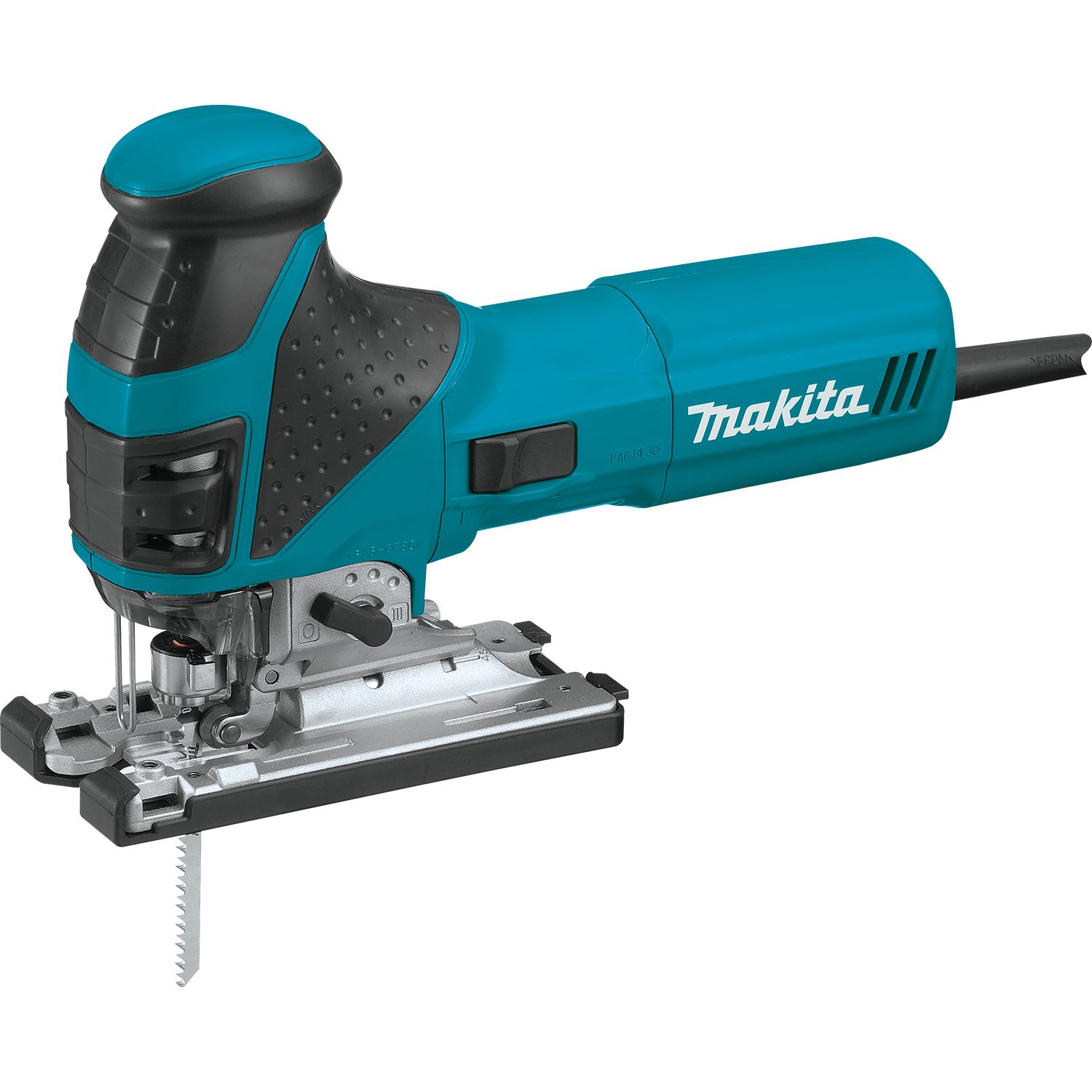
The manufacturer describes the 4351FCT barrel grip as closer to the work surface. It uses a slide on/off lever; the 4350FCT uses a top handle with trigger/lock-on. The published cutting capacities and speed ranges are similar, but neither source establishes which grip feels more controllable to you.
Explore this need in the finder →What does the manual say about orbital action?
Position 0 is straight; I is small orbit for mild steel, aluminum and hardwood; II is medium orbit for wood/plywood and faster aluminum or mild steel; III is large orbit for faster wood/plywood. Use the maker chart as guidance, not a promise of finish or rate.
Explore this need in the finder →Is the 4351FCT vacuum-ready and can it bevel?
Makita’s exact page and manual describe a base-mounted optional dust nozzle that connects to a vacuum, plus bevels to 45 degrees either way. The page lists the cover plate and anti-splinter insert in the package; the manual warns that the anti-splinter insert cannot be used in bevel cuts. It does not confirm vacuum-plus-bevel compatibility.
Explore this need in the finder →The Makita 4351FCT is the barrel-grip counterpart to the 4350FCT. This assessment uses Makita USA’s exact 4351FCT page and its linked manual and parts breakdown; it is not a hands-on test. Makita describes the barrel grip as closer to the work surface, but that is a design rationale, not proof that every user will steer it more accurately. The selection hinge is grip and control layout: the 4351FCT has a barrel grip and slide switch, while the 4350FCT is top-handle with a trigger and lock-on button. Their main published cutting figures and listed accessories are similar. The exact 4351FCT page identifies the barrel-grip model and its package.
Same class of cut, different hand position
The US page lists a 6.3-amp corded motor, one-inch stroke, 800–2,800 SPM variable-speed range, and maximum 90-degree capacities of 5-5/16 inches in wood, 3/8 inch in steel and 25/32 inch in aluminum. Listed net weight is 5.5 pounds and overall length is 10-3/4 inches. These are published specifications rather than independently measured cutting limits. The linked manual gives the 4351FCT family a 5.5-pound net weight as well.
For a large nominal capacity, the blade still has to be appropriate and project far enough through the work. Makita’s manual calls for supporting the workpiece and advancing slowly on curves; its speed chart depends on the stock’s type and thickness. The 4351FCT should not be chosen from the maximum capacity alone. It is a corded tool, so a supply cord and a nearby compatible outlet remain part of the working arrangement.
Switch, speed and orbital choices
The manual describes the 4351FCT’s on/off slide lever, a variable-speed dial from 800 to 2,800 SPM, constant-speed control and soft start. The LED illuminates when the trigger is pulled, as the manual describes. Unlike the 4350FCT’s trigger-and-lock-on arrangement, the barrel model uses a slide switch. That distinction affects how a user starts and stops the saw; it should not be reduced to a simple “better” or “worse” label.
Its action lever has position 0 for straight cutting and I, II and III for increasing orbital action. Makita lists straight action for clean wood/plywood cuts and for mild steel, stainless steel and plastics. Its manual charts I as small orbit for mild steel, aluminum and hardwood; II as medium orbit for wood/plywood and faster aluminum or mild-steel work; III as large orbit for faster wood/plywood cutting. Follow the model manual and blade instructions rather than assuming the most aggressive setting is always faster or suitable. Orbital motion changes the blade’s path; it does not ensure a square edge or safe progress through a particular workpiece.
Dust and bevel options have limits
Makita specifies a built-in blower that clears the cut line. It is not dust capture. The manual describes an optional dust nozzle fitted to the base and connected to a vacuum cleaner. The exact package does not list that nozzle or vacuum hose, so confirm both the accessory and connection path before relying on extraction. The page lists an anti-splintering device and cover plate in the box; the manual says the anti-splintering device cannot be used for bevel cutting. That is a concrete limitation when selecting a setup for a delicate edge.
The cast-aluminum base supports bevels up to 45 degrees to either side. The manual describes loosening the base bolt with the supplied hex wrench, tilting the base, and re-tightening it. Do not assume the optional extraction arrangement is compatible with every bevel setting; the manual passage reviewed does not establish that combination. The built-in blower and the bevel base are individually documented, but a vacuum-plus-bevel match remains unclaimed.
Package details and comparison
The 4351FCT product page lists six blades, an anti-splintering insert, cover plate, hex wrench and case. It lists T-tang blades, and the included models are identified as T-shank on the page. No battery or charger is part of this corded arrangement. Compare the exact 4351FCT carton against any seller listing, particularly if buying used, because the saw’s capability does not confirm that the accessories are present.
In relation to the 4350FCT, the 4351FCT keeps the same published stroke, SPM range and maximum capacities, but changes to a barrel grip, different switch, longer listed body and slightly lower listed weight. The 4350FCT’s top handle and trigger may be more familiar to some users; the 4351FCT’s barrel shape places the hand nearer the base. Neither page supplies a comparative test that resolves a buyer’s grip preference. The smaller 4329K is a separate, lower-capacity specification with a wrench-operated blade clamp and no documented built-in blower. Choose between them by actual requirements, not a general “professional” label.
The available manufacturer page supports this as a current-reference US model, but does not guarantee availability or the exact seller package. Before ordering, verify the 4351FCT suffix, T-shank blade compatibility, included case and six-blade package, and any separately purchased nozzle/hose. No price, stock or buyer-experience claim is made here.
Limits of this assessment: this review does not claim ownership, use, measured vibration, noise, dust capture or cut accuracy. Makita’s stated vibration and precision language is attributed to the manufacturer and is not treated as an independent result.
Key specifications
Key details at a glance
| Power source | Corded mains power |
|---|---|
| Grip format | Barrel grip |
| Motor type | Brushed |
| Brushless motor | No |
| Blade interface | T shank |
| Cut-action settings | 0 / 1 / 2 / 3 |
| Maximum documented speed | 2800 SPM |
| Maximum documented bevel | 45° |
| Battery included | No |
| Charger included | No |
| Blade listed in package | Yes |
| Rated motor current | 6.3 A |
| Stroke length | 1 in |
| Hard case listed in package | Yes |
Use the exact model’s instructions for operating limits, supplied equipment and version differences.
Sources for this review
Sources for this assessment
Make the next check about your project
Use the finder to combine material, blade interface, grip and operating setup. It matches documented capabilities, not guaranteed results.