
Your needs, this model
Does it fit your priorities?
Can GVJ02Z use a vacuum during bevel cutting?
Yes, the GVJ02 manual says to place the dust-extraction nozzle on the side opposite the bevel; if it is on the same side, reinstall it on the opposite side. The nozzle is optional, and the anti-splintering device cannot be used for bevel cuts.
Explore this need in the finder →What comes in the GVJ02Z tool-only package?
Makita’s exact U.S. page lists two each of three blade SKUs and a hex wrench, while excluding the battery and charger. The parts breakdown lists the dust nozzle assembly as optional; confirm that a seller’s exact box contains the accessories you need.
Explore this need in the finder →How does GVJ02Z differ from the GVJ01Z?
Both are brushless XGT saws with the same broad capacity and action chart, but GVJ02Z is the top-handle model with a large trigger and lock-on button. GVJ01Z has a barrel grip and dual on/off buttons. Their manuals also differ on whether vacuum extraction is explicitly supported during beveling.
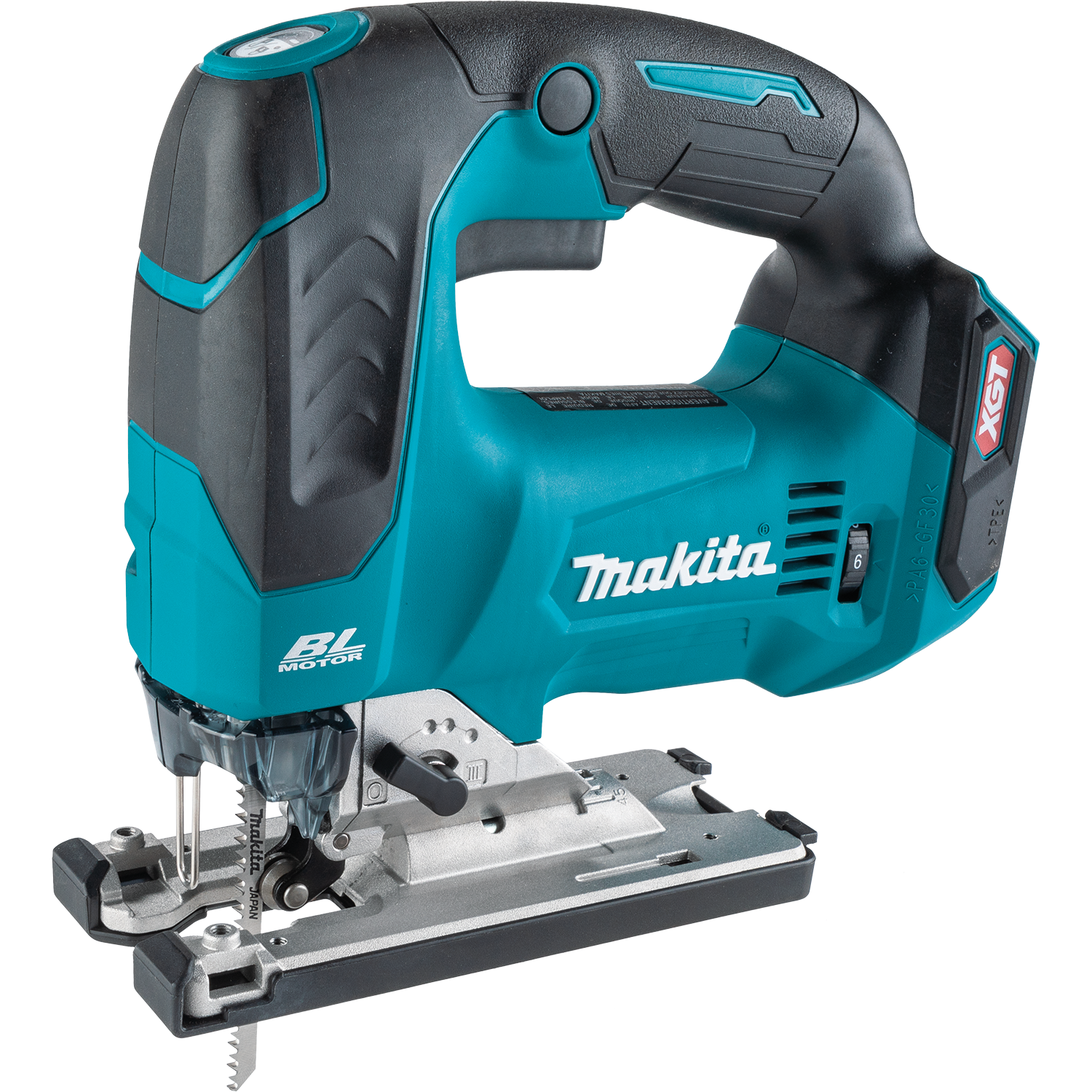
Explore this need in the finder →Assessment in brief: The GVJ02Z is Makita’s 40V max XGT brushless top-handle jigsaw. It is related to the barrel-grip GVJ01Z but is a distinct control layout: a large variable-speed trigger and lock-on button are paired with the speed dial. The U.S. page and model manual document a 1-inch stroke, up to 3,500 SPM, three orbital settings plus straight action, an integrated blower and 0–45-degree bevel adjustment. The exact tool-only package lists blades and a hex wrench, not a battery or charger.
Top handle, trigger and XGT battery
The D-shaped handle puts the hand above the motor, and the GVJ02 page describes a large two-finger variable-speed trigger with a lock-on button. The GVJ01Z uses a barrel grip and dual ambidextrous on/off buttons instead. Both are brushless XGT tools with a six-position speed dial, so the distinction is not “trigger versus no speed control”; it is how the saw is held and switched. A buyer who prefers a traditional top-handle format should compare this with the GVJ01 rather than assume a handle change is only cosmetic.
This is a 40V max XGT product, not an 18V LXT jigsaw. The manual names 36–40V max, battery examples including BL4020, BL4025 and BL4040/BL4040F, and specified charger families. Makita says the Z package is tool only; do not count on a battery or charger being in the box. The XGT platform is a reason to shortlist this model only if the buyer can support it, not a reason to cross-match it to an 18V LXT pack.
Modes, materials and blade interface
The manual lists a 1-inch stroke, 0–3,500 SPM, 5-5/16-inch wood capacity, 3/8-inch mild-steel capacity and 13/16-inch aluminum capacity. Its application chart maps straight action to plastics, mild or stainless steel and clean wood/plywood cuts; small orbit to hardwood, aluminum and mild steel; medium orbit to wood/plywood and faster aluminum or mild-steel cutting; and large orbit to faster wood/plywood cuts. Makita describes orbital action as pushing the blade forward on the cutting stroke to increase speed. Use the position that matches the material and the finish you need; these are manufacturer directions, not an independent test of accuracy or cut quality.
The page calls the shank “T” tang and lists two each of three named T-shank blade models. The GVJ02 manual specifies B-type blades only, and the parts breakdown lists an E-10687 jigsaw blade set. Those descriptions should not be collapsed into a generic claim that any T-shank blade fits. Verify the exact model-listed B-type blade and replacement stock before purchasing. The manual also recommends suitable cutting oil for metal cutting; the listed maximum capacity is not a guarantee of a clean edge with an arbitrary blade.
One useful dust-and-bevel detail
The integrated blower clears the line, while an optional dust nozzle is a separate route to a Makita vacuum. Here the GVJ02 manual goes further than a bare list of those two features: it says that when making a bevel cut with dust extraction, install the extraction nozzle on the side opposite the bevel; if it is on the same side, reinstall it on the opposite side. That supports a vacuum-plus-bevel arrangement with a specific setup requirement, not an unrestricted “vacuum works at every angle” guarantee. The manual also says the anti-splintering device cannot be used during bevel cuts.
This documented routing condition distinguishes the GVJ02 from models whose manuals list both an optional vacuum connection and a bevel base without confirming that the two can be combined. If that combination is your non-negotiable requirement, the opposite-side instruction matters. Check the accessory part, vacuum hose and the side of the bevel in the actual setup; dust capture is not a substitute for checking the tool’s instructions.
Package and source discrepancies
The exact U.S. page lists two each of three blades and a hex wrench; batteries and charger are excluded. The parts breakdown includes a dust-nozzle assembly among optional accessories, so do not assume vacuum extraction hardware is in the Z package. The product page’s marketing copy says 5.8 lb with a 2.5Ah battery, while its specifications list 6.1 lb; the manual gives 6.0–6.6 lb with battery. Overall length also differs: the page lists 8-3/4 inches while the manual states 10-3/4 inches with BL4025. These manufacturer figures conflict, so this assessment does not choose one, rank the saw by weight or length, or claim a measured value.
GVJ02Z is a reasonable comparison for an XGT owner who wants a top handle, trigger control, a built-in blower and a manual-backed vacuum/bevel setup. Compare it with the barrel-grip GVJ01Z if you favor closer-to-work grip and push-button switching. Before choosing, confirm the exact tool-only package, battery and charger platform, B-type blade compatibility, optional extraction pieces and seller’s actual box contents. This is a documentation-based assessment; it does not report a personal cut, runtime, vibration, accuracy, durability or ownership experience.
Key specifications
Key details at a glance
| Power source | Cordless |
|---|---|
| Battery platform | Makita 40V max XGT |
| Grip format | Top handle |
| Motor type | Brushless |
| Brushless motor | Yes |
| Blade interface | T shank |
| Cut-action settings | 0 / 1 / 2 / 3 |
| Maximum documented speed | 3500 SPM |
| Maximum documented bevel | 45° |
| Battery included | No |
| Charger included | No |
| Blade listed in package | Yes |
| Integrated cutline blower | Yes |
| Optional vacuum-extraction route documented | Yes |
| Stroke length | 1 in |
| Maximum listed cutting capacity | 5.31 in |
| Hard case listed in package | No |
Use the exact model’s instructions for operating limits, supplied equipment and version differences.
Sources for this review
Sources for this assessment
Make the next check about your project
Use the finder to combine material, blade interface, grip and operating setup. It matches documented capabilities, not guaranteed results.