
Your needs, this model
Does it fit your priorities?
Which orbital setting does Makita recommend for hardwood and plywood?
The manual chart puts hardwood in small-orbit position I, while wood and plywood appear at positions I, II and III for different action levels; position 0 is the straight option for clean wood/plywood cuts. Makita describes dial-speed ranges separately and says speed depends on material type and thickness. Treat the chart as a starting guide, choose the appropriate blade and verify the setup on scrap rather than treating the table as a cut-quality guarantee.
Explore this need in the finder →Does the JV0600K kit include a vacuum hose or dust nozzle?
No. The exact Makita USA included-items list names one B-10 blade, a hex wrench and the tool case; the separate manual describes a vacuum hose at the rear port and the US flyer lists the dust nozzle and hose as optional accessories. The built-in blower clears the cut line but is not dust collection. Check the exact hose, nozzle and shop-vac connection separately.
Explore this need in the finder →What blade shank does the exact JV0600K accept?
Makita USA's exact JV0600K page says T-shank (T tang) and lists the included blade as 792529-7-1. The manufacturer's US B-10 product page describes the matching 792529-7 blade as T-shank. Its linked JV0600 manual uses the term B type and says to use only those blades; check the actual blade marking and exact model instructions before using another blade standard.
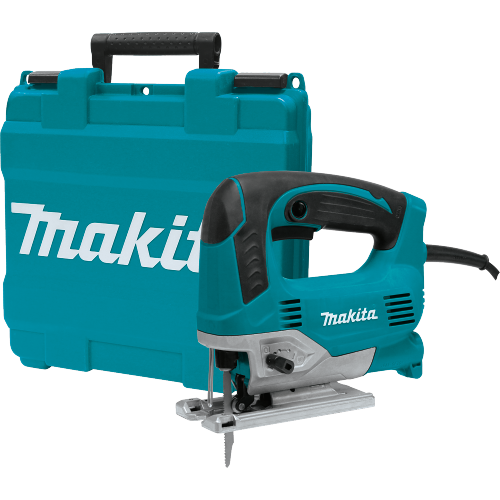
Explore this need in the finder →The Makita JV0600K is a corded, top-handle jigsaw sold as a kit with a case, blade and hex wrench. Its documented appeal is a familiar mix of trigger-and-dial speed control, three orbital choices plus straight action, and a route for attaching a vacuum. It is not a cordless platform buy, and the extraction hose or dust nozzle is not named in the exact kit contents. This is a source-based assessment; no independent cut, vibration, straightness or comfort test was performed.
Separate speed choice from orbital action
Makita’s US product page lists a 6.5-amp corded saw with a 500–3,100 SPM range, a variable-speed dial and a two-finger trigger. The instruction manual explains that the dial sets a speed ceiling and trigger pressure changes speed beneath it; a lock button enables continuous operation. That gives the operator two control inputs, but it does not establish how easy the saw is to hold on a particular line. The manual’s 7/8-inch stroke and the manufacturer’s 3-1/2-inch wood and 3/8-inch steel capacity figures are specifications, not promises for every blade, material or cut.
The action lever offers setting 0 for straight motion and I, II or III for small, medium or large orbit. Makita’s chart is usefully specific: 0 is recommended for clean cuts in wood and plywood, and for mild steel, stainless steel and plastics; I covers mild steel, aluminum and hardwood as well as wood and plywood; II covers wood and plywood and faster work in aluminum or mild steel; III is the faster wood-and-plywood option. These are the manufacturer’s starting recommendations, not an outcome guarantee. Its speed chart suggests dial ranges for wood, mild steel, stainless, aluminum and plastics, while warning that the appropriate speed depends on material type and thickness. Start from the manual, select a suitable blade, and verify the setup on scrap.
Check the blade naming before buying spares
The current Makita US page says the JV0600K uses “T” shank (tang-shank) blades. The exact included blade is listed as part 792529-7-1; Makita’s US B-10 blade page identifies the matching 792529-7 blade as T-shank. There is a naming wrinkle: the linked JV0600 instruction manual warns to use only “B type” blades. The tool, kit blade and current US parts description point to the intended fit, but if you already own a non-Makita blade or are ordering an alternate interface, check the marking and the exact manual rather than relying on “universal jigsaw blade” wording. T-shank and U-shank are not interchangeable assumptions.
Dust and bevel capability are different setups
A built-in blower clears debris from the cut line; it does not collect dust. Separately, Makita describes a through-the-body port for vacuum use, and the instruction manual says to connect a Makita vacuum hose at the rear of the tool. The US flyer lists the dust nozzle and hose as optional accessories. The exact JV0600K package list names only one blade, a hex wrench and the tool case, so do not assume dust hardware is in the box. Confirm the hose, nozzle and shop-vac connection you need before buying. The documentation does not establish that an extraction attachment can remain installed through every bevel arrangement.
The base can be tilted from 0 to 45 degrees in either direction. Unlike a quick-release shoe, the manual describes loosening a rear bolt with the included hex wrench, setting the angle and tightening the bolt again. That is a useful adjustment range, but shoppers who frequently change bevels should decide whether this tool-and-wrench procedure suits their work. Do not treat a case photo or general retailer description as evidence of an angle stop or a quick bevel lever.
How it compares on paper
The Bosch JS470E is another corded, top-handle, T-shank saw with trigger-and-dial control; Bosch lists a 7-amp motor and its manual describes four action positions. The Makita’s package page is clearer about the included case and B-10 blade, while its own cut-action guide and optional vacuum parts have to be checked separately. These are documentary differences, not a head-to-head test. The earlier DEWALT DW317K review also covers a corded top-handle option, but DEWALT’s checked sources do not identify that model’s blade-shank standard, so no blade interchangeability is implied here.
The JV0600K is worth considering when a mains-powered top handle, a speed dial, documented orbital choices and a case-included kit match the job. It is a weaker fit if cordless use is essential, an external dust setup must arrive in the box, or quick tool-free bevel changes are a priority. Confirm the full JV0600K suffix, the included B-10 blade, exact voltage/version, and any separately needed vacuum pieces with the seller. Makita’s JV0600K product page, instruction manual, US flyer and B-10 blade page provide the useful pre-purchase checks.
Key specifications
Key details at a glance
| Power source | Corded mains power |
|---|---|
| Grip format | Top handle |
| Motor type | Brushed |
| Brushless motor | No |
| Blade interface | T shank |
| Cut-action settings | 0 / 1 / 2 / 3 |
| Maximum documented speed | 3100 SPM |
| Maximum documented bevel | 45° |
| Battery included | No |
| Charger included | No |
| Blade listed in package | Yes |
| Integrated cutline blower | Yes |
| Optional vacuum-extraction route documented | Yes |
| Rated motor current | 6.5 A |
| Stroke length | 0.88 in |
| Hard case listed in package | Yes |
Use the exact model’s instructions for operating limits, supplied equipment and version differences.
Sources for this review
Sources for this assessment
Make the next check about your project
Use the finder to combine material, blade interface, grip and operating setup. It matches documented capabilities, not guaranteed results.