
Your needs, this model
Does it fit your priorities?
What comes with the Makita VJ04R1 kit, and how does VJ04Z differ?
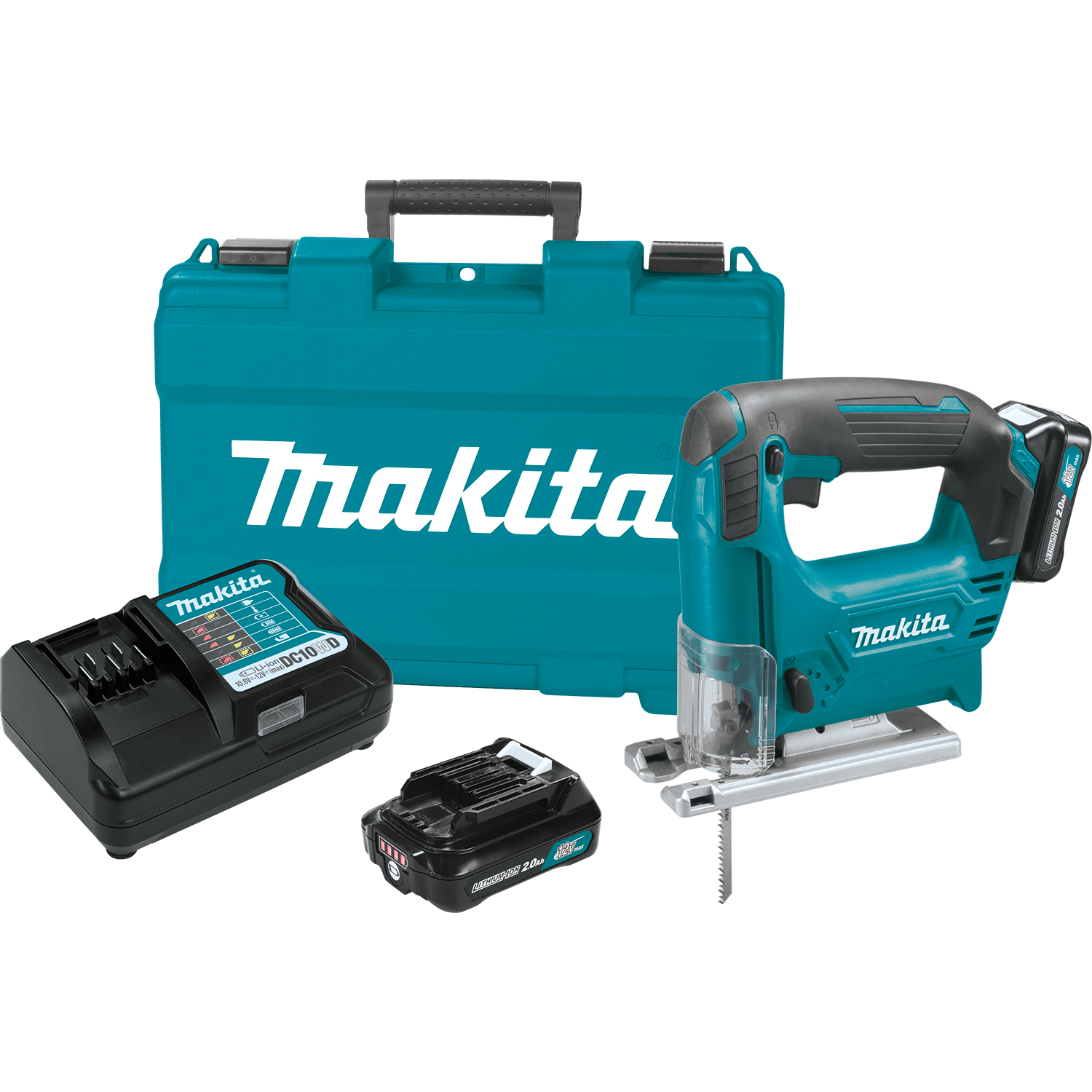
Makita’s 2016 VJ04R1 flyer lists two BL1021B 2.0Ah batteries, a DC10WD charger, one blade and case 821691-2. The exact VJ04Z page identifies the same VJ04 saw as a tool-only option with battery and charger sold separately. The flyer and parts list disagree on the blade reference, so check the particular package and exact blade marking.
Explore this need in the finder →Can VJ04 use a vacuum while bevel cutting?
No. The VJ04 manual says dust extraction cannot be performed during bevel cuts. It documents a rear-port vacuum hose as an optional accessory and separately shows base beveling from 0–45 degrees left or right. Choose one arrangement at a time and check the hose fit.
Explore this need in the finder →Which blade should I buy for VJ04?
The manual cautions to use B-type blades only. The older VJ04 flyer calls the interface T tang; it lists blade 723053-9, whereas the parts list identifies B-10 US blade 792529-7 as standard equipment. Verify the exact VJ04-approved blade rather than assuming every generic T-shank blade fits.
Explore this need in the finder →This is a source-based assessment of the discontinued Makita VJ04R1, not a hands-on review. Its useful identity is quite specific: an older 12V max CXT top-handle kit with a relatively short 11/16-inch stroke, a variable trigger up to 2,900 strokes per minute, and a manual whose blade-action chart is more important than any broad “cuts anything” claim. Makita’s exact US VJ04R1 page marks it discontinued, so this is a comparison reference rather than a claim of current stock or future support.
VJ04R1 is a kit, not the bare-tool suffix
The exact model is a cordless 12V max CXT saw. Makita’s 2016 flyer lists two BL1021B 2.0Ah batteries, a DC10WD charger, one blade and a carrying case for VJ04R1; its separate VJ04Z page identifies the discontinued bare-tool version. The shared VJ04 manual and parts list support treating VJ04Z as a package-only variant of the same saw, not another cutting mechanism. The flyer gives case 821691-2. It also lists blade 723053-9, while the model parts breakdown lists a B-10 US blade, 792529-7, as standard equipment. Because those official package references differ, verify the exact blade and contents if assessing a particular used or remaining-stock offer.
VJ04 is distinct from the later VJ05Z: VJ04 is top-handle and its exact sources do not establish a brushless motor; VJ05Z is a brushless barrel-grip model in the same CXT family. The shared battery label does not make their body, control or package details interchangeable.
Small published capacity, simple variable-trigger control
The VJ04 manual specifies an 11/16-inch stroke and 0–2,900 SPM. Speed varies with trigger pressure; the documentation does not describe the five-position speed dial found on some newer cordless models. Makita lists 2-9/16 inches of wood, 1/16 inch of mild steel and 5/32 inch of aluminum at 90 degrees. The manual’s battery-dependent length is 9-1/8 inches with BL1016 or BL1021B and 9-7/8 inches with BL1041B; listed weight ranges from 3.8 to 4.2 pounds with battery. These are manufacturer figures, not measured cut results or evidence about a specific blade or board.
The manual’s action lever has four marked positions: 0 for straight up-and-down movement, then I, II and III for progressively larger orbital action. Makita assigns straight action to mild and stainless steel, plastics, and clean wood or plywood. Small orbit is listed for mild steel, aluminum and hardwood; medium orbit for wood and plywood and for faster aluminum or mild-steel cuts; large orbit for faster wood and plywood. The chart is practical guidance, not a guarantee of speed or finish. Match the blade to the material, secure the stock and check the manual before choosing a setting.
Blade terminology deserves a deliberate check. The VJ04 manual says to use B-type blades only, while the older flyer labels the interface “T” tang and its kit blade number differs from the shared parts list’s B-10 listing. That evidence supports neither a universal fit claim nor the assumption that every blade labeled T-shank is appropriate. Confirm the exact blade marking and VJ04 instructions before buying replacements.
Blower, vacuum and bevel are not one interchangeable setup
The VJ04 flyer describes a built-in blower for clearing the line of cut and a separate dust port for a vacuum. Its manual describes an optional hose connected at the rear of the tool. Those are different dust routes: the blower helps uncover the cut line; a connected vacuum is the documented collection arrangement, and the kit list does not include the hose. The cast-aluminum base can be tilted from 0 to 45 degrees left or right, with a hex wrench, and the cover must be raised for bevel cuts. The manual explicitly says dust extraction cannot be performed while bevel cutting. Accordingly, the same vacuum arrangement should not be selected for a bevel requirement. The manual also cautions that the anti-splinter device cannot be used on bevel cuts.
Who might still compare it?
VJ04R1 may make sense as a carefully identified earlier-model comparison for a shopper who already owns compatible 12V max CXT packs, wants a top handle, accepts the manual’s modest listed capacities, and values a kit whose older flyer includes two batteries, a charger and case. It is not a reason to buy an unverified used package: the saw is discontinued, seller condition and remaining accessories can vary, and no current price or availability is established here. Its smaller capacities distinguish it from VJ06R1J, whose manual lists a longer stroke and substantially greater wood and metal capacity, as well as a brushless motor and tool-less blade change.
Before considering a VJ04 listing, verify the exact R1 kit versus Z tool-only suffix, the condition and identity of each CXT battery, charger and case, the blade interface and supplied blade, the vacuum hose fit, and the seller’s return and warranty terms. Read the model-specific manual rather than inferring capabilities from a neighboring Makita jigsaw.
Limits of this assessment: no ownership, cutting test, runtime test, durability evaluation, noise measurement or personal experience is claimed. Specifications and operating guidance above come from Makita’s exact product page, VJ04 manual, parts breakdown and 2016 flyer.
Key specifications
Key details at a glance
| Power source | Cordless |
|---|---|
| Battery platform | Makita 12V max CXT |
| Grip format | Top handle |
| Blade interface | T shank |
| Cut-action settings | 0 / 1 / 2 / 3 |
| Maximum documented speed | 2900 SPM |
| Maximum documented bevel | 45° |
| Battery included | Yes |
| Charger included | Yes |
| Blade listed in package | Yes |
| Integrated cutline blower | Yes |
| Optional vacuum-extraction route documented | Yes |
| Stroke length | 0.69 in |
| Hard case listed in package | Yes |
Use the exact model’s instructions for operating limits, supplied equipment and version differences.
Sources for this review
Sources for this assessment
Make the next check about your project
Use the finder to combine material, blade interface, grip and operating setup. It matches documented capabilities, not guaranteed results.