
Your needs, this model
Does it fit your priorities?
What does the VJ05Z tool-only package include, and what does VJ05R1J add?
Makita's VJ05Z page says battery and charger are not included. Its shared parts breakdown marks a B-10 US blade, hex wrench and cover plate as standard equipment. The VJ05R1J kit page lists two 2.0Ah BL1021B batteries, a DC10WD charger, a jigsaw blade and a tool case. The 2017 flyer and parts list differ on the case number, so verify the exact offer contents.
Explore this need in the finder →Which replacement blade interface should I buy for VJ05Z?
Makita's exact US page calls the interface T tang and its shared parts list identifies an included B-10 US blade, while the VJ05 manual says to use B-type blades only. Confirm the exact blade is marked for the VJ05 before buying; do not assume every blade sold as T-shank is approved.
Explore this need in the finder →Can I use a vacuum and bevel at the same time on VJ05Z?
The manual supports a Makita vacuum connected through an optional dust nozzle and separately documents bevels from 0–45 degrees left or right. It does not establish that vacuum extraction remains compatible while beveling. The exact VJ05Z page describes a built-in cutline blower, so do not treat the optional nozzle as included or assume the two dust setups are interchangeable.
Explore this need in the finder →This is a source-based assessment of Makita’s VJ05Z, not a hands-on test. The useful question is less “how powerful is 12V?” than whether its 12V max CXT battery family, barrel grip, cut-action chart and exact blade instructions suit the work you actually do.
VJ05Z is the 12V CXT bare tool
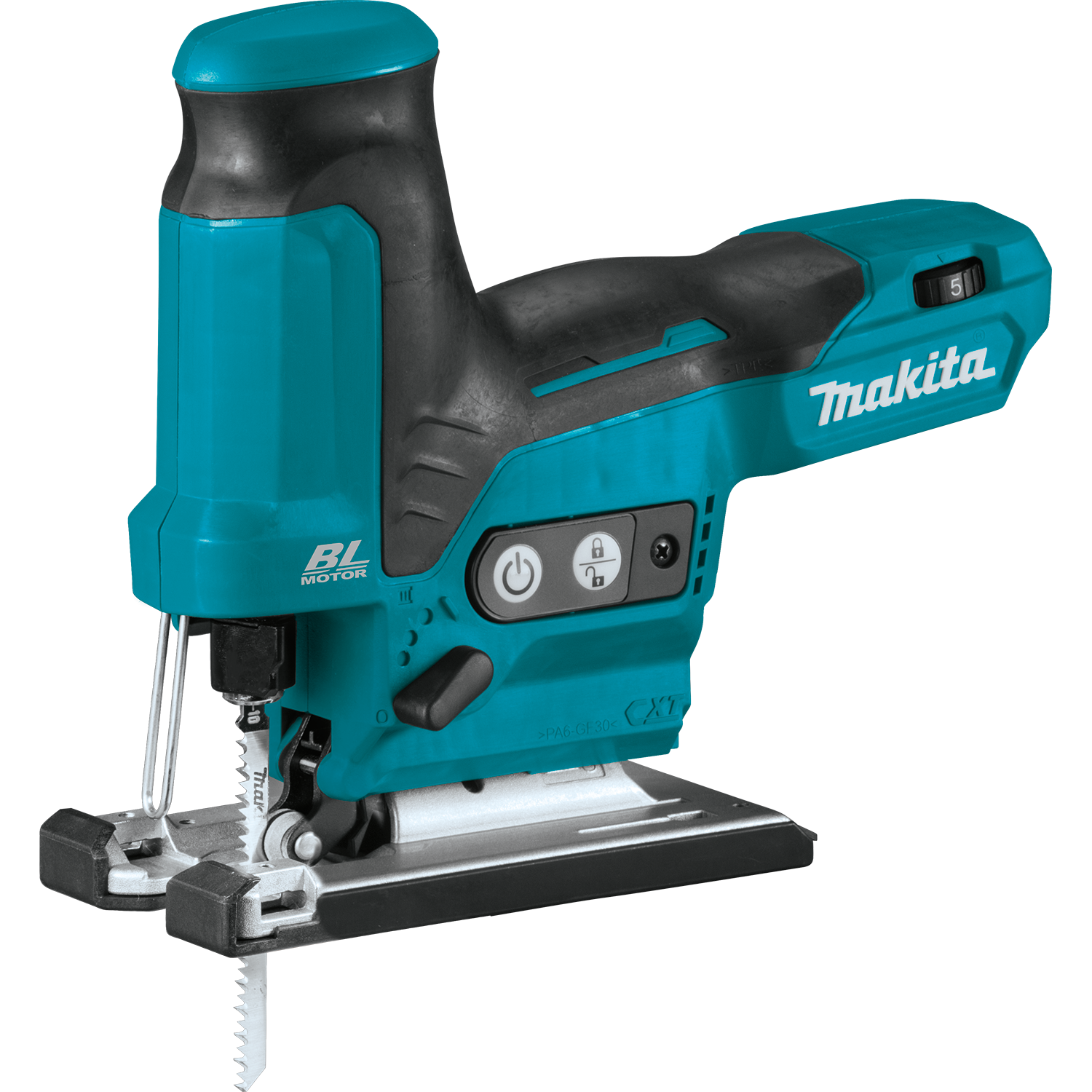
Makita identifies VJ05Z as a brushless, cordless barrel-grip jigsaw for the 12V max CXT slide-style battery system. It is a tool-only package: Makita says the battery and charger are not included. Its model page separately links to VJ05R1J, the kit version, and that kit page identifies the saw inside as VJ05Z. In other words, the suffix changes what arrives in the box, not the saw’s operating platform or grip.
The VJ05R1J listing names two 2.0Ah BL1021B batteries, a DC10WD charger, one jigsaw blade and a tool case. The 2017 kit flyer identifies the case as 821549-5, while the shared parts list uses a different case-related part number; Makita’s current kit page simply says “tool case.” Treat the case number as unresolved and verify the exact contents of the offer. Don’t confuse the CXT VJ05Z with the separately listed XVJ05Z: that different model has an initial “X” and belongs to Makita’s 18V LXT line.
Choose blade action from the material chart
The 7/8-inch stroke and five-position dial cover a published 800–3,000 strokes per minute range. The manual describes four action positions: 0 is straight, while I, II and III add progressively larger orbital motion. Makita’s chart places mild steel, stainless steel, plastics and cleaner wood or plywood cuts at straight action; small orbit is listed for hardwood, aluminum and mild steel; medium orbit for wood and plywood and for faster aluminum or mild-steel cuts; and large orbit for faster wood or plywood cutting. These are manufacturer setup directions, not promises about edge quality, speed on a particular board or blade life.
Makita’s page copy is inconsistent about the switch: one passage mentions a variable-speed trigger with lock-on, while the VJ05 manual describes a lock/unlock button, standby and a separate start/stop button; the dial selects speed. For operation, use the model-specific manual sequence rather than assuming a variable trigger controls the speed.
The manual’s separate starting-speed table suggests dial positions 4–5 for wood, 3–5 for mild steel and aluminum, 3–4 for stainless steel, and 1–4 for plastics. It also warns that higher speed may cut faster but shorten blade life, and that the right setting varies with the material and thickness. The page advertises soft start and a no-load speed reduction for starting cuts; the manual explains that soft no-load function operates when the dial is set at 2 or higher. Secure the stock, choose a material-appropriate blade, follow the manual, and check the setup on scrap rather than treating a dial number as a measured result.
Check the blade and dust setup before buying
There is a nomenclature wrinkle worth taking seriously. Makita’s US product page calls the blade interface “T” tang, and the shared parts breakdown lists a B-10 US blade as standard equipment. The VJ05 manual, however, says to use only B-type blades. That supports the supplied model-specific B-10 blade; it is not a license to assume every blade sold as T-shank fits. Confirm the exact blade marking and VJ05 instructions before buying replacements. The parts breakdown also lists a hex wrench and cover plate as standard equipment; the bare-tool label means the battery and charger are absent, not that the product is a cordless kit.
Makita describes a built-in blower that clears the cut line. The manual also documents an optional dust nozzle connected to a Makita vacuum; it does not appear in the bare-tool package list. Keep those routes separate when deciding what to buy: confirm the nozzle, hose and extractor fit, and don’t assume that vacuum capture remains compatible while beveling. The base does bevel from 0–45 degrees left or right, adjusted with a hex wrench. The manual says the anti-splintering device cannot be used for bevel cuts.
Who should compare it—and what to verify
VJ05Z is a plausible research shortlist candidate for someone already using Makita’s 12V max CXT slide-style system who wants a compact barrel-grip layout and documented orbital choices. The manual lists 3-1/2 inches of wood capacity, 3/8 inch in mild steel and 13/16 inch in aluminum at 90 degrees; those are manufacturer limits, not a guarantee that every blade or workpiece can be cut cleanly. Manual weight varies from 3.9 to 4.2 pounds with the listed battery cartridges, so the lighter product-page figure is not a bare-tool weight.
If you already own Makita 18V LXT packs, the leading “X” in XVJ05Z marks a different model and battery platform; this assessment does not establish those packs as compatible with VJ05Z. Before ordering, check the exact VJ05Z versus VJ05R1J suffix, included battery and charger, B-type blade marking, dust attachment needs, case contents and seller terms. Makita’s product page and manual explain the intended features, but neither establishes your personal cut quality or a current offer’s condition.
Key specifications
Key details at a glance
| Power source | Cordless |
|---|---|
| Battery platform | Makita 12V max CXT |
| Grip format | Barrel grip |
| Motor type | Brushless |
| Brushless motor | Yes |
| Blade interface | T shank |
| Cut-action settings | 0 / 1 / 2 / 3 |
| Maximum documented speed | 3000 SPM |
| Maximum documented bevel | 45° |
| Battery included | No |
| Charger included | No |
| Blade listed in package | Yes |
| Integrated cutline blower | Yes |
| Optional vacuum-extraction route documented | Yes |
| Stroke length | 0.88 in |
| Hard case listed in package | No |
Use the exact model’s instructions for operating limits, supplied equipment and version differences.
Sources for this review
Sources for this assessment
- Makita USA VJ05Z product page
- Makita USA VJ05R1J kit product page
- Makita VJ05 instruction manual
- Makita VJ05R1J/Z parts breakdown
- Makita VJ05R1J new-tool flyer
- Makita USA B-10 / 792529-7 jig-saw blade page
- CPSC bounded exact-name recall query: VJ05Z
- CPSC bounded exact-name recall query: VJ05R1J
- Makita USA XVJ05Z product page (distinct 18V LXT model name)
Make the next check about your project
Use the finder to combine material, blade interface, grip and operating setup. It matches documented capabilities, not guaranteed results.