
Your needs, this model
Does it fit your priorities?
Is XVJ01Z an 18V LXT or a 12V CXT saw?
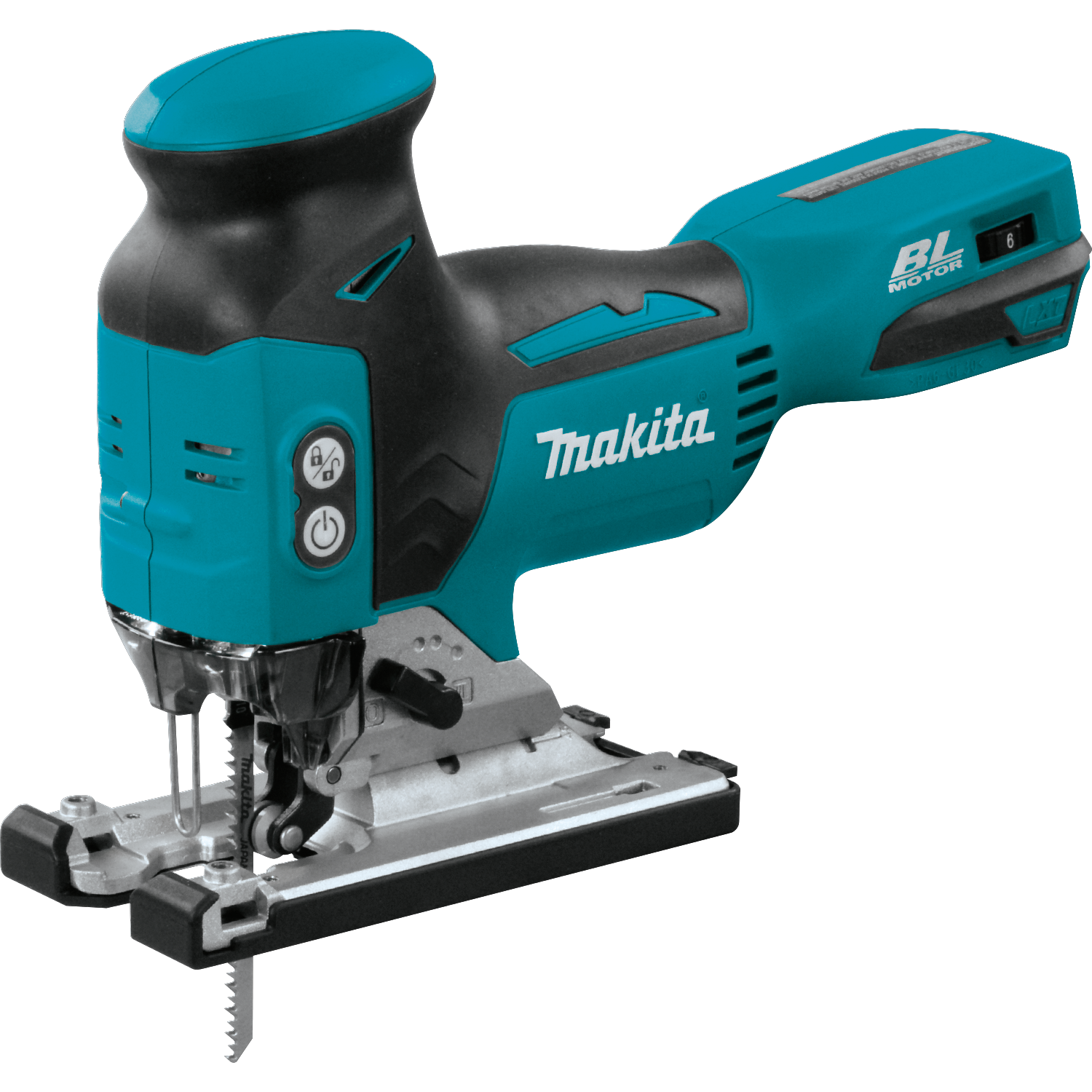
Makita identifies XVJ01Z as an 18V LXT brushless barrel-grip model. Its manual lists LXT packs; it is not the similarly named 12V CXT VJ05Z. Check the exact model prefix and your battery platform.
Explore this need in the finder →Which action does Makita recommend for hardwood?
The XVJ01 manual lists small orbital action for hardwood. It separately places clean wood/plywood cuts in straight action and faster wood/plywood cuts in larger orbital positions. Choose a suitable blade and use the chart as manufacturer guidance, not a finish guarantee.
Explore this need in the finder →Does the built-in blower collect dust?
No. The product page describes a built-in blower to clear the cutline; the manual separately documents an optional dust nozzle connected to a vacuum. The manual does not confirm vacuum extraction while beveling, and the anti-splintering device cannot be used on bevel cuts.
Explore this need in the finder →Assessment in brief: The XVJ01Z is an 18V LXT brushless barrel-grip jigsaw sold as a tool-only package. Makita documents a 1-inch stroke, a six-position speed dial covering 800–3,500 strokes per minute, three orbital settings plus straight action, a built-in cutline blower and a base that tilts up to 45 degrees in either direction. Its strongest documented case is for a buyer who wants the closer-to-work grip and already has a compatible LXT battery. The manual’s material chart and the blade terminology deserve more attention than the headline features.
What the XVJ01Z is—and is not
This is the barrel-grip member of Makita’s current LXT jigsaw pair in the manufacturer’s U.S. catalog. It is not the XVJ04Z, which has a D-shaped top handle, a shorter 7/8-inch stroke and a lower 0–3,000 SPM range. Nor is it the 12V CXT VJ05Z: the leading X in XVJ01Z identifies an 18V LXT platform. Those differences affect grip, battery compatibility and operating feel; they are not suffix trivia.
The exact XVJ01Z page describes the package as tool only and says the battery and charger are not included. It lists an anti-splinter insert, cover plate, hex wrench and one jigsaw blade. The older parts breakdown itemizes blade references B-22, B-10 US and BR13 in its accessory list, while the later flyer calls the included item only a “Jig Saw Blade.” That is not enough to promise that a particular listing still has every pictured or originally supplied accessory, especially if it is used or open-box.
Read the cut-action chart before choosing a blade
The action lever offers straight cutting and three orbital positions. Makita’s manual says orbital motion pushes the blade forward on the cutting stroke to increase cutting speed. Its application chart is more useful than treating the dial as a simple “more is better” control: straight action is the documented choice for plastics, mild or stainless steel, and clean cuts in wood or plywood; small orbit is listed for hardwood, aluminum and mild steel; medium orbit is listed for wood and plywood and for faster aluminum or mild-steel cutting; large orbit is for faster cuts in wood and plywood. This is manufacturer guidance, not a promise of edge quality or a report of a cut test.
For a visible or delicate edge, the chart points toward straight action rather than the faster, more aggressive orbit settings. For hardwood or metal, Makita names a particular orbital position, but the suitable blade, speed and work support still matter. The manual says to use an appropriate coolant when cutting metal; it does not turn the saw’s listed capacity into a guarantee that any blade will cut to that depth cleanly.
The exact product page calls the interface “T” tang. The XVJ01 parts sheet names several B-series blade SKUs, and the product flyer describes separately sold T-shank blades. The instruction manual does not give the same blade-type specification found in some other Makita manuals. Treat the manufacturer’s model-specific blade references as the useful compatibility check; do not infer that every generic T-shank blade or accessory is suitable.
Dust, bevels and the battery platform
A built-in blower moves debris away from the line of cut, but it is not dust collection. Makita separately documents an optional dust nozzle that connects to a vacuum. The manual also allows a 0–45-degree bevel, while warning that the anti-splintering device cannot be used during bevel cuts. It does not explicitly establish whether vacuum extraction and bevel cutting work together in the same setup, so this assessment does not count that combination as confirmed. If vacuum capture is essential, verify the exact nozzle and hose arrangement and keep the bevel question open.
The XVJ01Z uses Makita 18V LXT slide batteries; the manual lists specific LXT battery and charger families and cautions against unlisted packs or chargers. A “tool only” purchase can make sense for an existing LXT owner, but a buyer starting from scratch must account for battery and charger separately. The manual gives a 5.0–5.7 lb battery-equipped range; the product page and flyer quote 5.5 lb with a battery. Those are manufacturer figures, not an independent weighing, and do not establish how a particular battery changes balance in the hand.
Where it fits in a shortlist
Compare the XVJ01Z with the top-handle XVJ04Z if you are choosing within Makita’s LXT line: the first trades the traditional handle shape for barrel-grip control and offers a 1-inch stroke and higher published speed range; the second is more compact on paper and has a top handle, trigger and speed dial. Compare it with the XVJ05Z only after checking the manual-backed settings and package; that is another barrel-grip LXT saw but a separate model, with its own speed range and blade documentation.
The XVJ01Z may suit someone who values a barrel grip, has an appropriate LXT battery and can use the manual’s action chart to choose settings by material. It is a poorer fit if the purchase must include batteries, if a confirmed vacuum-plus-bevel arrangement is essential, or if the buyer needs generic blade interchangeability without checking the model’s listed blade family. Before ordering, confirm the exact XVJ01Z code, included accessories, compatible battery, blade markings, seller package and return terms. This assessment reports no ownership, hands-on use, measured performance, runtime, durability or customer experience; it analyzes Makita’s product page, manual, parts breakdown and flyer.
Use the exact model’s instructions for operating limits, supplied equipment and version differences.Key specifications
Key details at a glance
Power source Cordless Battery platform Makita 18V LXT Grip format Barrel grip Motor type Brushless Brushless motor Yes Blade interface T shank Cut-action settings 0 / 1 / 2 / 3 Maximum documented speed 3500 SPM Maximum documented bevel 45° Battery included No Charger included No Blade listed in package Yes Integrated cutline blower Yes Optional vacuum-extraction route documented Yes Stroke length 1 in Maximum listed cutting capacity 5.31 in Hard case listed in package No
Make the next check about your project
Use the finder to combine material, blade interface, grip and operating setup. It matches documented capabilities, not guaranteed results.