
Your needs, this model
Does it fit your priorities?
What orbital guidance does Makita publish for the XVJ02Z?
The XVJ02 manual lists position 0 as straight for clean wood/plywood and mild steel, stainless steel and plastics. Its chart assigns hardwood, aluminum and mild steel to small-orbit I; wood/plywood and faster aluminum/mild steel work to II; and faster wood/plywood cutting to III. Treat the chart as a starting point, use a suitable blade and confirm your actual setup on secured scrap.
Explore this need in the finder →Does XVJ02Z include a vacuum hose or dust nozzle?
No separate vacuum nozzle or hose appears on the exact XVJ02Z tool-only package list. The manual describes optional nozzle-and-vacuum use, while the product’s integrated blower clears the cutline rather than collecting dust. Verify the accessory, hose fit and vacuum before relying on external extraction.
Explore this need in the finder →What is included with XVJ02Z and which batteries fit it?
The exact US SKU is tool only: Makita says the battery and charger are not included, and its flyer/catalog list a jigsaw blade as standard equipment. It belongs to the Makita 18V LXT platform; do not assume 12V CXT or 40V XGT battery fit. Confirm the exact XVJ02Z suffix and included blade with the seller.
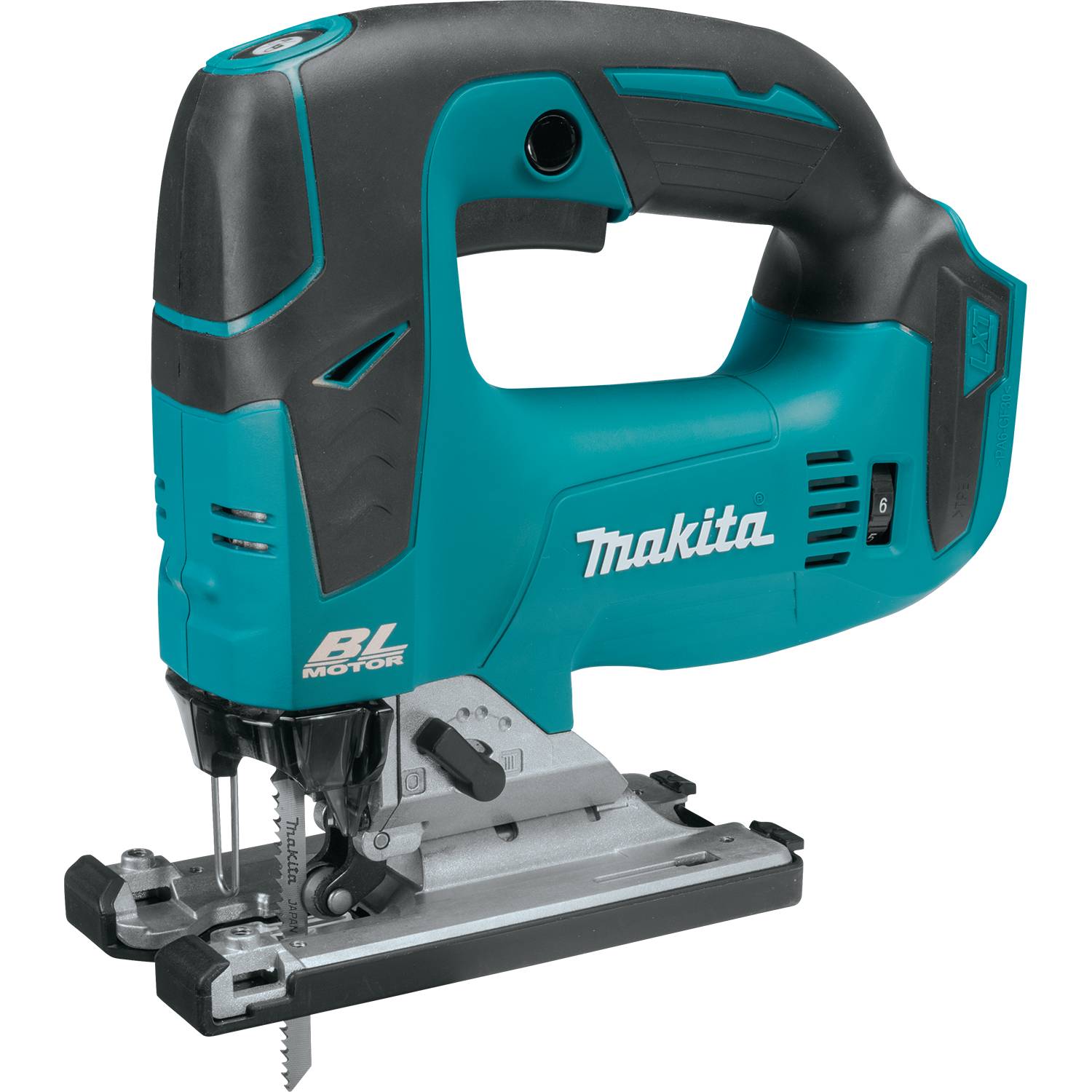
Explore this need in the finder →The Makita XVJ02Z is a current-reference 18V LXT brushless top-handle jigsaw sold as a tool-only configuration. Its strongest documented distinctions from the older brushed XVJ03 are a six-position speed dial, a 800–3,500 SPM range, a no-load speed-reduction feature, two work lights and an integrated cutline blower. It remains a bare tool: the exact US page does not include a battery or charger. This review is based on manufacturer documents, not a hands-on cut, runtime, vibration or comfort test.
A better-defined control set, not a tested cut-quality claim
Makita’s exact US XVJ02Z page identifies a brushless 18V LXT saw, tool only. The product page specifies a 1-inch stroke, 800–3,500 strokes per minute, six speed-control settings, a trigger, and a feature that lowers speed when the tool is not cutting. It also lists an electric brake, lock-on button and dual LED lights. Those controls distinguish the XVJ02Z from the older XVJ03, whose manual describes trigger control from 0–2,600 SPM without a separate speed dial. The distinction matters for shoppers who want a selectable speed ceiling and more documented speed range; it does not prove smoother cuts or longer battery life in a particular project.
The manufacturer says the brushless design can deliver “up to 50% longer runtime” than similar non-brushless models. That is a Makita comparison claim, not an independent measurement here; actual runtime depends on battery, material, blade, settings and load. The exact listing gives capacities of 5-5/16 inches in wood, 3/8 inch in mild steel and 25/32 inch in aluminum, plus a 5.8-pound weight with battery and 10-1/2-inch overall length. These are published specifications. The needed battery pack is not included in this XVJ02Z tool-only package, so do not treat the stated with-battery weight as a bare-tool weight.
Use the action chart as a setup guide
The action selector has position 0 for straight motion and three orbital settings, I through III. Makita’s manual recommends straight position 0 for clean wood or plywood cuts and for mild steel, stainless steel and plastics. It identifies small orbit I for hardwood, aluminum and mild steel; medium orbit II for wood and plywood and faster aluminum or mild steel cutting; and large orbit III for faster work in wood and plywood. This is a material-specific chart, not a blanket assertion that orbital motion suits every cut. Choose an appropriate blade and treat the chart as a starting point, then verify your intended setup on scrap with the work secured.
The manual describes a T-type blade interface, while Makita’s current product page and XVJ02Z flyer use T-shank/T-tang terminology. The flyer’s standard-equipment line lists a jigsaw blade with the tool-only configuration. The accessible product image and exact SKU describe the XVJ02Z, but the package should still be checked at the point of sale for the precise blade and contents. If replacing or stocking blades, compare the saw’s model-specific instructions with the shank marking; a blade’s advertised cut material does not establish interface fit.
Blower, vacuum and bevel are separate considerations
The XVJ02Z has an integrated blower to clear the cut line; that is not dust extraction. Makita’s manual separately describes an optional dust nozzle and connection to a vacuum. The exact tool-only page does not list the nozzle or vacuum hose as included, so a user who wants captured dust should verify the accessory number, hose fit and vacuum connection separately. The distinction matters for indoor work: a blower can move chips away from a line without collecting airborne dust.
The base tilts to 45 degrees left or right. The manual describes loosening and tightening the base bolt with a hex wrench to set a bevel; the product page’s bevel range should not be mistaken for a quick-release adjustment. The anti-splinter device is not for bevel cuts. The manual does not establish that an attached extraction accessory can remain connected in every bevel arrangement, so this assessment treats external-vacuum beveling as unconfirmed. The built-in blower and bevel features are documented together as a normal setup, but actual debris clearing still depends on material, blade and cut geometry.
Tool-only platform fit and the XVJ02Z’s limits
The XVJ02Z is a sensible shortlist candidate on paper when a buyer already has compatible Makita 18V LXT batteries and wants a top-handle brushless tool with both straight and orbital action. Its exact suffix is important: “Z” denotes the tool-only package in this US listing, so a new LXT owner needs to price a compatible battery and charger separately and check what the seller actually ships. Do not assume compatibility with Makita’s 12V CXT or 40V XGT packs. Makita’s product page specifies a T-shank interface; shoppers with a required U-shank blade inventory should not assume it will accept those blades.
Compared with XVJ03, the XVJ02Z adds brushless drive, speed dial settings, no-load speed reduction, dual LEDs and a blower in Makita’s published feature list. The XVJ03 is discontinued and can appear as a kit with batteries and charger, so this is not a direct package comparison. Compare the exact suffix and included accessories as well as the tool feature set. The sources used here are Makita’s XVJ02Z product page, its linked XVJ02 instruction manual, the XVJ02Z flyer and the linked parts breakdown. Verify the exact tool-only contents, battery platform and accessories before purchase.
Key specifications
Key details at a glance
| Power source | Cordless |
|---|---|
| Battery platform | Makita 18V LXT |
| Grip format | Top handle |
| Motor type | Brushless |
| Brushless motor | Yes |
| Blade interface | T shank |
| Cut-action settings | 0 / 1 / 2 / 3 |
| Maximum documented speed | 3500 SPM |
| Maximum documented bevel | 45° |
| Battery included | No |
| Charger included | No |
| Blade listed in package | Yes |
| Integrated cutline blower | Yes |
| Optional vacuum-extraction route documented | Yes |
| Stroke length | 1 in |
| Hard case listed in package | No |
Use the exact model’s instructions for operating limits, supplied equipment and version differences.
Sources for this review
Sources for this assessment
- Makita USA XVJ02Z exact US product page
- Makita XVJ02 instruction manual linked from the exact XVJ02Z US page
- Makita XVJ02Z English product flyer / technical file
- Makita XVJ02Z parts breakdown linked from the exact US page
- Makita U.S.A. 2016/2017 general catalog, XVJ02Z entry (page 17 capture)
- Makita USA B-10 792529-7 T-shank blade page
- CPSC bounded exact-name query for Makita XVJ02Z
Make the next check about your project
Use the finder to combine material, blade interface, grip and operating setup. It matches documented capabilities, not guaranteed results.