
Your needs, this model
Does it fit your priorities?
Does the XVJ04Z kit include a battery or charger?
No. Makita labels the exact XVJ04Z offer tool only and says the battery and charger are sold separately. The product page lists B-50, B-51 and B-52 blades; check that a particular seller’s box retains them.
Explore this need in the finder →Which blade type does the XVJ04 manual allow?
The manual says to use B-type jig-saw blades only. The product page and flyer also use “T” tang wording and name B-50, B-51 and B-52 T-shank blades. Verify the exact model-compatible blade marking instead of treating every T-shank blade as interchangeable.
Explore this need in the finder →Can the XVJ04Z vacuum setup be used while beveling?
Makita documents an optional vacuum nozzle and a 0–45-degree base, but the manual does not establish their coexistence. The anti-splintering device cannot be used in a bevel cut. Treat vacuum-plus-bevel compatibility as unconfirmed.
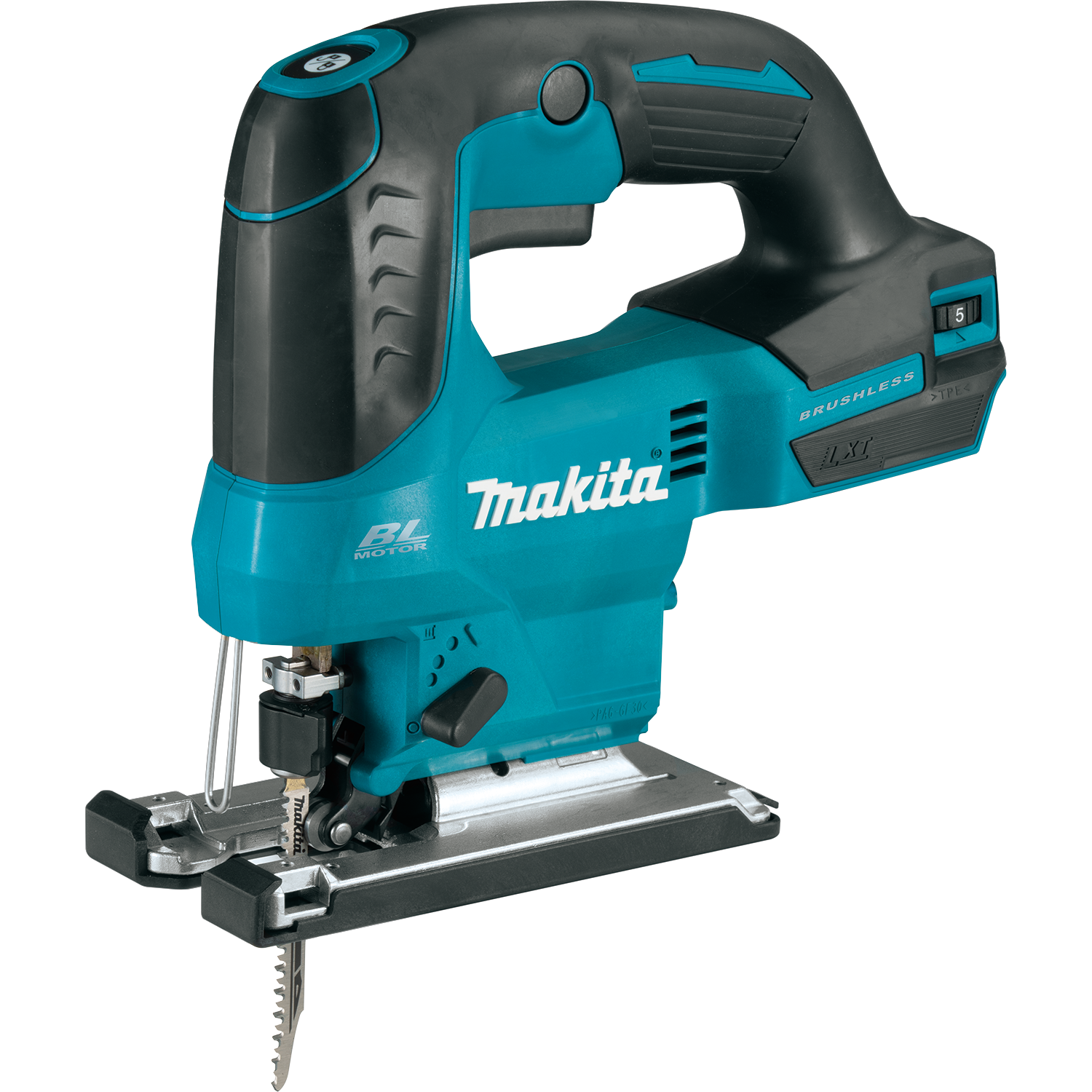
Explore this need in the finder →Assessment in brief: The XVJ04Z is Makita’s compact 18V LXT brushless top-handle jigsaw in this group. Its U.S. product page lists a 7/8-inch stroke, a 0–3,000 SPM range, three orbital settings plus straight action, a variable-speed trigger, speed dial, soft no-load start, built-in blower and 0–45-degree bevel base. It is a tool-only package. The meaningful comparison is not simply “smaller versus larger”: it is a D-handle saw with a different control layout and operating range from the barrel-grip XVJ01Z.
Compact top-handle format
Makita calls the XVJ04Z its compact, lightweight LXT D-handle jig saw. The manufacturer lists 3.8 lb as tool-only weight and 5.2 lb with an 18V 5.0Ah battery; the manual gives a battery-equipped range of 4.6–5.3 lb. Those numbers describe different configurations and published sources rather than a local measurement. They can help frame a comparison, but they do not tell you how this grip will feel during a particular cut.
The model shares Makita’s 18V LXT battery platform with the XVJ01Z, but the grip and mechanics differ. XVJ04Z has a 7/8-inch stroke and tops out at 3,000 SPM; XVJ01Z has a 1-inch stroke, a barrel grip and a higher 800–3,500 SPM dial range. Neither difference proves one makes a straighter cut. The XVJ04Z’s top handle may be the more familiar format for a buyer accustomed to holding a jigsaw over the work, while the XVJ01Z places the grip closer to the work surface.
Choose action by material
Makita’s XVJ04 manual states that only B-type blades should be used. The product page and 2022 flyer call the shank “T” tang and list three named T-shank blades—B-50, B-51 and B-52—while the parts breakdown lists the blade set as E-10687. Keep those statements together rather than translating them into a blanket promise about every T-shank blade: check the exact model-marked blade family and the current package before buying replacements.
The saw’s lever switches between straight action and three orbital settings. Makita explains that orbital action moves the blade forward during the cutting stroke to increase cutting speed. The manual’s chart directs straight action toward plastics, mild or stainless steel and clean cuts in wood or plywood. It lists small orbit for hardwood, aluminum and mild steel; medium orbit for wood or plywood and faster aluminum or mild-steel cuts; large orbit for faster wood or plywood cuts. These settings are operating guidance, not measured cut results. They show why the faster setting is not automatically the choice for a finish edge or for every material.
Published capacities are 5-5/16 inches in wood, 3/8 inch in mild steel and 25/32 inch in aluminum; the manual expresses aluminum as 20 mm (25/32 inch). Use those as manufacturer-listed limits, not as a promise that the saw, blade and stock will produce a usable cut at the maximum depth. The manual recommends suitable cutting oil for metal to reduce blade wear.
Blower and optional extraction
The XVJ04Z has a built-in blower to help keep the cutline visible. A separate dust nozzle is an optional accessory for connecting a Makita vacuum. The manual also describes bevel cutting up to 45 degrees to either side, but it does not affirm vacuum extraction during the bevel setup. Its explicit restriction is that the anti-splintering device cannot be used when making bevel cuts. Do not treat the blower as a vacuum, or infer that a vacuum connection remains available with every base or accessory arrangement.
For an ordinary straight or orbital cut where a visible line matters, the integrated blower is a documented feature. If dust collection is a must-have, check the nozzle, hose and extractor as a separate system; confirm whether the specific cut and bevel plan is supported before relying on the attachment. The product page’s included blade set, not a generic stock photograph, is the evidence for the named B-50/B-51/B-52 blades.
Package and buying checks
The exact U.S. page labels XVJ04Z tool only and says the battery and charger are sold separately. It lists the three blades, while the linked parts breakdown also shows a hex wrench and cover plate. No carry case is established as an included item in the product-page list. The product flyer’s dimensions differ slightly from the page and manual: it states an overall length of 10-1/8 inches, whereas the page and manual say 10-1/4 inches. The discrepancy is preserved here and is not used to rank or fit the tool.
This model is worth comparing for an LXT owner who wants the top-handle format, trigger control and documented 0–3,000 SPM range. It is less compelling if the expected package must contain a battery, charger or case, if the buyer needs a confirmed vacuum-plus-bevel setup, or if blade fit will be assumed from the phrase “T tang” alone. Verify the XVJ04Z suffix, battery and charger compatibility, blade type, accessory contents and seller return terms. This review is a document-based assessment—not a use report, cut test, runtime test, independent weighing or customer-experience summary.
Key specifications
Key details at a glance
| Power source | Cordless |
|---|---|
| Battery platform | Makita 18V LXT |
| Grip format | Top handle |
| Motor type | Brushless |
| Brushless motor | Yes |
| Blade interface | T shank |
| Cut-action settings | 0 / 1 / 2 / 3 |
| Maximum documented speed | 3000 SPM |
| Maximum documented bevel | 45° |
| Battery included | No |
| Charger included | No |
| Blade listed in package | Yes |
| Integrated cutline blower | Yes |
| Optional vacuum-extraction route documented | Yes |
| Stroke length | 0.88 in |
| Maximum listed cutting capacity | 5.31 in |
| Hard case listed in package | No |
Use the exact model’s instructions for operating limits, supplied equipment and version differences.
Sources for this review
Sources for this assessment
Make the next check about your project
Use the finder to combine material, blade interface, grip and operating setup. It matches documented capabilities, not guaranteed results.