
Your needs, this model
Does it fit your priorities?
Does XVJ05Z use the same batteries as VJ05Z?
No. Makita identifies XVJ05Z as an 18V LXT saw and VJ05Z as a 12V max CXT saw. The XVJ05 manual lists LXT battery cartridges, while the VJ05 manual lists CXT packs. Similar model names do not make those battery platforms interchangeable.
Explore this need in the finder →What is in the XVJ05Z tool-only package?
The exact product page says battery and charger are not included. Separately, its included-items section lists two each of three jigsaw blade models, a 413F05-1 dust-extraction attachment and a 458191-5 dust cover. Check the actual seller package, since this page does not prove that any particular used or open-box listing retains each item.
Explore this need in the finder →Can I combine XVJ05Z vacuum extraction and bevel cuts?
Makita’s exact page lists a dust-extraction attachment, and the manual explains connecting the tool to a Makita vacuum. The manual separately documents a 0–45-degree base but does not confirm vacuum extraction while beveling. Keep that combination unverified; a built-in blower is a separate route and the anti-splintering insert cannot be used in a bevel cut.
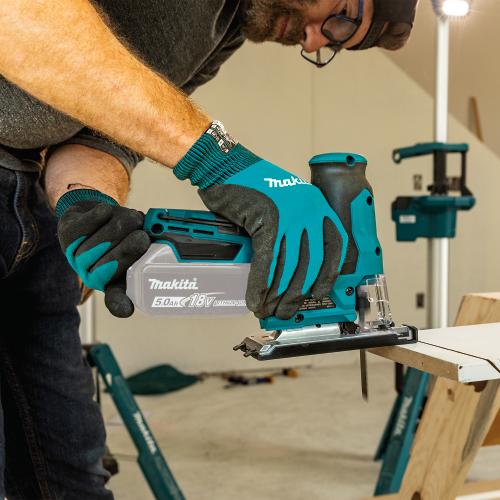
Explore this need in the finder →Makita’s XVJ05Z is a cordless 18V LXT brushless barrel-grip jigsaw, assessed here from its exact US product page and model-specific manual rather than a hands-on test. The leading “X” is important: XVJ05Z is not the smaller 12V max CXT VJ05Z. The two share a short model-name pattern and barrel-grip form, but the documented battery platforms and package information differ. XVJ05Z is also a tool-only SKU, though Makita’s page lists several accessories separately under its included-items section.
18V LXT body, tool-only battery package
The exact XVJ05Z US product page identifies an 18V LXT brushless barrel-grip saw, UPC 088381-780377. It labels the package tool-only and says the battery and charger are not included. That does not mean the package is accessory-free: the same page separately lists two each of three jigsaw blade models, plus one dust-extraction attachment (413F05-1) and one dust cover (458191-5). Confirm the precise seller package and contents rather than assuming a battery or charger comes with the bare tool—or that the published included-items list has been preserved in a particular offer.
The XVJ05 manual names BL1815N, BL1820B, BL1830B, BL1840B, BL1850B and BL1860B battery cartridges. Those are 18V LXT packs, not VJ05Z’s 12V CXT cartridges. The manual describes a five-position dial from 1 to 5, a lock/unlock button and separate start/stop operation. It specifies 800–3,000 SPM and a 7/8-inch stroke. A soft-start function and soft no-load rotation feature are described in the manual; these are documented controls, not claims that we measured vibration, speed stability or cutting time.
Use Makita’s material/action chart as a boundary
The XVJ05 manual lists four action positions. Position 0 is straight action and is recommended for mild and stainless steel, plastics, and clean wood or plywood. Position I adds small orbit for mild steel, aluminum and hardwood. Position II is for wood and plywood and faster aluminum or mild-steel work. Position III is the large-orbit setting for faster wood or plywood cuts. Speed starting ranges are material-specific: the manual gives 4–5 for wood, 3–5 for mild steel and aluminum, 3–4 for stainless steel and 1–4 for plastics, while noting that appropriate speed varies with material and thickness. Higher speed can shorten blade life. These instructions are reference points, not a guarantee of cut quality or a recommendation to use one setting on every stock piece.
Makita’s manual specifies 5-5/16 inches of wood capacity, 3/8 inch of mild steel and 13/16 inch of aluminum at 90 degrees; its listed mass ranges from 4.4 to 5.1 pounds depending on battery and attachments. The exact product page lists 5 pounds with a separately sold battery and gives aluminum as 25/32 inch rather than the manual’s 13/16. That small manufacturer discrepancy is retained rather than converted into a performance conclusion. Treat either set as published specifications, not measured depth, runtime or an assurance that any blade can safely cut to that limit.
The manual says to use B-type blades only, while Makita’s US page calls the interface T tang and lists included T-shank blade SKUs. The supplied blade list gives more context, but it does not establish that any generic blade marketed as T-shank is approved. Check the exact blade model against the XVJ05 manual before replacing it.
Two dust routes, with a bevel compatibility limit
Makita describes a built-in blower for clearing the cut line and includes an XVJ04 dust-extraction attachment and dust cover in the page’s accessory list. The manual explains attaching the nozzle to connect a Makita vacuum. The blower and vacuum are distinct arrangements; a blower is not extraction, and the presence of an attachment in the product page’s list does not guarantee that a seller’s opened or used package still has it. The manual documents a base that tilts from 0 to 45 degrees left or right and separately documents vacuum connection, but it does not establish vacuum capture during bevel cutting. Accordingly, blower-plus-bevel is documented as an arrangement, while vacuum-plus-bevel remains unknown in this assessment. The anti-splintering insert is also not compatible with bevel cutting.
Who should compare XVJ05Z?
This model may suit someone already equipped with Makita 18V LXT batteries who prefers a barrel grip and wants the documented speed dial, orbital choices and deeper wood capacity. It is not the CXT choice for VJ05Z owners merely because the model numbers look alike. Compare against other LXT saws by grip, package and dust setup, not by battery voltage alone. The exact page itself presents a tool-only package, and neither it nor the manual proves stock, price, warranty terms or what a third-party seller currently includes.
Before deciding, verify the exact XVJ05Z suffix, compatible 18V LXT pack, charger separately if needed, the blade interface and model-specific blade instructions, and whether the listed blade set, dust nozzle and cover are present. If a vacuum is essential, check the attachment/hose compatibility; if beveling is essential, do not assume the vacuum route remains available in that same setup.
Limits of this assessment: no ownership, cutting test, runtime test, measured weight, durability assessment, noise measurement or customer experience is claimed. The review summarizes manufacturer documentation, including its separately preserved page/manual aluminum-capacity discrepancy.
Key specifications
Key details at a glance
| Power source | Cordless |
|---|---|
| Battery platform | Makita 18V LXT |
| Grip format | Barrel grip |
| Motor type | Brushless |
| Brushless motor | Yes |
| Blade interface | T shank |
| Cut-action settings | 0 / 1 / 2 / 3 |
| Maximum documented speed | 3000 SPM |
| Maximum documented bevel | 45° |
| Battery included | No |
| Charger included | No |
| Blade listed in package | Yes |
| Integrated cutline blower | Yes |
| Optional vacuum-extraction route documented | Yes |
| Stroke length | 0.88 in |
| Hard case listed in package | No |
Use the exact model’s instructions for operating limits, supplied equipment and version differences.
Sources for this review
Sources for this assessment
Make the next check about your project
Use the finder to combine material, blade interface, grip and operating setup. It matches documented capabilities, not guaranteed results.