
Your needs, this model
Does it fit your priorities?
Which CJ160V controls and blade motion does the documentation support?
The U.S. manual distinguishes the D-handle CJ160V trigger and stopper from the separate CJ160VA barrel-grip switch. Standard speed is dial settings 1–5 (800–2,800/min), with AUTO as a separate setting whose target may vary with the work. The orbital knob has positions 0–III; position 0 is straight motion, while I–III add orbit. These are control descriptions, not measured cutting results.
Explore this need in the finder →Can the CJ160V use an external cleaner and bevel in the same setup?
No. The U.S. manual describes an external cleaner connected with a dust-collection adapter and a separate adapter, but explicitly says angular cuts cannot be made with the dust collector fitted. It also prohibits angular cuts with the chip cover. For beveling, set orbit 0 and remove both; use external collection only for a square-cut arrangement. The exact U.S. tool card lists a dust-collection adapter, but the cleaner and connecting adapter remain separate.
Explore this need in the finder →What metal work is documented for the CJ160V?
For mild steel, aluminum or copper the manual directs a material-appropriate blade, speed dial 3–4, orbital position 0 or I and cutting fluid; listed maximum depths are 10 mm mild steel and 20 mm aluminum. Stainless-steel plate is a different procedure: separate No. 97 blade, 1.5–2.5 mm stock, position 0 and cutting fluid. The manual does not document cast iron, and its dial 1–2 warning against metal thicker than 1 mm is a low-speed caution, not maximum capacity.
Explore this need in the finder →This is a source-based assessment of the earlier Metabo HPT CJ160V, not a hands-on test. The model is named in a dated U.S. manufacturer card and in a U.S. instruction manual that also covers a separately drawn CJ160VA configuration. I have not used or measured a sample, and the published capacities are not promises about the speed, finish or life of a cut.
What the U.S. CJ160V record identifies
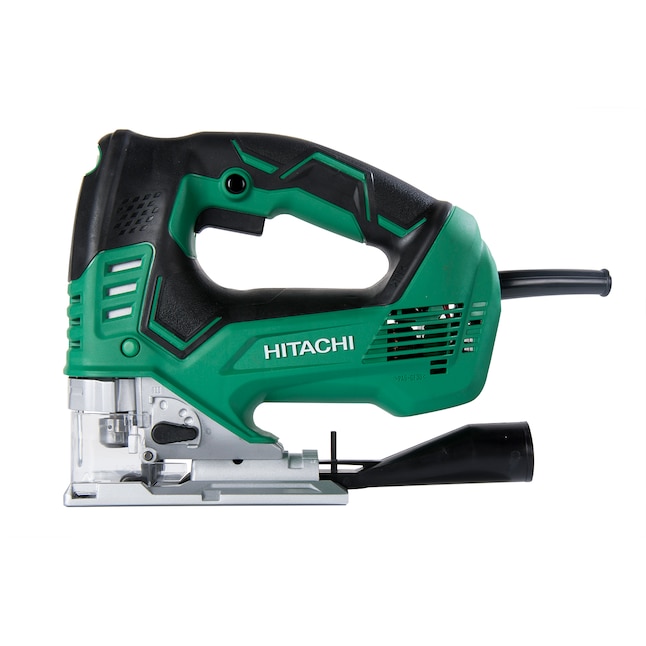
The exact U.S. tool card calls this a variable-speed jig saw and identifies CJ160V. It is a corded D-handle arrangement: the manual's parts illustration shows the CJ160V trigger and stopper, unlike the barrel-grip switch form separately drawn for CJ160VA. That control distinction matters if a buyer has a strong preference about hand position or switch operation. The shared manual specifies a 120 V AC, 60 Hz supply and 7.0 A current for both models. Confirm the nameplate on an actual unit rather than relying on a family similarity or a seller's short title.
The manual lists 800–2,800 strokes per minute, 26 mm (1-1/32 inch) stroke and 5.5 lb (2.5 kg) weight. Its standard speed dial positions 1–5 span the no-load range. AUTO is a separate setting, described as 1,400/min without load and 2,800/min with load; the manual cautions that work conditions can prevent the tool from reaching or returning exactly to those targets. Those are control specifications, not an independent speed or vibration test.
Choose action and stock together
The orbital selector has four positions, 0 through III. Position 0 moves the blade up and down without the extra orbital travel; I–III add it. The manual recommends less orbit for hard material and for accuracy, and more for soft lumber or plastic when work efficiency is the priority. That advice is broad: it does not rate a particular hardwood species, guarantee a smooth edge, or identify one setting for every blade and workpiece. Choose a blade for the material and keep the base supported on the work as the instructions direct.
Metabo HPT's manual lists maximum capacities of 160 mm in wood, 20 mm in aluminum and 10 mm in mild steel. These manufacturer figures should not be mistaken for ideal thicknesses or tested results. There is a separate low-speed warning: at dial settings 1 or 2, do not cut wood thicker than 8 mm or metal thicker than 1 mm. That caution is not the saw's maximum capacity. For metallic material, the manual directs the user to dial scales 3–4, use orbital position 0 or I, and apply cutting fluid. A straight-action plan uses position 0; selecting the metal option does not mean one blade or one setup suits all the listed metals.
Stainless steel is a narrower case, not a general-purpose metal claim. The manual names a separate No. 97 blade for stainless plate and specifies 1.5–2.5 mm stock, position 0 and cutting fluid. The U.S. tool card lists No. 41, No. 42 and No. 123X blades, not No. 97. The manual does not document cast iron. The card and manual checked for this review do not confirm a T- or U-shank family; a Lowe's listing title labels CJ160V T-shank, but that retail wording is not manufacturer confirmation. Verify the actual clamp and intended blade before buying replacement blades.
Vacuum connection and beveling conflict
The manual describes external collection through the dust-collection adapter, a separate connecting adapter and a cleaner. The exact CJ160V manufacturer card lists a dust-collection adapter among its accessories, but it does not include a cleaner or the connecting adapter; the condition and exact contents of an old or used offer must still be checked. The reviewed U.S. sources do not establish a built-in cutline blower, so I do not recommend the CJ160V as a blower match.
Beveling is a different fit question from dust capture. The base can pivot up to 45 degrees to either side in 15-degree markings, and the manual directs the user to set orbital position 0 for an angled cut. It then explicitly says angular cuts cannot be made with the chip cover or dust collector adopted. So the practical arrangements separate: use an unshrouded, no-collector shoe for a bevel; use the collector arrangement for square cuts. Do not read the base's degree markings as permission to keep the dust accessories fitted.
Historical package and offer checks
The 2020 U.S. manufacturer card lists No. 41 and No. 42 blades, ten No. 123X blades, an Allen wrench, splinter guard, chip cover, dust-collection adapter, sub-base and case. It is a helpful historical package reference, not a guarantee that a particular seller still has every piece. The retrieved exact-model Lowe's page says the item is no longer sold on Lowe's; that says nothing about every other seller or used listing. The current U.S. Metabo HPT jigsaw filter captured for this research names other models, while the warranty list's inclusion of a model would not establish that an old unit remains under warranty. Verify suffix, nameplate, condition, written contents, service history and return terms.
Research-based take
The CJ160V is worth distinguishing for a shopper who wants an older corded D-handle saw with a trigger and stopper, a broad speed dial plus AUTO, and a selectable 0–III orbital mechanism. The manual gives useful boundaries for lumber, named plastics, mild metals and the separate stainless-blade procedure. A complete external-collection route is possible, but it cannot coexist with bevel cutting in the fitted arrangement.
The main drawback is offer-level uncertainty, not a claim that the tool cannot cut: this is an earlier model, the captured Lowe's listing is withdrawn from that retailer, and the sources do not settle a current seller's package, condition or price. Blade shank also remains unconfirmed by the manufacturer documents reviewed here. Use the exact model label and manual, inspect the shoe and clamp, and check the needed accessory set before comparing an old listing with current-reference saws. This analysis reports documents only; it does not claim personal use, a measured cut, a tested finish or a warranty outcome.
Key specifications
Key details at a glance
| Power source | Corded mains power |
|---|---|
| Grip format | Top handle |
| Motor type | Single-phase series-commutator motor |
| Cut-action settings | 0 / 1 / 2 / 3 |
| Maximum documented speed | 2800 SPM |
| Maximum documented bevel | 45° |
| Blade listed in package | No |
| Optional vacuum-extraction route documented | Yes |
| Rated motor current | 7 A |
| Stroke length | 1.03 in |
| Hard case listed in package | Yes |
Use the exact model’s instructions for operating limits, supplied equipment and version differences.
Sources for this review
Sources for this assessment
- Metabo HPT U.S. CJ160V Variable Speed Jig Saw tool card, 2020-03-19
- Metabo HPT U.S. CJ160V / CJ160VA instruction manual
- Lowe's exact CJ160V U.S. model listing (no longer sold by this retailer)
- Metabo HPT U.S. saw catalogue filtered to Jig Saw (2026-10-30 capture)
- Metabo HPT U.S. individual-tool warranty list (checked 2026-10-31)
- CPSC bounded exact-name CJ160V recall query
- Lowe's image linked from the exact CJ160V U.S. listing

Make the next check about your project
Use the finder to combine material, blade interface, grip and operating setup. It matches documented capabilities, not guaranteed results.