
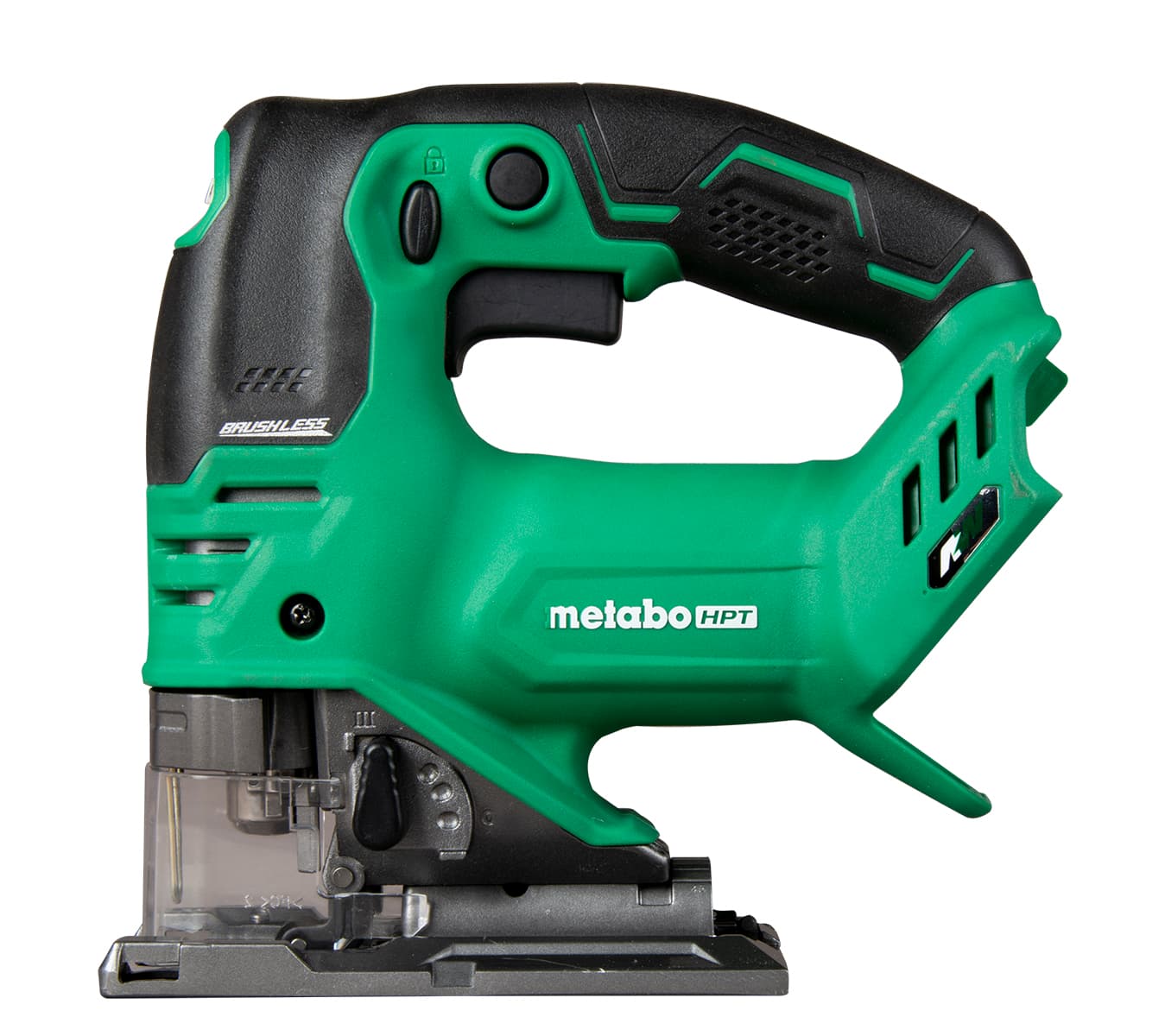
Your needs, this model
Does it fit your priorities?
Does the CJ36DAQ4 tool-body package include a battery, charger or ET36A adapter?
No. The exact U.S. page marks battery included as 0, says the ET36A AC adapter is compatible but not included, and lists the CJ36DAQ4 as tool body only. Its supplied-item list names the No. 41 blade, 4 mm wrench, chip cover and splinter guard. The linked manual's CJ36DA (NN) package list also says battery, charger and dust-collection adapter are not contained. Verify the seller's exact CJ36DAQ4 suffix and written package contents.
Explore this need in the finder →Which battery packs are documented for the CJ36DAQ4?
Metabo HPT identifies 18V/36V MultiVolt battery operation, and the linked CJ36DA manual names the BSL36B18 as its example while expressly excluding older BSL3660/3626/3620 and BSL18xx/BSL14xx series packs. The exact saw body does not include a battery or charger; do not treat generic Metabo HPT 18V packs as interchangeable. The separate ET36A AC adapter is an alternate power arrangement, not a battery included with this SKU.
Explore this need in the finder →Can the CJ36DAQ4 bevel while the dust collector or chip cover is fitted?
No. The manual says angular cutting cannot be done with either the chip cover or dust collector installed; the chip cover itself also cannot attach while the base is inclined. The product page rates the base to 45 degrees right and left. Use the built-in blower setup for bevel work, remove the chip cover, and use the separate dust-collection adapter only for square cuts. The blower clears the line but is not dust capture.
Explore this need in the finder →The Metabo HPT CJ36DAQ4 is a 36V MultiVolt brushless top-handle jigsaw with two separate ways to power the same saw body: a compatible MultiVolt battery or the ET36A AC adapter. The U.S. listing is tool-body only, so the machine is not a ready-to-cut battery kit.
Keep the CJ36DAQ4 suffix and CJ36DA manual bridge clear
Metabo HPT’s exact U.S. page identifies the retail model as CJ36DAQ4 and links an owner manual whose internal cover calls the saw CJ36DA. That is a useful official page-to-family bridge for operating instructions, not a reason to collapse every similar CJ model into one product. This assessment keeps CJ36DAQ4 as the product identity and the linked CJ36DA document as its manual source; CJ18DAQ4, CJ90VST2 and older CJ-numbered saws remain separate records.
The exact CJ36DAQ4 page lists a No. 41 blade, a 4 mm hex wrench, a chip cover and a splinter guard. It states that no battery is included and that the ET36A adapter is compatible but sold separately. The linked manual’s CJ36DA (NN) accessory list also excludes the battery, charger, plastic case, dust-collection adapter, sub base and battery cover. Treat the page’s suffix and a seller’s written carton list as decisive; an accessory photo or the word “MultiVolt” does not turn this bare tool into a kit.
Battery and AC-adapter power are different plans
For cordless work, the manufacturer identifies 18V/36V MultiVolt battery packs. The linked manual names the BSL36B18 as an example and warns that older BSL3660/3626/3620 and BSL18xx/BSL14xx batteries cannot be used. That makes the platform filter meaningful: a generic Metabo HPT 18V pack is not automatically compatible. The body weighs 4.4 lb without a battery; the manual lists 6.6 lb with a BSL36B18 installed. Neither figure predicts how long a particular pack will run.
The alternative is the ET36A AC adapter with cord. The exact page identifies it as an optional, separate accessory; it is not a direct cord on the saw and does not come in the CJ36DAQ4 body package. This gives the model a corded mains operating arrangement when the appropriate adapter is purchased, but it does not erase the pack, charger or adapter cost and compatibility check. The two power arrangements are alternatives, not a simultaneous setup.
Four orbital positions, with specific material limits
The linked manual describes four selector positions, from 0 with no orbital movement through positions I–III. In standard mode the speed range is 800–3,500 strokes per minute; AUTO varies from 1,400–3,500 according to load. Stroke length is 1-1/32 in. These are published specifications, not a measured comparison or a promise that a particular speed will produce a certain edge.
For general lumber, the manual describes both ordinary and pocket cutting. Its guidance is to reduce orbital action for harder stock and accuracy, and increase it for softer materials such as lumber and plastic. The manual lists phenol-resin and vinyl-chloride plastics, plus mild steel, aluminum and copper plate. It does not split wood into an approved hardwood-versus-softwood rating, so those more specific material labels should not be inferred from the broad “wood” capacity.
Stainless steel is the special case. The manual requires a separate No. 97 blade, position 0 and cutting fluid, and gives a blade-specific 1.5–2.5 mm thickness range. Its general specification table separately lists 1/8 in (3.2 mm) stainless capacity. The exact product page and tool card list mild-steel capacity as 13/32 in, while the linked manual says 25/64 in (10 mm). These source figures are close but not identical; do not treat them as a single tested or universal rating. The package’s included No. 41 blade is not the stainless No. 97 blade.
Dust collection can remove the bevel option
The built-in blower clears loose debris from the cutline; it is not a dust-capture system. Metabo HPT lists dust collector 370492 as a separate accessory. The owner manual says angular cutting cannot be done with the dust collector installed, and the chip cover cannot be attached while the base is inclined. Its exact page and tool card list bevel capacity to 45 degrees right and left. In practice, the documented bevel arrangement is the blower with the chip cover removed; the external vacuum adapter arrangement is a square-cut plan. Do not combine “vacuum” and “bevel” just because both features are listed separately.
The saw also includes a splinter guard, which the manual says can reduce splintering on wood. That is not a finish guarantee. The separate sub base is described as useful for curved work, but it is not part of the listed tool-body contents; the manual says fitting it reduces blade protrusion by 3 mm. Check blade length and clearance for the real stock.
Who should shortlist this body?
The CJ36DAQ4 is worth comparing if you need a top-handle, T-shank-only body, already own the specified MultiVolt battery family, or want the separate ET36A corded supply as an option. Its manual-supported orbit settings and built-in cutline blower give it several documented arrangements, but the package omissions matter: budget for power hardware, and for an external vacuum adapter if extraction is essential. A battery-platform match does not answer the box-contents question.
Before buying, confirm the exact CJ36DAQ4 suffix, compatible MultiVolt pack or ET36A adapter, and the written items in the seller’s box. For metal, verify blade type, speed, stock thickness and cutting-fluid instructions against the current manual. If you need a bevel, remove the chip cover and do not use the dust collector in that setup. This review is an evidence-based assessment of manufacturer documentation and the exact-page image; no hands-on use, ownership, cutting test, runtime measurement or customer experience is claimed.
Key specifications
Key details at a glance
| Power source | Cordless |
|---|---|
| Battery platform | Metabo HPT 18V/36V MultiVolt |
| Grip format | Top handle |
| Motor type | Brushless |
| Brushless motor | Yes |
| Blade interface | T shank |
| Cut-action settings | 0 / 1 / 2 / 3 |
| Maximum documented speed | 3500 SPM |
| Maximum documented bevel | 45° |
| Battery included | No |
| Charger included | No |
| Blade listed in package | No |
| Carry bag listed in package | No |
| Integrated cutline blower | Yes |
| Optional vacuum-extraction route documented | Yes |
| Stroke length | 1.03 in |
| Maximum listed cutting capacity | 6.3 in |
| Hard case listed in package | No |
Use the exact model’s instructions for operating limits, supplied equipment and version differences.
Sources for this review
Sources for this assessment

Make the next check about your project
Use the finder to combine material, blade interface, grip and operating setup. It matches documented capabilities, not guaranteed results.