
Your needs, this model
Does it fit your priorities?
What cutting capacities are documented for the earlier CJ90VST?
The exact-family manual lists 90 mm maximum depth in wood and 8 mm in mild steel, while the U.S. tool card does not publish capacity figures. These are manufacturer limits, not a promise about blade life, cut speed or finish. At dial settings 1 or 2, the manual separately warns against wood thicker than 10 mm and metal thicker than 1 mm; that low-speed caution is not the machine's maximum capacity. Confirm the exact model and nameplate because the manual says voltage specifications vary by area.
Explore this need in the finder →Which blade interface and accessories does the CJ90VST card identify?
The exact Metabo HPT U.S. card says CJ90VST accepts T-shank blades only and lists a No. 41 blade and Allen wrench. It also describes tool-less blade changes. The card is dated 2020, not an exact seller carton inventory; neither a case, blade count nor external vacuum adapter is established. Check the exact model label and written package contents, and select replacement blades approved for this saw.
Explore this need in the finder →Can the earlier CJ90VST collect dust and still bevel?
The integrated blower directs debris away from the cut line; it is not dust capture. The official family manual also describes connecting external dust-collection equipment through an adapter and hose, but expressly says angular cutting cannot be done with the collector installed. The manual includes an angular-cutting procedure but the saved evidence does not state a maximum bevel degree. Verify the collector parts and exact offer before planning a bevel setup.
Explore this need in the finder →This is a source-based assessment of the earlier CJ90VST model, not a hands-on test. The exact U.S. Metabo HPT tool card is dated March 2020; its published figures and the accompanying manufacturer manual are useful for identifying a particular saw, but they do not prove what a current seller has in the box or whether a given used unit is sound.
What the CJ90VST record actually establishes
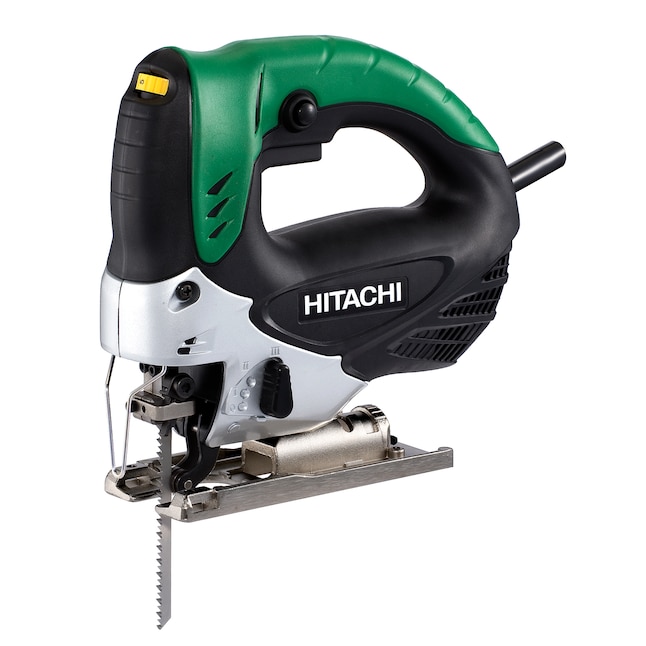
Metabo HPT's U.S. card names the CJ90VST and describes a corded D-handle jigsaw with a variable-speed range of 850–3,000 strokes per minute, a 3/4-inch stroke and a listed weight of 4.9 pounds. It also calls out four-mode orbital action, tool-less blade changes, a dust blower and a clamp that accepts T-shank blades only. Those are concrete identity and setup points, not a measured comparison of cutting speed or finish.
The official English model-family manual lists the CJ90VST and the distinct CJ90VAST. It gives the CJ90VST a 2.2 kg weight without its cord and lists 90 mm wood and 8 mm mild-steel cutting capacities. The U.S. card does not provide those capacity figures, so treat them as manual specifications rather than as a result demonstrated on a sample. The manual also says voltage varies by area and directs the user to check the nameplate. The U.S. card's 5.5-amp rating does not settle the exact voltage of a particular unit.
Blade and motion choices
The T-shank-only clamp is a real compatibility boundary: do not assume a U-shank blade will fit because it looks similar or because an online listing uses “universal” loosely. The card says changes are tool-less and lists a No. 41 blade and an Allen wrench. That is not a complete current carton inventory. It says nothing about a case, spare blade count, guide, dust-collection adapter or the contents of a particular second-hand offer.
The four-mode description is useful when deciding between a straighter, more controlled stroke and a more aggressive orbital action, but it does not prescribe an ideal setting for every piece of stock. In the manual, position 0 is the setting for accurate guided cuts. The manual names lumber and specified plastics as well as mild-steel, aluminum and copper plates; it names stainless-steel plate only with a separate No. 97 blade. Its material table is guidance for choosing a blade and thickness, not a promise that one blade handles every material.
Pay attention to the low-speed warning. At speed-dial settings 1 or 2, the manual says not to cut wood thicker than 10 mm or metal thicker than 1 mm. That is a caution about those low settings, not the machine's maximum cutting depth. For small curves the manual says to reduce feed, and it warns that feeding too quickly can break the blade. Keep the base against the work while sawing, and follow the instructions for the exact unit rather than turning these points into a predicted cut-quality claim.
Blower versus dust collection
The built-in blower pushes debris away from the line of cut; it is not an extractor and should not be described as dust capture. The manual separately explains how to connect external collection equipment through an adapter and hose. The exact U.S. card does not list that adapter, hose or a vacuum as included, so check whether the offer has the parts needed to connect the collector you intend to use.
There is an important setup interaction: the manual says angular cuts cannot be made with the dust collector installed. A shopper who needs both dust collection and bevel work should not assume those functions coexist in one fitted configuration. The manual includes an angular-cutting procedure, but the saved evidence does not establish a maximum bevel angle for this model. Confirm the angle range and the correct shoe setup in the exact saw's instructions before buying for a specific angled cut.
Keep the exact model suffix in view
CJ90VST is not interchangeable with the newer-looking CJ90VST2 just because the names and general layout are similar. Metabo HPT's captured current U.S. jigsaw filter lists CJ90VST2, not CJ90VST, and the company publishes separate source material under the two exact numbers. That establishes distinct reviewed identities, not a direct replacement relationship. The current CJ90VST2 page, manual and tool card also have their own specification differences; none should be silently copied onto the unsuffixed CJ90VST.
The available CJ90VST evidence is strongest for model identification, the U.S. card's controls and the family manual's operating cautions. It is weaker for a modern retail package: there is no captured current CJ90VST product page or exact carton list here. The manual covers more than one voltage region, while the official current filter has a different model number. Before considering an offer, verify the nameplate, exact suffix, condition, included items and whether the seller's blade and dust accessories match the work.
Research-based take
The CJ90VST may suit a buyer deliberately comparing an older corded D-handle saw that has a T-shank-only clamp, built-in cutline blower and selectable orbital movement. Its published 5.5 A and 4.9 lb figures give useful context, and the manual provides more than a bare feature list: it sets boundaries around low-speed work, blade selection, material-specific use and the vacuum/bevel conflict.
The main tradeoff is uncertainty at the offer level. The sources do not establish current stock, price, warranty eligibility, the condition of any used machine, or a complete box list; the family manual tells buyers to check the actual nameplate. A search result for CJ90VST may also surface CJ90VST2 or other suffixes. Treat this assessment as a way to screen an exact model, then compare the label and seller's written terms rather than assuming a photo, family resemblance or historical card proves the unit you will receive.
Key specifications
Key details at a glance
| Power source | Corded mains power |
|---|---|
| Grip format | Top handle |
| Motor type | Single-phase series commutator motor (model-family manual terminology) |
| Blade interface | T shank |
| Cut-action settings | 0 / 1 / 2 / 3 |
| Maximum documented speed | 3000 SPM |
| Battery included | No |
| Charger included | No |
| Blade listed in package | No |
| Integrated cutline blower | Yes |
| Optional vacuum-extraction route documented | Yes |
| Rated motor current | 5.5 A |
| Stroke length | 0.75 in |
Use the exact model’s instructions for operating limits, supplied equipment and version differences.
Sources for this review
Sources for this assessment
Make the next check about your project
Use the finder to combine material, blade interface, grip and operating setup. It matches documented capabilities, not guaranteed results.