
Your needs, this model
Does it fit your priorities?
Will the 2737-20 work with my Milwaukee M18 battery?
The 2737-20 is an 18V M18 tool, but the bare-tool package does not include a battery or charger. Use an M18 pack/charger specified for this tool; if you depend on the dust-collection attachment, its fit and hose connection are separate checks.
Explore this need in the finder →Can the 2737-20 use U-shank blades?
Milwaukee's 2737-20/2737B-20 operator manual says to use only T-shank jigsaw blades. Do not infer a U-shank fit from a generic jigsaw-blade listing; inspect the exact blade packaging and tool clamp instructions.
Explore this need in the finder →Can I bevel and connect a vacuum on the 2737-20 at once?
Milwaukee documents the shoe tilting up to 45 degrees and separately documents its dust-collection attachment, but the reviewed manual does not confirm the same setup with the attachment fitted. Treat that combination as unverified; the transparent blade cover and anti-splinter device must also be removed for bevel cuts.
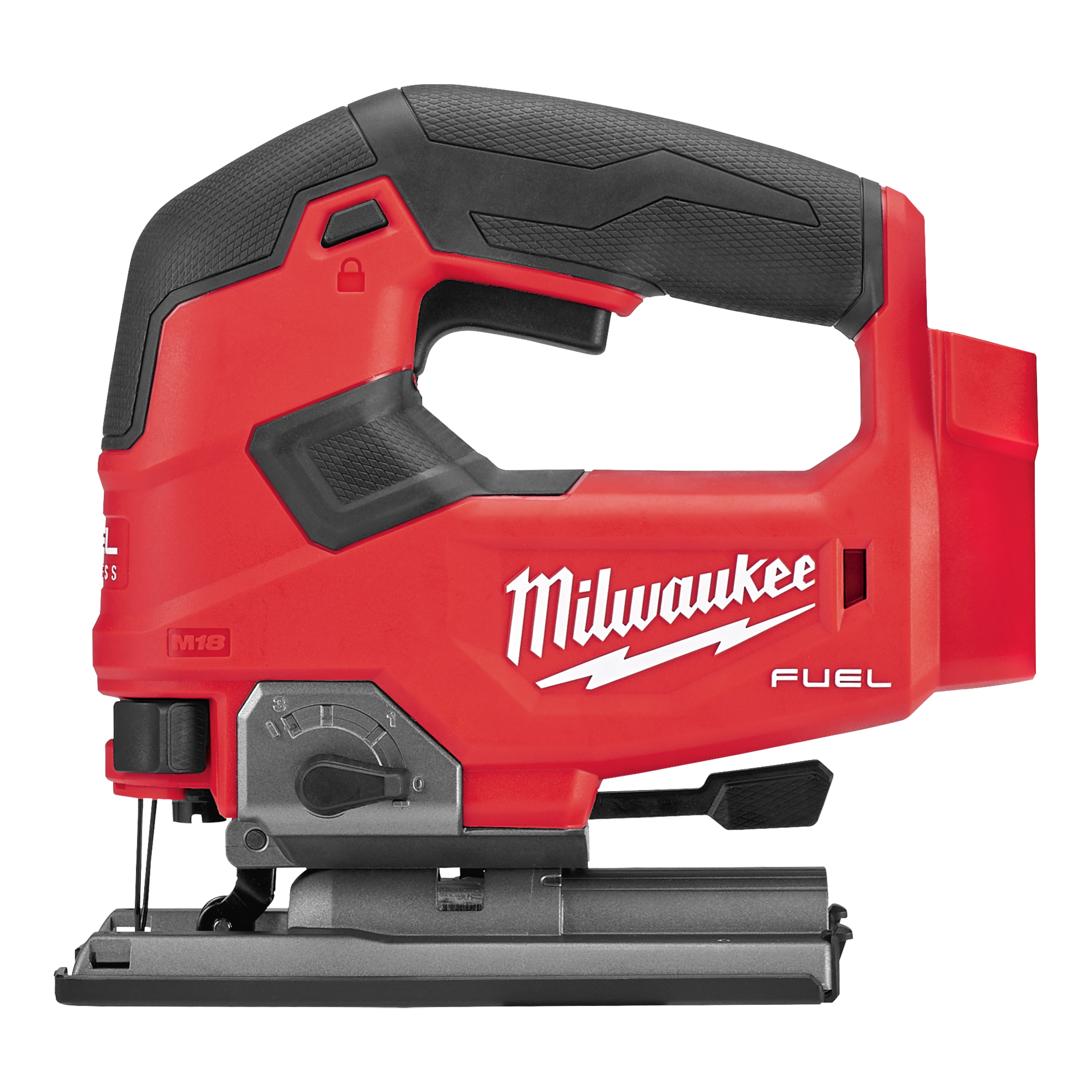
Explore this need in the finder →The Milwaukee 2737-20 is the D-handle member of the M18 FUEL jigsaw line, sold as a tool-only model. The distinction matters: its sibling 2737B-20 has a barrel grip and a different control layout, while 2737-21 is the kit package built around the 2737-20 saw. This assessment compares Milwaukee's current US product pages, its operator manual and service information; it is not a hands-on test, so it makes no claim about cut speed, runtime or finish from personal use.
What the exact package does—and does not—include
Milwaukee's 2737-20 page lists the saw, anti-splinter guard, dust collection tube, dust cover, hex wrench and shoe guard. It is a bare tool: the M18 battery and charger are separate purchases. The page's box list does not name a blade or carrying case, so confirm those items if you need them rather than treating a generic product photo or a seller's title as package proof.
The 2737-21 kit is a real alternative for someone who needs the power system as well as the saw. Its exact Milwaukee page identifies the included jigsaw as model 2737-20 and lists an M18 XC5.0 battery, M18/M12 multi-voltage charger, case and saw accessories. That makes the kit a package variant of the D-handle saw, not a different cutting chassis. One detail is unresolved: the current nine-item page list does not name a blade, while Milwaukee's 2018 catalog lists a jigsaw blade in this kit. Ask the seller to confirm current box contents if a blade is essential. The kit photograph shows a battery, charger and case, but package decisions here come from the manufacturer’s item list and its historical discrepancy, not the image alone.
A D-handle trigger, T-shank clamp and four orbital positions
The current product page identifies a brushless M18 FUEL saw with a variable-speed trigger, tool-less blade changes and four orbital positions. Milwaukee's shared manual names 18V DC, M18 battery and charger type, a 0-to-3,500 no-load strokes-per-minute range and a one-inch stroke for the 2737-20. Those are manufacturer-listed specifications, not measurements under load. The manual is explicit that this clamp takes T-shank jigsaw blades only; U-shank blades should not be assumed to fit.
For action, Milwaukee's chart is a useful start rather than a recipe for finish: it lists wood with positions 0 through 3, metal and aluminum with 0 through 1, and plastic with 0 through 2. It recommends zero orbit where a smoother cut is required. The separate product page makes broader claims about hardwoods and metals, but neither source proves that a particular blade, stock thickness or feed rate will produce an edge you like. Blade tooth geometry, work support and feed still matter. If finish is important, follow the blade maker's instructions and practice on scrap instead of treating a high orbit setting as an automatic speed improvement.
Beveling and dust collection need different checks
The shoe can tilt up to 45 degrees in either direction, with detents at 0, 15, 30 and 45 degrees. The manual says to remove the transparent blade cover and anti-splinter device before bevel or angle cuts, then make a test cut to confirm the angle. That instruction is easy to miss if the saw is being set up around a finished surface: the anti-splinter device is useful for its stated purpose, but it is not installed during the documented bevel setup.
The tool also has a switchable blower. In one position it clears debris from the line; in the other it directs air toward the dust chute for a dust-extraction solution. The exact 2737-20 package lists the dust collection tube, but not the hose or vacuum. Milwaukee's manual explains those separate arrangements but does not expressly establish beveling with the collection attachment installed. I would not treat the finder as proof that vacuum capture and bevel adjustment coexist on this model; verify the exact attachment and follow the manual before building a setup around both.
Where this model fits—and the comparison that matters
The 2737-20 makes the most sense to a buyer already using compatible M18 packs who prefers a D-handle and trigger control, wants the T-shank interface and values a separately documented blower and bevel option. The 2737B-20 is not just the same saw turned sideways: its barrel grip, side switches, six-position speed dial and auto-controlled start are distinct, and its manual adds explicit 5.0Ah limits for beveling and dust-attachment use. If those controls or battery-size restrictions affect your work, compare the two model assessments rather than relying on the shared M18 FUEL name.
Before purchase, confirm the full 2737-20 or 2737-21 suffix, whether you need the bare tool or the kit's battery/charger/case, the T-shank blades you intend to use, and the fit of any separate vacuum hose. Also check current seller terms, warranty and return conditions; no price, inventory or availability claim is made here. Milwaukee's 2737-20 product page, 2737-21 kit page and shared operator manual are the primary references to use for the exact tool and package.
Key specifications
Key details at a glance
| Power source | Cordless |
|---|---|
| Battery platform | Milwaukee M18 |
| Grip format | Top handle |
| Motor type | Brushless |
| Brushless motor | Yes |
| Blade interface | T-shank only |
| Cut-action settings | 0 / 1 / 2 / 3 |
| Maximum documented speed | 3500 SPM |
| Maximum documented bevel | 45° |
| Battery included | No |
| Charger included | No |
| Carry bag listed in package | No |
| Integrated cutline blower | Yes |
| Optional vacuum-extraction route documented | Yes |
| Stroke length | 1 in |
| Hard case listed in package | No |
Use the exact model’s instructions for operating limits, supplied equipment and version differences.
Sources for this review
Sources for this assessment
- Milwaukee US exact 2737-20 D-Handle Jig Saw page
- Milwaukee operator manual for 2737-20 and 2737B-20
- Milwaukee 2737-20 D-Handle service parts list, 54-40-2800
- Milwaukee US exact 2737-21 D-Handle Jig Saw Kit page
- Milwaukee M18 2018 catalog listing 2737-21 kit and 2737B-20 configuration
- CPSC bounded exact-name query for Milwaukee 2737-20
Make the next check about your project
Use the finder to combine material, blade interface, grip and operating setup. It matches documented capabilities, not guaranteed results.