
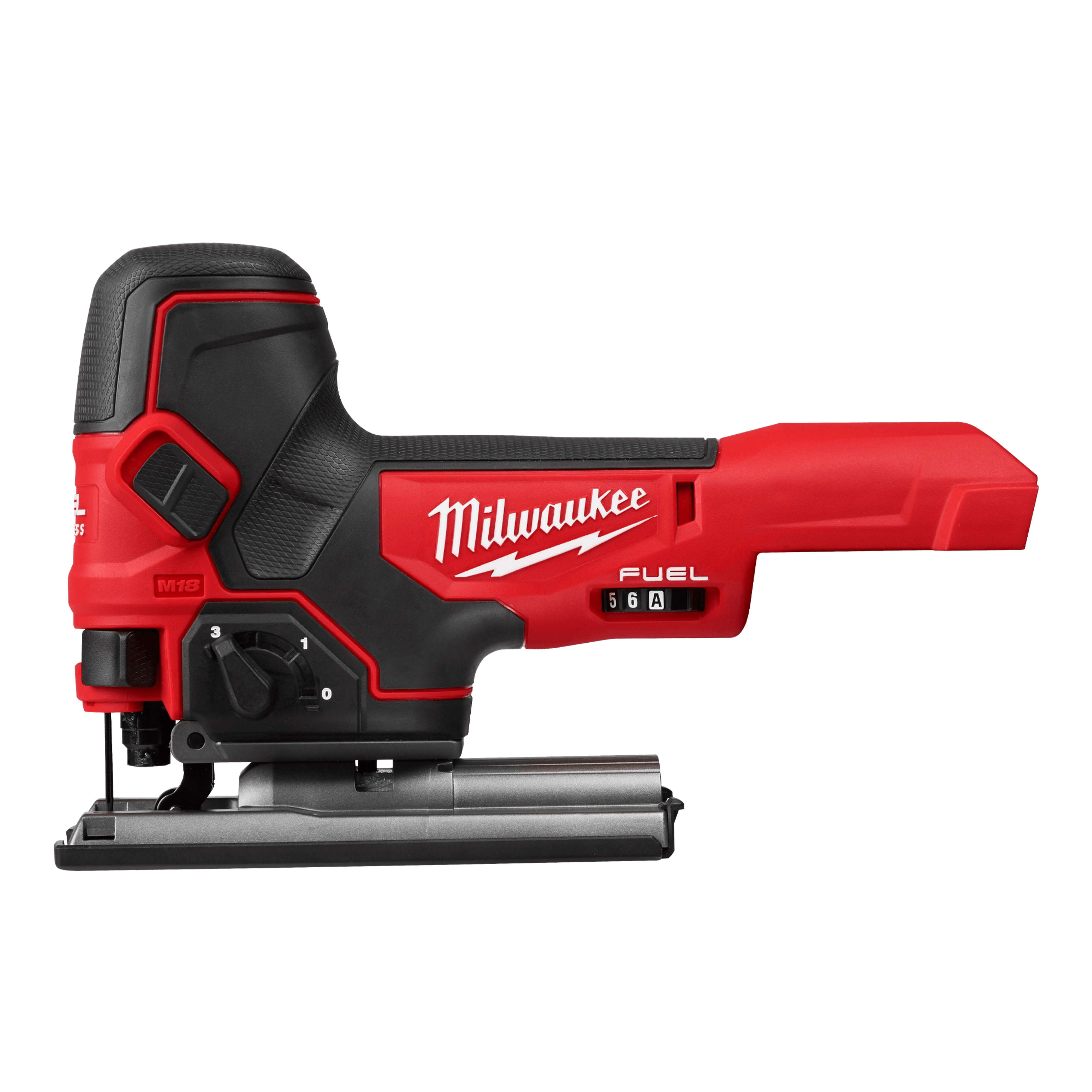
Your needs, this model
Does it fit your priorities?
Can I use a large M18 battery on the 2737B-20 and still bevel?
No. Milwaukee's manual specifically says not to attempt a bevel cut with a battery pack larger than 5.0Ah because the pack could strike the workpiece. It separately applies the same upper limit to the dust-collection attachment. Confirm your exact pack capacity before planning either setup.
Explore this need in the finder →Does the 2737B-20 accept U-shank blades?
Milwaukee's shared 2737-20/2737B-20 operator manual says to use only T-shank jig-saw blades. Choose a blade with the exact documented shank and material purpose; the name 'universal' in a listing does not establish clamp fit.
Explore this need in the finder →Can the 2737B-20 collect dust and bevel with a battery over 5Ah?
No. The manual gives an explicit no-bevel and no dust-collection-attachment limit for packs above 5.0Ah. Use a compatible M18 pack no larger than 5.0Ah for those setups, and verify a separate hose/extractor. The manual does not confirm beveling with the extraction attachment installed at any pack size, so do not assume the two attachments coexist.
Explore this need in the finder →The Milwaukee 2737B-20 is the barrel-grip counterpart to the M18 FUEL 2737-20 D-handle saw. Its body shape is only the first difference: the barrel model uses side switches and a six-position dial with an auto-controlled start, and its manual places specific battery-size limits on bevel cutting and the dust-collection attachment. This is an evidence-based reading of Milwaukee's current US page, shared operating manual and separate service-parts list—not a hands-on review or a claim about cut quality, battery life or measured performance.
Barrel-grip form, package and battery platform
Milwaukee identifies the 2737B-20 as an 18V M18 FUEL tool-only barrel-grip jigsaw. The exact page lists the saw, anti-splinter guard, dust collection tube, dust cover, hex wrench and shoe guard. Battery, charger and case are not listed in that package. Its page does not name a blade, although Milwaukee's 2018 catalog lists a jigsaw blade for the model; treat current blade inclusion as unresolved and ask about the exact seller package. Its parts list labels catalog 2737B-20 as the barrel-grip machine and uses serial prefix J71A; Milwaukee's separate 2737-20 parts list labels a D-handle model, so these are functional configurations rather than a suffix-only distinction.
The tool's elongated barrel lets the hand sit lower around the saw body than on the D-handle version. That is a grip preference, not a promise of better control for every user. The page describes two side switches for different hand positions, a brushless motor, six dial settings, an auto-start mode and tool-free bevel adjustment. If grip shape is decisive, compare the actual tool in a store when possible; a specification sheet cannot tell you how it will feel in your hand.
Do not overlook the five-amp-hour operating limit
The shared Milwaukee manual gives a clear restriction that changes the buying decision: it says not to make a bevel cut with a battery pack larger than 5.0Ah because the pack can strike the workpiece. It separately says the dust-collection attachment cannot be used with packs larger than 5.0Ah. Thus a high-capacity M18 battery is not an all-purpose upgrade for this model. If beveling or connected dust collection is essential, the supported setup needs a compatible M18 battery at or below that limit, and the buyer should confirm the exact pack and accessory fit before ordering.
Milwaukee's manual documents a shoe angle up to 45 degrees with detents at 0, 15, 30 and 45 degrees. It also requires removal of the transparent blade cover and anti-splinter device for bevel cuts. The no-larger-than-5Ah caveat is specific to the barrel-grip 2737B-20; it should not be silently transferred to the D-handle 2737-20. Conversely, do not shop for a large battery and assume the 2737B-20 retains every bevel or dust setup.
Blades, speed and orbital action
The manual says to use T-shank blades only. A broad “fits jigsaws” description does not establish that a U-shank blade belongs in this clamp, so check the exact blade markings and manual. Its material chart lists wood with orbital settings 0 through 3, metal and aluminum with 0 through 1, and plastic with 0 through 2; it recommends zero orbit when a smoother cut is the priority. Milwaukee's product copy separately mentions hardwoods and metals, but that is not an independent cut test. No specific cutting depth or finish is inferred here.
There is also a small but important published speed discrepancy. The exact product page describes six settings from 0 to 3,500 SPM, while the shared manual's model-specific no-load table lists 800 to 3,500 SPM for the 2737B-20. Both identify a maximum of 3,500; the lower endpoint is unresolved. Neither figure tells you how fast the saw will cut a particular material, so the finder uses neither endpoint to qualify a buyer's capacity needs.
Dust extraction and blower are not the same thing
The integrated blower can clear the cutline or be directed toward the dust chute when an extraction solution is attached. The package lists a dust collection tube, but not a vacuum or hose. More than that, the manual limits attachment use to a battery pack no larger than 5.0Ah. A blower that moves chips from the line is not the same as captured dust, and the words “dust collection tube included” do not mean an extractor is in the box.
The exact documents separately describe bevel adjustment and the dust-collection attachment, but do not expressly establish that the attachment remains fitted during a bevel cut. I have therefore not treated “vacuum plus bevel” as a documented single arrangement. If you need both simultaneously, ask Milwaukee for model-specific guidance before choosing the tool; the finder deliberately does not turn missing evidence into compatibility.
Who should compare it with the D-handle model
This 2737B-20 is worth considering if you already use M18, prefer a barrel grip and dial-based speed selection, and can work within the 5.0Ah cap whenever beveling or the dust-collection attachment is involved. The D-handle 2737-20 has a trigger-based control layout and does not carry those same explicit manual warnings. Neither form can be called universally better from the available evidence. The exact need—hand placement, battery already owned, dust setup and bevel work—should drive the comparison.
Before buying, verify the 2737B-20 suffix, confirm a suitable M18 pack no larger than 5.0Ah for the restricted setups, check the T-shank blade you plan to use, and confirm the exact dust hose/extractor. Review the current seller package, return terms and warranty; this assessment does not claim a price or availability. Consult Milwaukee's 2737B-20 US product page, operator manual and barrel-grip parts list for exact model details.
Key specifications
Key details at a glance
| Power source | Cordless |
|---|---|
| Battery platform | Milwaukee M18 |
| Grip format | Barrel grip |
| Motor type | Brushless |
| Brushless motor | Yes |
| Blade interface | T-shank only |
| Cut-action settings | 0 / 1 / 2 / 3 |
| Maximum documented speed | 3500 SPM |
| Maximum documented bevel | 45° |
| Battery included | No |
| Charger included | No |
| Carry bag listed in package | No |
| Integrated cutline blower | Yes |
| Optional vacuum-extraction route documented | Yes |
| Stroke length | 1 in |
| Hard case listed in package | No |
Use the exact model’s instructions for operating limits, supplied equipment and version differences.
Sources for this review
Sources for this assessment
Make the next check about your project
Use the finder to combine material, blade interface, grip and operating setup. It matches documented capabilities, not guaranteed results.