
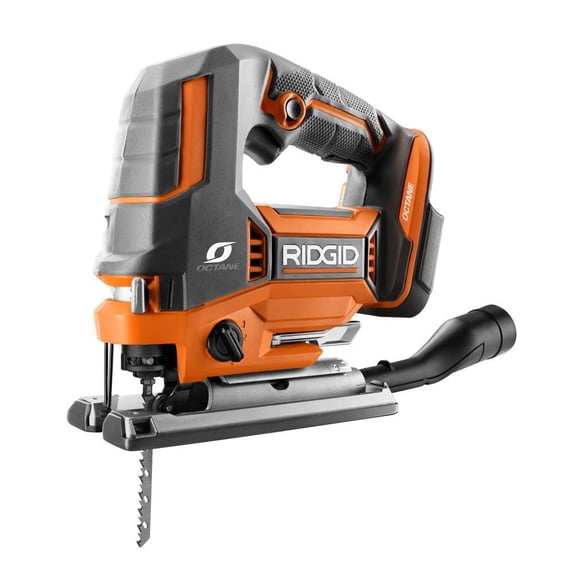
Your needs, this model
Does it fit your priorities?
Does the RIDGID R8832B accept T-shank blades, U-shank blades, or both?
The R8832 operator manual says the clamp is designed for both T- and U-shank blades. It does not establish which blade, if any, is in a particular U.S. standalone box; verify the actual blade and exact package before relying on an included blade.
Explore this need in the finder →What orbital settings does the R8832 manual assign to wood and plastic?
The manual lists four positions, 0–3. It associates setting 1 with plastics/PVC and scrolling or curving wood, setting 2 with plywood, decking and hardwood, and setting 3 with general lumber and softwood. It gives no species thickness or cut-quality guarantee; a one-inch stroke is not a cut-depth rating.
Explore this need in the finder →Can I keep the R8832 vacuum attachment connected while beveling?
No. The R8832 manual says not to use the dust-collection attachment with the base in a beveling position. Its blower and vacuum are alternative dust routes; the U.S. standalone package status is unknown, so verify the exact attachment and seller inventory.
Explore this need in the finder →Earlier model · document-based assessment, not a hands-on test
What is established about R8832B?
RIDGID’s current R86344B product page calls R8832B its previous model, and a RIDGID U.S. promotion lists R8832B in earlier tool-only combo packages. The manufacturer’s operator manual and repair sheet identify the saw body as R8832; the exact R8832B Home Depot Canada record points to that manual and gives a separate retail SKU. Together these sources support a distinct earlier 18V brushless jig-saw assessment, not an assumption that it shares every setting with R8831 or the later R86344B.
The U.S. standalone box contents are not settled. The exact Canadian listing describes a tool-only saw and lists a blade, vacuum attachment and operator manual, with battery and charger sold separately. That regional package record is useful context, but it is not a U.S. carton inventory. A U.S. combo-package listing does not tell us what an individual seller’s R8832B box contains. Ask for the nameplate and a written inventory rather than inferring that a battery, charger, blade, dust fitting or case will be included.
Speed controls and blade fit
The R8832 manual specifies a no-load range from zero to 3,500 strokes per minute and a one-inch stroke. That inch describes blade travel, not the thickness this saw can cut. The manual publishes no maximum depth or stock-thickness rating, and neither its speed range nor the OCTANE name is a substitute for a capacity table, runtime figure or comparative test.
The manual’s clamp is designed for both T-shank and U-shank blades. That is a meaningful distinction from the earlier R8831 manual, which specifies T-shank only. The included blade type remains unverified for a U.S. standalone package, so check the actual blade and saw label before using a mixed blade set. Blade shank compatibility also does not establish that a blade’s tooth pattern, length or material rating suits a particular workpiece.
The saw has a variable-speed trigger and a separate dial. Its Line-Start mode begins at a reduced speed until the blade engages, while numbered speed positions set different maximum speeds. The manual associates lower settings with starting cuts and certain harder materials, and higher settings with wood and some soft metals; it warns against extended use at low speed. These are maker instructions, not evidence of tested edge quality, cutting speed or battery life.
Use the orbital chart by material
The four orbital positions run from 0 through 3: position 0 has no orbit, position 1 has minimal orbit, position 2 medium orbit, and position 3 maximum orbit. RIDGID’s chart ties setting 1 to plastics/PVC and scrolling or curving wood; setting 2 to plywood, decking and hardwood; and setting 3 to general lumber and softwood. It assigns position 0 to thin sheet metal and countertop/laminate work. The guide’s matcher preserves those documented material/action differences instead of treating every orbital setting as interchangeable.
For metal or conduit, the manual specifically directs the saw to the no-orbit position and recommends a metal-cutting blade. It advises changing speed or tooth count if the blade heats, chatters or vibrates, and says not to force the tool. The publication does not give a metal gauge, named alloy capacity, wood thickness limit or measured finish. “Thin sheet metal” is therefore not a promise that a particular workpiece will fit this saw-and-blade combination.
Dust and bevel settings do not always coexist
A switch selects either cutline blower airflow or a vacuum route through the rear dust port; they are alternatives rather than simultaneous modes. The exact Canadian retail record lists the vacuum attachment, but the U.S. standalone package is not verified. A vacuum and hose are separate fit checks even where an adapter is available.
The important limitation is the shoe: RIDGID says not to use the dust-collection attachment while the base is in a beveling position. The base itself adjusts up to 45 degrees left or right, with positive stops at 0 and 45 degrees. The manual does not list 15-degree detents for this R8832 body. If beveling is essential, use the blower plan rather than matching an external-vacuum setup as if both functions were cleared together. The R8831’s separate 15-degree stop description should not be transferred to this saw.
How it sits between adjacent RIDGID models
R8832B is not just an R8831 package variant: its own model manual documents a different clamp and orbital control set, and its repair sheet has an R8832-specific switch and mechanism listing. The later R86344B page describes a four-mode selector, a one-touch blade clamp and a claimed 20% vibration reduction compared with R8832B. That is the successor manufacturer’s comparison, not an independent vibration measurement or proof of how every R8832B feels in use. Compare the separate R8831 assessment and R86344B review for their distinct source-backed setups.
Who should keep this earlier model in view?
On the documents alone, the R8832B is worth considering as an earlier RIDGID 18V body for someone who can verify its condition, accepts a compatible battery setup and values selectable T- or U-shank blades, material-specific orbital positions and a beveling shoe. The main reasons to pause are practical: the U.S. standalone box is unknown, and the verified retailer image shows the exact-model saw body but cannot establish what any U.S. offer includes. The manual gives no maximum cut depth, and the vacuum attachment cannot remain on the saw during beveling. A seller’s exact suffix, included parts, return terms and current condition need independent confirmation. No price, stock, customer experience, measured cut or personal use is represented here.
Primary references: RIDGID R8832 operator manual; RIDGID R8832 repair sheet; RIDGID Product Manuals search; Home Depot Canada exact R8832B listing (regional package evidence only); RIDGID U.S. R86344B successor page; RIDGID U.S. R8832B combo promotion; bounded exact-name SaferProducts.gov query. Sources checked October 30, 2026.
Key specifications
Key details at a glance
| Power source | Cordless |
|---|---|
| Battery platform | Ridgid 18v |
| Grip format | Top handle |
| Motor type | Brushless |
| Brushless motor | Yes |
| Blade interface | T- and U-shank |
| Cut-action settings | 0 / 1 / 2 / 3 |
| Maximum documented speed | 3500 SPM |
| Maximum documented bevel | 45° |
| Integrated cutline blower | Yes |
| Optional vacuum-extraction route documented | Yes |
| Stroke length | 1 in |
Use the exact model’s instructions for operating limits, supplied equipment and version differences.
Sources for this review
Sources for this assessment
- Official RIDGID 18 V Jig Saw R8832 operator manual
- Official RIDGID R8832 Jig Saw repair sheet, Revision 05
- RIDGID Product Manuals search for R8832 and linked model documents
- Home Depot Canada exact R8832B listing, model SKU 1001311413 (regional package evidence only)
- RIDGID U.S. R86344B product page naming R8832B as the previous model
- RIDGID U.S. promotion listing R8832B in tool-only combo packages
- Bounded exact-name SaferProducts.gov recall query for R8832B
- Walmart exact R8832B product-listing page (used for image identity only; not package evidence)
Make the next check about your project
Use the finder to combine material, blade interface, grip and operating setup. It matches documented capabilities, not guaranteed results.