
Your needs, this model
Does it fit your priorities?
Which orbital setting does RYOBI associate with hardwood versus softwood on the JS651L1?
The JS651L/JS651L1 chart assigns position 2/medium orbit to plywood, decking and hardwood, and position 3/maximum orbit to general lumber and softwood. These are manufacturer starting settings; the manual does not rate hardwood thickness or promise a particular edge finish.
Explore this need in the finder →Can the JS651L1 connect to an external vacuum, and is the hose in the package?
The manual identifies a rear vacuum port and directs the user to fit a 1 1/4-inch-diameter hose, which it explicitly says is not provided. It does not document the hose remaining compatible through bevel adjustment, so treat beveling as a separate setup unless RYOBI confirms otherwise.
Explore this need in the finder →What does the exact JS651L1 package list, and what blade types are identified?
The exact US page lists three jigsaw blades, an edge guide, an Allen wrench and a tool bag. The exact-family repair sheet itemizes two wood-cutting blades and one metal-cutting blade for the JS651L1 configuration. Check that the seller's suffix and included list match the exact package; the manual requires T-shank blades only.
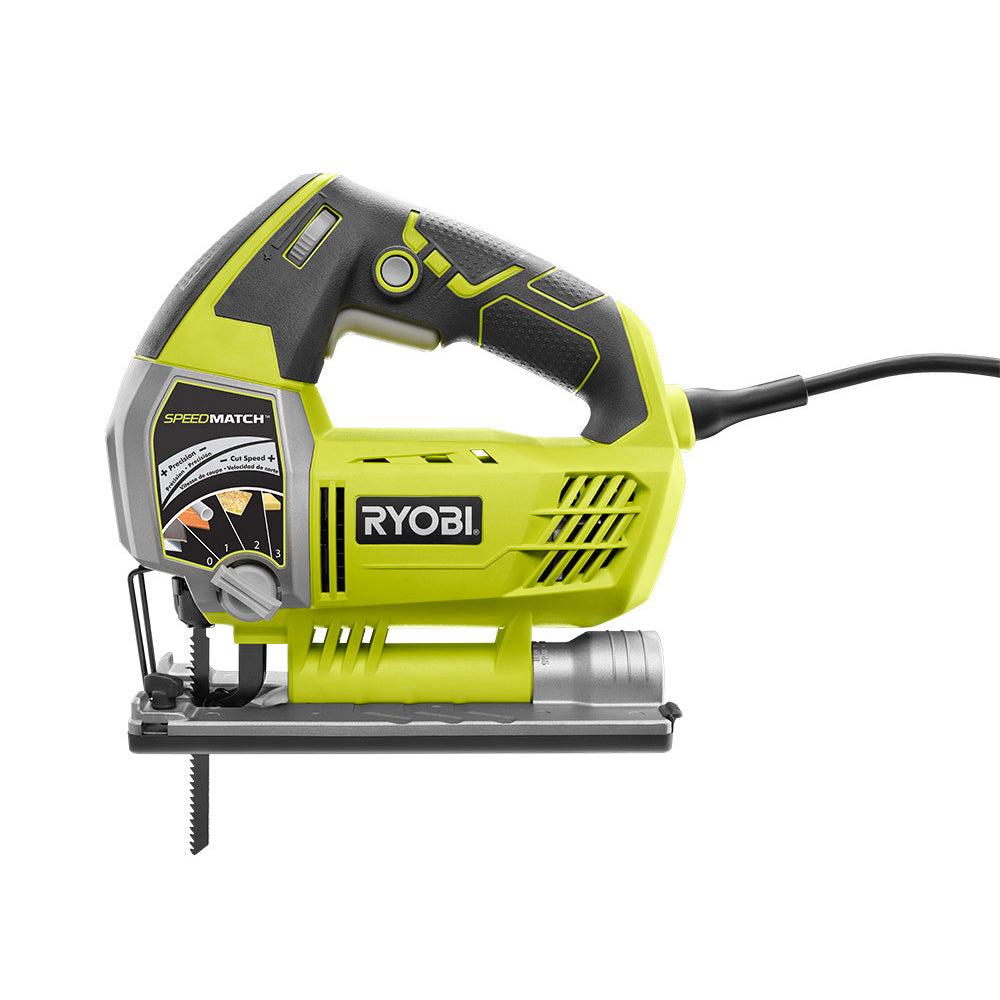
Explore this need in the finder →The RYOBI JS651L1 is a corded, top-handle jigsaw whose official name includes SpeedMatch. Its exact US product page identifies the 6.1-amp model and lists three blades, an edge guide, Allen wrench and tool bag. I also reviewed the JS651L/JS651L1 operator manual and the family repair sheet, which calls out JS651L1-specific motor, housing and drive components. The resulting assessment is tied to this exact retail suffix; it is not a user test and makes no claim about stock, seller contents beyond the documented package or measured cutting performance.
What the ratings and selector tell you
The manual's electrical table lists 120V AC, 60Hz and 6.1A. At 120V it gives a no-load range of 350–3,200 strokes per minute and a one-inch stroke. These numbers are specifications, not a promise that the saw will cut a given material faster than another model. The repair sheet's brush assemblies support a brushed-motor description. RYOBI's exact page calls the product SpeedMatch; the manual separately describes a variable-speed selector and lock-on trigger, plus an orbital-adjustment knob. In other words, the source evidence points to user-set controls, not automatic material recognition.
The manual says the blade clamp is designed for T-shank blades only. That is an important supply check if you already own blades or plan to buy a special-purpose blade. The three-blade count comes from the exact US product page. The repair sheet itemizes two wood-cutting blades and one metal-cutting blade for the JS651L/JS651L1 configuration, but any offer should still be checked against the exact JS651L1 suffix and its written package list. The same page names the edge guide, Allen wrench and tool bag; it does not describe a hard case.
Use the material chart, not just the orbital label
RYOBI's JS651L/JS651L1 chart assigns position 0 (no orbit) to countertop or laminate board and thin sheet metal. For the metal row it specifies a 14–24 TPI metal blade. Position 1/minimal orbit is paired with plastics and PVC, and with scrolling cuts in wood. Position 2/medium orbit is assigned to plywood, decking and hardwood; position 3/maximum orbit is listed for general lumber and softwood. The manual explicitly says metals and conduit should be cut with the orbital control at 0.
The settings are manufacturer guidance rather than a cut test. The manual describes higher orbit as faster but rougher, which is useful when weighing a tradeoff, but does not certify a clean edge or a maximum thickness. It also does not state a maximum cut depth. Follow blade-maker recommendations for stock type and tooth count, secure the material, and begin with a careful setup rather than assuming that a higher amperage or a longer stroke solves a capacity problem.
Vacuum connection and bevel setup are different arrangements
A clear distinction from the JS481LG is the JS651L1's documented rear vacuum port. The operator manual gives an installation step for a 1 1/4-inch-diameter hose and explicitly says that hose is not provided. It then instructs the user to begin cutting. The manual does not limit that hose instruction to a single orbital position, so the assessment connects the general extraction route with the separately charted material/action settings. That is an interpretation of the manual's setup and cutting sections, not a test of extraction efficiency.
The same manual describes bevel angles from 0° to 45° right or left, marked in 15° increments. The supplied 1/8-inch hex key is used to loosen the base pivot screw. A caution notes that the edge-guide knob may need to be moved or removed so that the blade clamp does not contact it during bevel cuts. The sources do not confirm that the rear hose remains compatible while adjusting or making a bevel cut, so the assessed vacuum plans leave bevel co-use unknown. The fact that the saw can bevel in a no-hose arrangement is separate from any claim about an attached extractor.
Comparison and purchase checks
Compared with RYOBI's JS481LG, the JS651L1 has a higher listed current draw (6.1A versus 4.8A), a one-inch rather than 3/4-inch stroke, a 3,200 rather than 3,000 SPM top specification, a three-blade package and a manual-documented 1 1/4-inch vacuum hose route. The JS481LG page lists one wood blade and its optional dust-port accessory has a part-number discrepancy between the family manual and repair sheet. These are meaningful documentary differences for setup and included equipment; they do not establish comparative torque, precision, durability, comfort or speed on a real cut.
Before ordering, confirm the JS651L1 model suffix and complete written list, make sure a compatible T-shank blade suits the workpiece, and plan for a separate 1 1/4-inch hose if extraction is required. Check whether the edge guide needs repositioning for a bevel setup. If a particular material thickness, bevel-with-vacuum arrangement, hard-metal/cast-iron task, ceramic tile or specific finished edge is essential, the sources reviewed here do not settle that question. The JS651L1 is best compared as a corded tool with a well-described manual chart and package—not as a guarantee of a particular result.
Key specifications
Key details at a glance
| Power source | Corded mains power |
|---|---|
| Grip format | Top handle |
| Motor type | Brushed |
| Brushless motor | No |
| Blade interface | T shank |
| Cut-action settings | 0 / 1 / 2 / 3 |
| Maximum documented speed | 3200 SPM |
| Maximum documented bevel | 45° |
| Battery included | No |
| Charger included | No |
| Blade listed in package | Yes |
| Carry bag listed in package | Yes |
| Optional vacuum-extraction route documented | Yes |
| Rated motor current | 6.1 A |
| Stroke length | 1 in |
| Hard case listed in package | No |
Use the exact model’s instructions for operating limits, supplied equipment and version differences.
Sources for this review
Sources for this assessment
Make the next check about your project
Use the finder to combine material, blade interface, grip and operating setup. It matches documented capabilities, not guaranteed results.