
Your needs, this model
Does it fit your priorities?
Does the P524 page list a battery and charger in the same package?
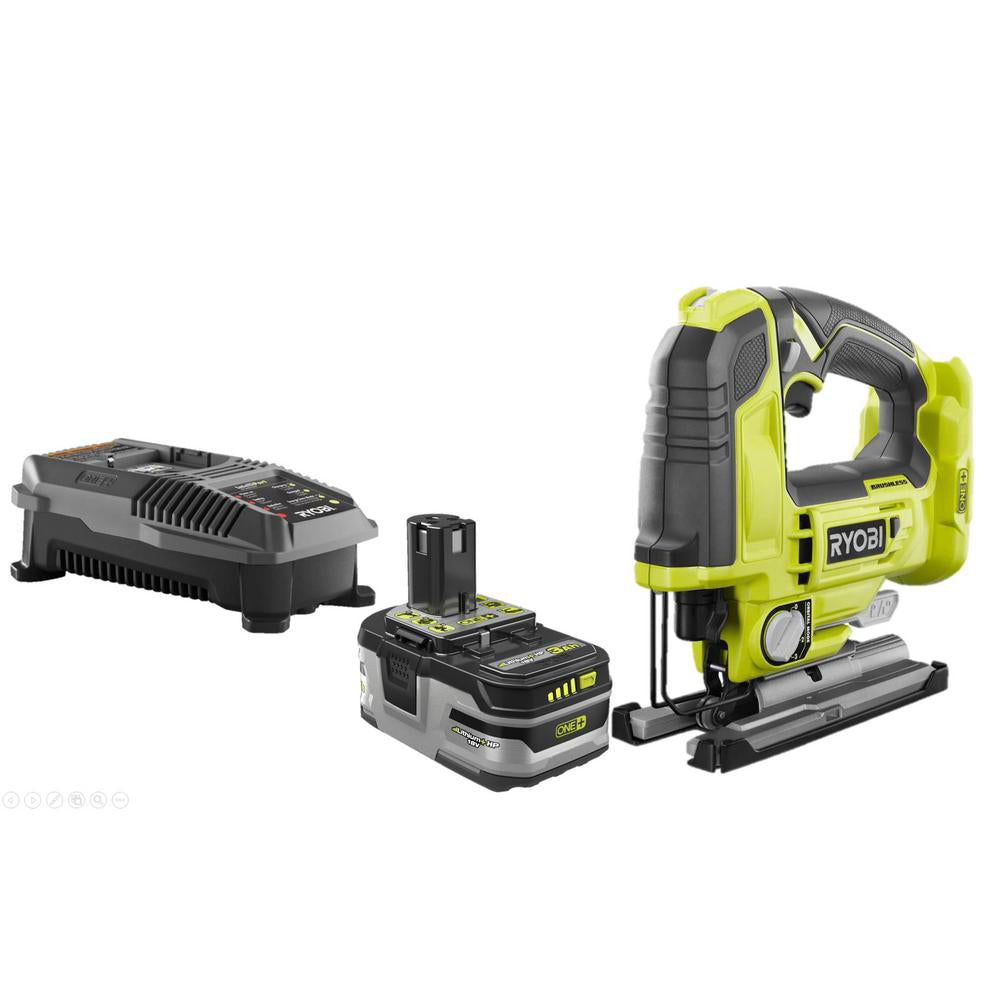
No. The exact P524 Includes list names the saw and a wood-cutting blade, while the separate P524KN kit page title specifies a 3.0Ah LITHIUM+ HP battery and 18V charger. That title does not identify the charger or battery model numbers or every small item. Match the exact suffix and verify the seller's carton.
Explore this need in the finder →Which P524 orbital setting does RYOBI chart for hardwood versus general softwood?
The P524 manual recommends setting 2/medium orbit for plywood, decking, and hardwood, and setting 3/maximum orbit for general lumber and softwood. It also assigns 0/no orbit to thin sheet metal and laminate and 1/minimal orbit to plastic/PVC or scrolling wood. These are manufacturer starting instructions, not a cut-depth or finish guarantee.
Explore this need in the finder →What blade and dust connections are documented for the P524?
The P524 manual says the clamp is for T-shank blades only. RYOBI describes a sight-line blower, but the checked P524 page/manual do not establish an external-vacuum adapter or hose route. Select a blade for the work and do not assume a vacuum fit.
Explore this need in the finder →What bevel range and speed range are stated for this model?
The manual lists 800–3,500 no-load SPM and a 1-inch stroke; its base can be angled 45° to either side, with positive stops at 0° and 45°. It advises checking intermediate angles with a protractor and removing the battery before adjustment. The page does not state a maximum cut depth, and the 4.0-lb listing does not say whether a pack is included in that weight.
Explore this need in the finder →This is a document-based review of the earlier US RYOBI P524 brushless jigsaw. It draws on the exact model page, the P524 operator's manual, and RYOBI's speed-control insert; it is not a hands-on test, and it makes no claim about present stock or a used tool's condition.
Identify the saw body and the package suffix
RYOBI's exact P524 page identifies an 18V ONE+ brushless jig saw and marks the model discontinued. Its written Includes list names the P524 saw and one wood-cutting blade. It does not list a battery or charger. A distinct page identifies P524KN as an 18V ONE+ brushless jigsaw kit with a 3.0Ah LITHIUM+ HP battery and an 18V charger. The P524KN title does not give either component's model number or a complete item-by-item carton list, so the suffix and seller's written contents still matter.
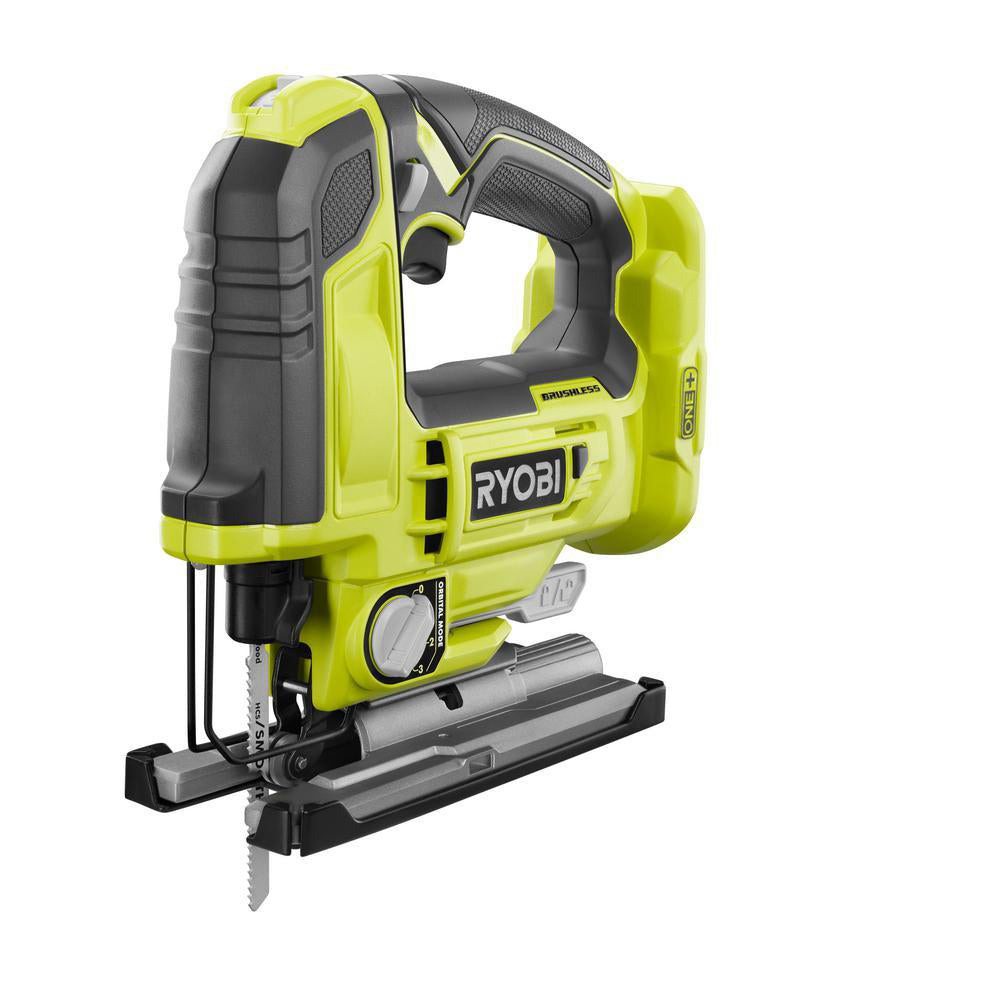
The P524 page publishes 4.0 lb, but does not say whether that figure includes a battery. Treat it as the manufacturer's listing value, not a measured bare-tool weight. Its product copy also lists a cast-aluminum non-marring shoe and sight-line blower. That blower helps clear the line; it is not a vacuum, and the P524 manual does not document an external-vacuum adapter or hose route.
Four settings with specific material guidance
The P524 manual's four-position chart is useful because it does not prescribe one action setting for every cut. Position 0 is no orbit: the chart names countertop or laminate board and thin sheet metal. Position 1 is minimal orbit for plastics and PVC; for scrolling or curving wood, the manual pairs that setting with a scrolling blade. Position 2 is medium orbit for plywood, decking, and hardwood. Position 3 is maximum orbit for general lumber and softwood.
Those are the manufacturer's starting recommendations, not results from comparative cutting. The manual describes more orbit as faster but rougher. Blade tooth pattern, stock, support, feed, and the line being followed all affect a cut, and none of the cited sources establishes a clean-edge promise. The chart's metal direction is no orbit with a suitable metal-cutting blade; the included blade is listed as a wood-cutting blade, so it should not be treated as a metal blade. Thin-sheet guidance is not a maximum-thickness rating. The reviewed sources do not publish a maximum cut depth or a rated stock-thickness limit, and they do not establish a ceramic or cast-iron application.
Speed control and bevel range
The P524 manual specifies an 800–3,500 no-load SPM range, a one-inch stroke, and four orbital settings. A lever above the handle sets the maximum speed while the trigger varies the saw from zero to that preset. A separate 2018 insert explains changing that limit before or during operation. The manual warns against prolonged continuous use at low speed because the saw may overheat. This is a variable-speed lever and trigger arrangement, not an automatic material selector.
The page and manual describe a 0–45° bevel range to either side. The manual identifies positive stops at 0° and 45°; 15° and 30° are indicated by the scale, not the same positive-stop arrangement. For intermediate angles it recommends a protractor. Removing the battery is part of the adjustment procedure. A stated range is not independent verification of angle accuracy, so check the base before a critical bevel cut.
Blade fit, dust, and limits
The manual is explicit that the clamp is for T-shank blades only and warns that a non-T-shank blade may not be retained correctly. It is a tool-free clamp, but the instructions still call for battery removal before blade work and checking that the blade is seated against the support roller. U-shank fit is not documented. RYOBI describes the sight-line blower, but the checked P524 sources do not establish a compatible vacuum fitting. Buyers who need dust collection should not substitute an assumed hose connection for model-specific confirmation.
The exact page and manual are silent on a maximum cut depth, maximum workpiece thickness, or a battery basis for the 4.0-lb figure. Those blanks matter more than a broad material list when deciding whether a particular stock is within the tool's limits. Clamp and support the work, select a blade for the actual material, follow the safety instructions, and verify clearances before beveling.
P524 versus the P524KN kit
P524 and P524KN should not be treated as two different cut-control designs based solely on their retail suffixes. The exact P524KN page titles the kit with a 3.0Ah LITHIUM+ HP battery and 18V charger; its official image shows the saw with a battery attached and charger beside it. The image does not prove the full carton list or identify the pack and charger models. Check the seller's exact suffix and written contents, especially for older stock.
Place it in the RYOBI lineup
The P524 is an earlier brushless top-handle model, not a current PCL525B or PBLJS01B with a transplanted name. Its own manual supplies the P524 settings and T-shank-only limit. In particular, do not borrow package contents, speed figures, dust arrangements, or current-reference status from those other saws. The maker's conditional faster-cutting claim is not repeated here as a measured advantage over another model.
For an owner of compatible RYOBI 18V ONE+ packs, P524's charted action choices, blower, and 45° bevel range describe a flexible documented setup. That assessment must be weighed against its earlier status, unresolved seller condition, exact-package uncertainty, no stated depth rating, and no documented vacuum route. Read the P524 manual and speed insert, and verify the exact model suffix, package, condition, and return terms before considering a listing. No ownership, customer experience, measured performance, or live availability is claimed here.
Key specifications
Key details at a glance
| Power source | Cordless |
|---|---|
| Battery platform | RYOBI 18V ONE+ |
| Grip format | Top handle |
| Motor type | Brushless |
| Brushless motor | Yes |
| Blade interface | T shank |
| Cut-action settings | 0 / 1 / 2 / 3 |
| Maximum documented speed | 3500 SPM |
| Maximum documented bevel | 45° |
| Battery included | No |
| Charger included | No |
| Blade listed in package | Yes |
| Carry bag listed in package | No |
| Integrated cutline blower | Yes |
| Stroke length | 1 in |
| Hard case listed in package | No |
Use the exact model’s instructions for operating limits, supplied equipment and version differences.
Sources for this review
Sources for this assessment
Make the next check about your project
Use the finder to combine material, blade interface, grip and operating setup. It matches documented capabilities, not guaranteed results.