
Your needs, this model
Does it fit your priorities?
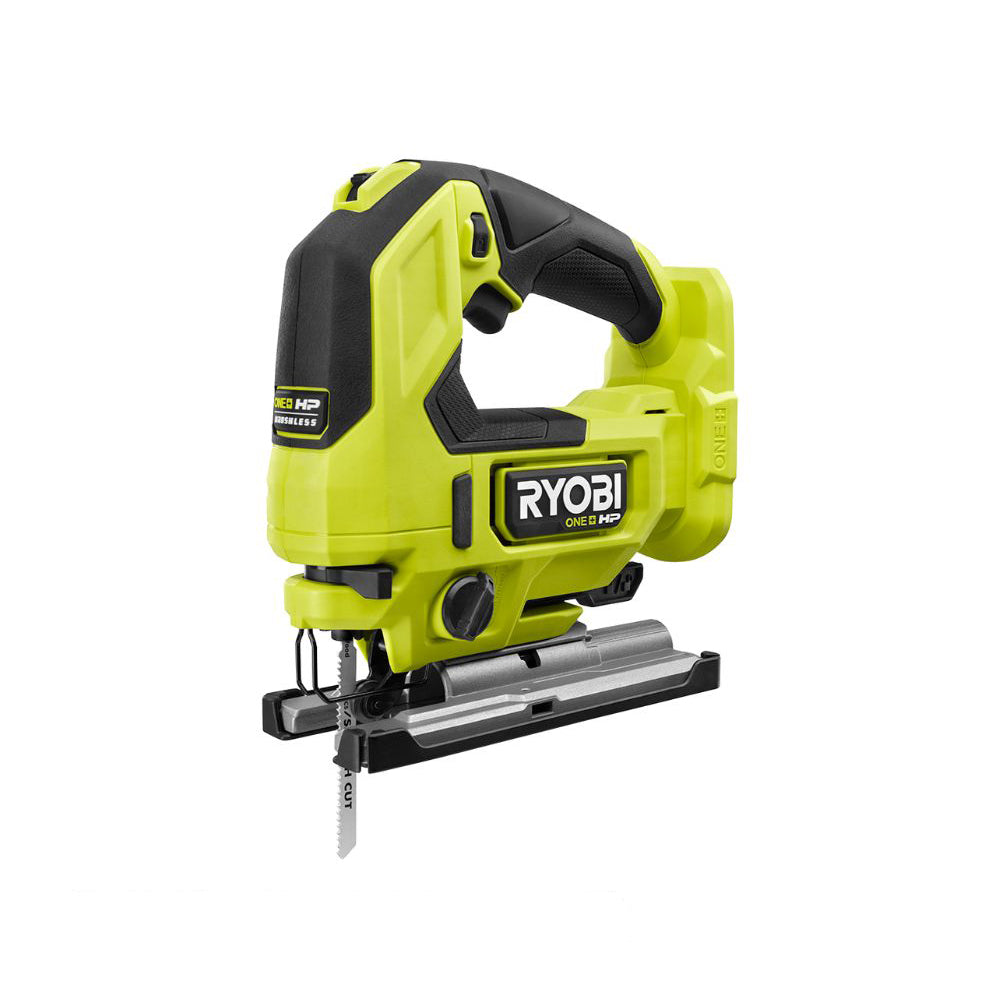
Does PBLJS01B include a RYOBI battery and charger?
No. The exact PBLJS01B US product-page details list the saw, a T-shank wood-cutting blade, non-marring shoe and operator's manual, and say the battery and charger are sold separately. RYOBI lists PBLJS01K1 as a distinct kit SKU; verify its specific included items rather than treating the tool-only suffix as a kit.
Explore this need in the finder →What blade shank does the PBLJS01 accept?
The PBLJS01 operator's manual says this saw is designed for T-shank blades only. The exact PBLJS01B page also lists a T-shank wood-cutting blade. U-shank fit is not established; check blade length, tooth pattern and intended material as well as the shank.
Explore this need in the finder →Which action setting is documented for hardwood?
The model manual maps setting 2 (medium orbit) to plywood, decking and hardwood. Setting 0 is straight/no orbit, setting 1 is minimum orbit for plastic/PVC or scrolling wood, and setting 3 is maximum orbit for general lumber and softwood. Metal should be cut with no orbit and a suitable blade. These are manufacturer recommendations, not our test results.
Explore this need in the finder →The RYOBI PBLJS01B is a current 18V ONE+ brushless jigsaw with a useful separation between its straight setting and three material-specific orbital settings. The reviewed PBLJS01B configuration is the tool-only SKU, not a battery-and-charger kit.
What the PBLJS01B package actually identifies
RYOBI's US page identifies the PBLJS01B as an 18V ONE+ HP brushless jigsaw. Its exact tool-only package description lists the saw, a T-shank wood-cutting blade, a non-marring shoe and the operator's manual; it says the battery and charger are sold separately. RYOBI lists the same saw body separately as kit SKU PBLJS01K1. That exact kit page names the PBLJS01 saw, a T-shank wood blade, one PBP002 2Ah battery, a charger and a tool bag; the charger model is not specified in the checked page. That suffix distinction matters more than the family name if you are buying a first RYOBI battery tool: the platform match does not by itself tell you what is in the box or predict runtime.
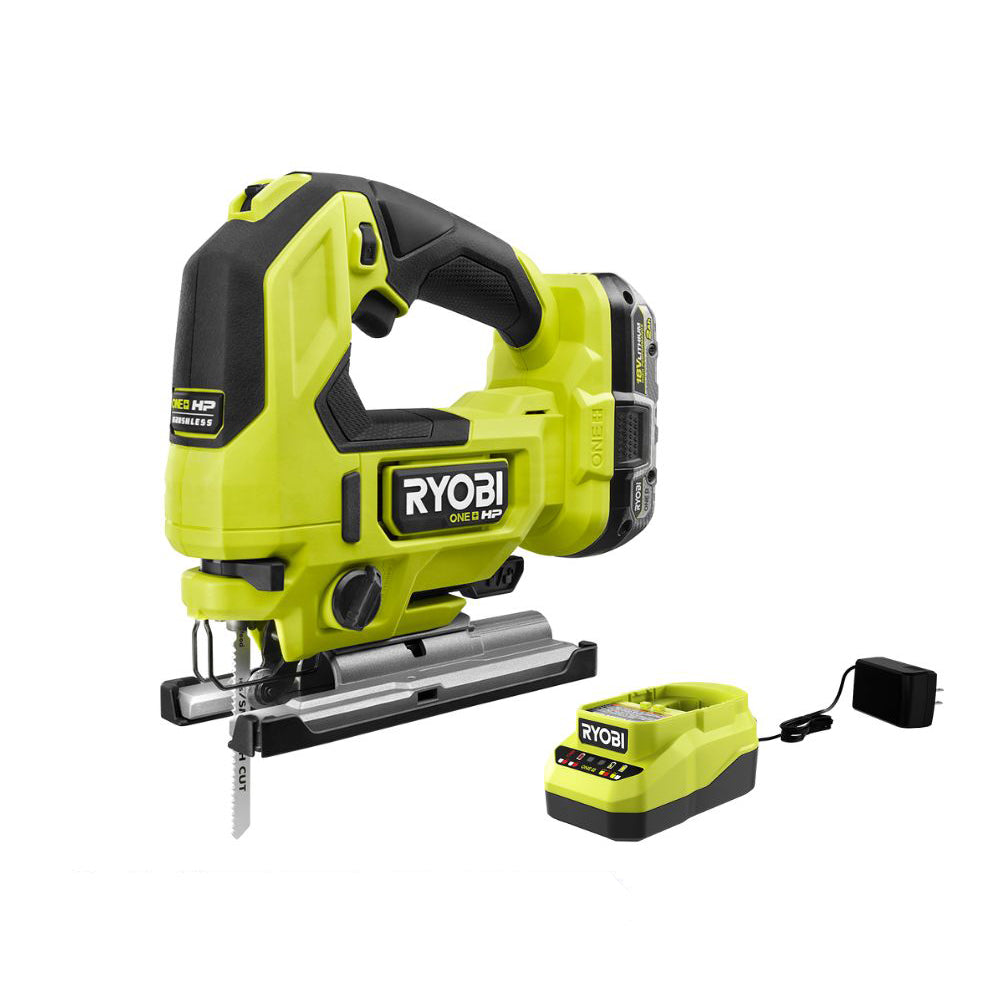
This is a top-handle configuration, and the official page presents it as an HP brushless model. Those labels describe product design, not an independent performance test. The 18V ONE+ system may be a convenient fit for an existing RYOBI pack owner, but the page's general compatibility language is not a reason to assume an unrelated brand's pack will fit.
Four action positions are not four interchangeable recipes
The PBLJS01 manual lists a 1-inch stroke, a no-load speed range of 800–3,400 SPM and four orbital positions. It pairs those positions with specific work: position 0 is straight/no-orbit for countertop or laminate board and thin sheet metal; position 1 is minimum orbit for plastics and PVC or scrolling and curving wood cuts; position 2 is medium orbit for plywood, decking and hardwood; and position 3 is maximum orbit for general lumber and softwood. The manual says lower orbit can make a smoother, slower cut, while higher orbit trades a rougher finish for faster action. That is guidance from the manufacturer, not a result measured here.
For a shopper comparing this with a simpler saw that offers only one or two motion settings, the useful distinction is not merely the number on the selector. It is whether the manual documents a setting for the actual material and cut. The PBLJS01 guide specifically assigns metal to setting 0. Its metal section recommends an appropriate metal-cutting blade, firm support and speed adjustment if the blade heats or chatters; it does not authorize orbital metal cutting. No hard-metal, ceramic or numeric material-thickness rating is established by the checked sources.
Blade fit and bevel adjustment
The blade interface is unusually clear: the PBLJS01 manual says the saw is designed for T-shank blades only, and the PBLJS01B page lists a T-shank wood blade in the package. Do not infer U-shank compatibility from another jigsaw in the same battery family. The manual also stresses inserting a blade fully and confirming that it locks and sits in the support roller before operating. The listed package's wood blade is not a universal answer for metal, plastic or fine scroll work; match tooth pattern and blade construction to the job.
The shoe can be angled left or right through 45 degrees. The manual describes positive positions at 0 and 45 degrees and gives intermediate 15- and 30-degree arrangements, with a protractor recommended when an exact angle matters. This is a useful documented capability, but the shoe should be reset and checked before a cut rather than treating its detents as a precision measurement.
Limitations that should stay visible
The model-specific manual warns against extended use at low speed under constant load because the saw may overheat; it recommends cooling the tool unloaded at full speed if that happens. It also warns against forcing the saw and recommends securing work. These practical limits are more decision-relevant than promotional percentage comparisons, which depend on a stated test material and comparison model and should not be read as a guarantee for a different battery, blade or cut.
The exact current US page and manual reviewed here do not establish a maximum cutting depth, a tool weight, a built-in cutline blower or a compatible external-vacuum setup. The manual mentions an optional edge guide and labels it not included. Unknown does not mean absent from every possible accessory offer, but it is not a documented match for a shopper who requires one of those details.
Who should shortlist it?
PBLJS01B makes most sense as a source-documented option for someone already using RYOBI 18V ONE+ batteries who wants a T-shank-only top-handle saw and will follow the manual's action/material chart. It is also worth comparing with other saws if hardwood, plastic and softwood work call for different orbit positions. A buyer without a compatible battery should compare the exact PBLJS01K1 package, whose page lists a PBP002 2Ah battery, a charger, a T-shank wood blade and a tool bag; the charger model is not named on that page.
This assessment is based on the exact US model page, the PBLJS01 operator's manual and a bounded exact-name recall query. No hands-on cutting, ownership or performance testing is claimed; check the current manual and exact seller SKU before purchase.
Key specifications
Key details at a glance
| Power source | Cordless |
|---|---|
| Battery platform | RYOBI 18V ONE+ |
| Grip format | Top handle |
| Motor type | Brushless |
| Brushless motor | Yes |
| Blade interface | T shank |
| Cut-action settings | 0 / 1 / 2 / 3 |
| Maximum documented speed | 3400 SPM |
| Maximum documented bevel | 45° |
| Battery included | No |
| Charger included | No |
| Blade listed in package | Yes |
| Stroke length | 1 in |
Use the exact model’s instructions for operating limits, supplied equipment and version differences.
Sources for this review
Sources for this assessment

Make the next check about your project
Use the finder to combine material, blade interface, grip and operating setup. It matches documented capabilities, not guaranteed results.