
Your needs, this model
Does it fit your priorities?
Does JS314901 take T-shank and U-shank blades?
Its manual and official product material say the clamp accepts most common T- and U-shank blades. The included blades are named by use, not by shank, so check the packaging.
Explore this need in the finder →Can the JS314901 cut plastic with orbital action?
The 6A manual assigns setting 2 to fast plastic cutting and setting 0 to accurate no-orbit cutting. Use a scrap test rather than treating that setting as a promised edge finish.
Explore this need in the finder →Which metal capacity should I trust for JS314901?
The product page lists 9 mm metal capacity but its linked manual lists 6 mm. This guide uses the manual figure and preserves the discrepancy; neither is a measured cut result.
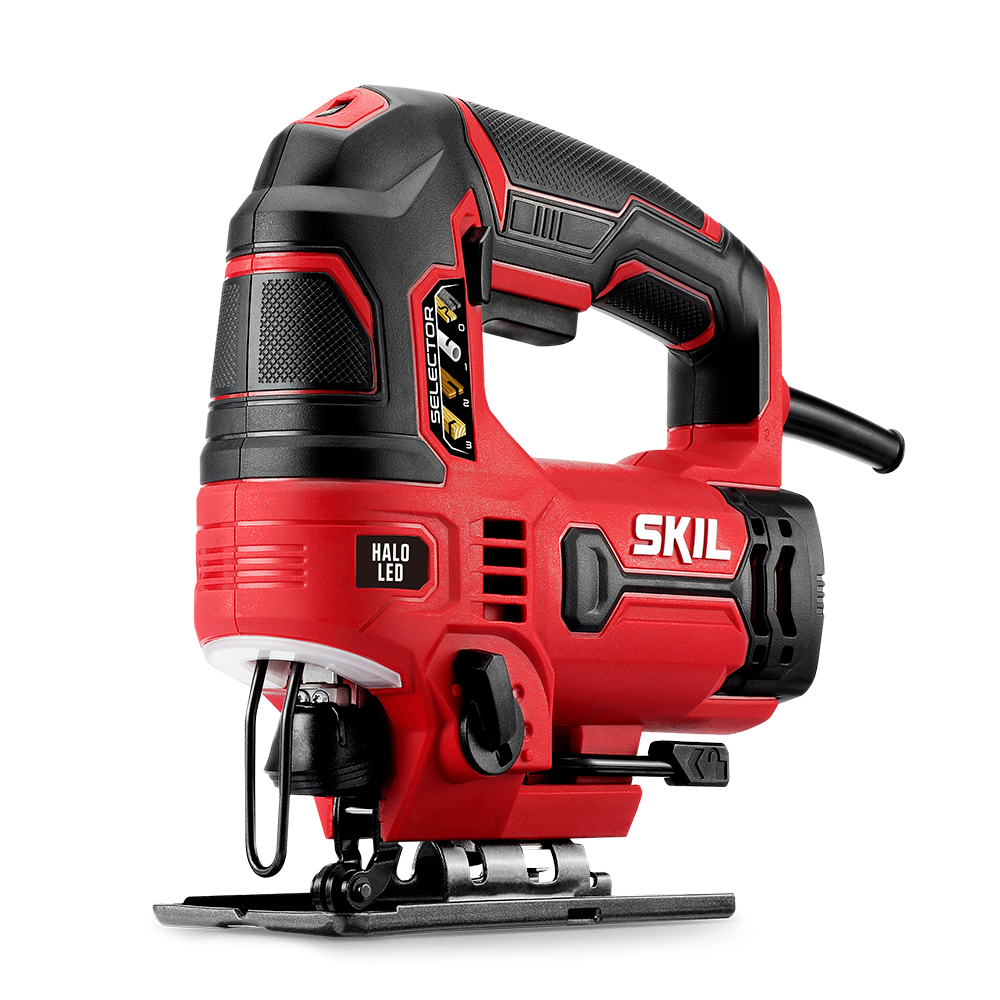
Explore this need in the finder →The SKIL JS314901 is a 6A corded jigsaw for a 120V, 60Hz supply. Its US product page describes four orbital settings, speed control, a dust-blowing switch, a tool-free blade clamp, bevel adjustment and a Halo light. The linked JS314901 manual identifies a 23 mm stroke and no-load range of 800–3,200 strokes per minute. The page lists the tool at 4.63 pounds; treat that as a manufacturer specification, not a weighed saw. I have not used or tested it.
One specification conflict matters for metal
SKIL’s product page lists a 9 mm metal capacity, while the exact model manual says 6 mm. The manual also lists 85 mm wood and 16 mm aluminum capacities. These are source specifications, not measured performance. Because the two official documents disagree, I use the lower manual figure for conservative editorial guidance and retain the page’s 9 mm statement as a conflict. Neither number promises a result for every alloy, blade, cut direction or work-support arrangement.
The JS314901 is a separate saw from SKIL’s 5A JS313101. The 6A manual lists 85 mm wood capacity and a 23 mm stroke; the 5A manual lists 75 mm and 18 mm. The 6A page also describes a tool-free shoe adjustment and Halo light. Those differences may matter if you want more published capacity or a quicker adjustment; they do not establish that the 6A model makes a cleaner or faster cut.
Match orbit to the work rather than choosing a speed by habit
The manual maps position 0 to accurate cutting in all materials, position 1 to faster metal cutting, position 2 to plastic and position 3 to hard wood. It also warns that the higher orbital settings are intended for straight cuts, and says to try scrap first. “Hard wood” is the manual’s phrase, not a full chart of lumber species or a guarantee for every hardwood. Choose a blade rated for the material and use zero orbit for splinter-sensitive stock. A lower edge-splintering risk still depends on blade, feed, support and cut direction.
The exact manual names T- and U-shank blade compatibility. Its tool-free clamp is useful if your blade collection includes both common standards, but the instructions say “most commonly available,” not every length or profile. The package lists one wood blade and one metal blade without telling you which shank they use. Check the blade packaging rather than assuming the blades are a matched set for every job.
Blower, bevel and the corded trade-off
The blower moves dust away from the cutline; it is not a dust extractor. The page and manual do not establish a vacuum adapter or hose fit. The product page describes tool-free bevel adjustment; the manual gives 0- and 45-degree shoe positions. SKIL’s 6A setup is the more convenient of the two corded models if repeated bevel changes are central, because the 5A JS313101 manual uses a hex wrench. The adjustment method still needs to suit the user and work surface.
A corded tool avoids choosing a battery pack for each session, but the cord requires an outlet and a clear route that does not cross the cut. The manual calls for clamping the work and disconnecting the plug before blade or shoe changes. There is no case or vacuum accessory in the listed JS314901 box contents, so make a separate plan if storage or captured dust is essential.
Who should shortlist this 6A model?
Consider the JS314901 when you want a corded 120V saw, tool-free bevel adjustment, a Halo light and the option to fit common T- or U-shank blades. The four-position selector gives the manual a clear material-specific starting point for metal, plastic and hard wood. Its published measurements and capacities give a useful comparison point with the lighter-current JS313101, but they are not a hands-on verdict.
Hold back if you need a settled metal-depth threshold without checking the manual/product-page discrepancy, a published hardwood species limit, a vacuum connection, or a complete package with a case. The official JS314901 page showed the product listed but sold out when checked; this assessment does not imply current retailer availability. Confirm the exact model, manual, seller, package contents and return terms before purchase.
Key specifications
Key details at a glance
| Power source | Corded mains power |
|---|---|
| Grip format | Top handle |
| Blade interface | T- and u-shank |
| Cut-action settings | 0 / 1 / 2 / 3 |
| Maximum documented speed | 3200 SPM |
| Maximum documented bevel | 45° |
| Battery included | No |
| Charger included | No |
| Blade listed in package | Yes |
| Integrated cutline blower | Yes |
| Rated motor current | 6 A |
| Stroke length | 0.91 in |
| Maximum listed cutting capacity | 3.35 in |
| Hard case listed in package | No |
Use the exact model’s instructions for operating limits, supplied equipment and version differences.
Sources for this review
Sources for this assessment
Make the next check about your project
Use the finder to combine material, blade interface, grip and operating setup. It matches documented capabilities, not guaranteed results.