
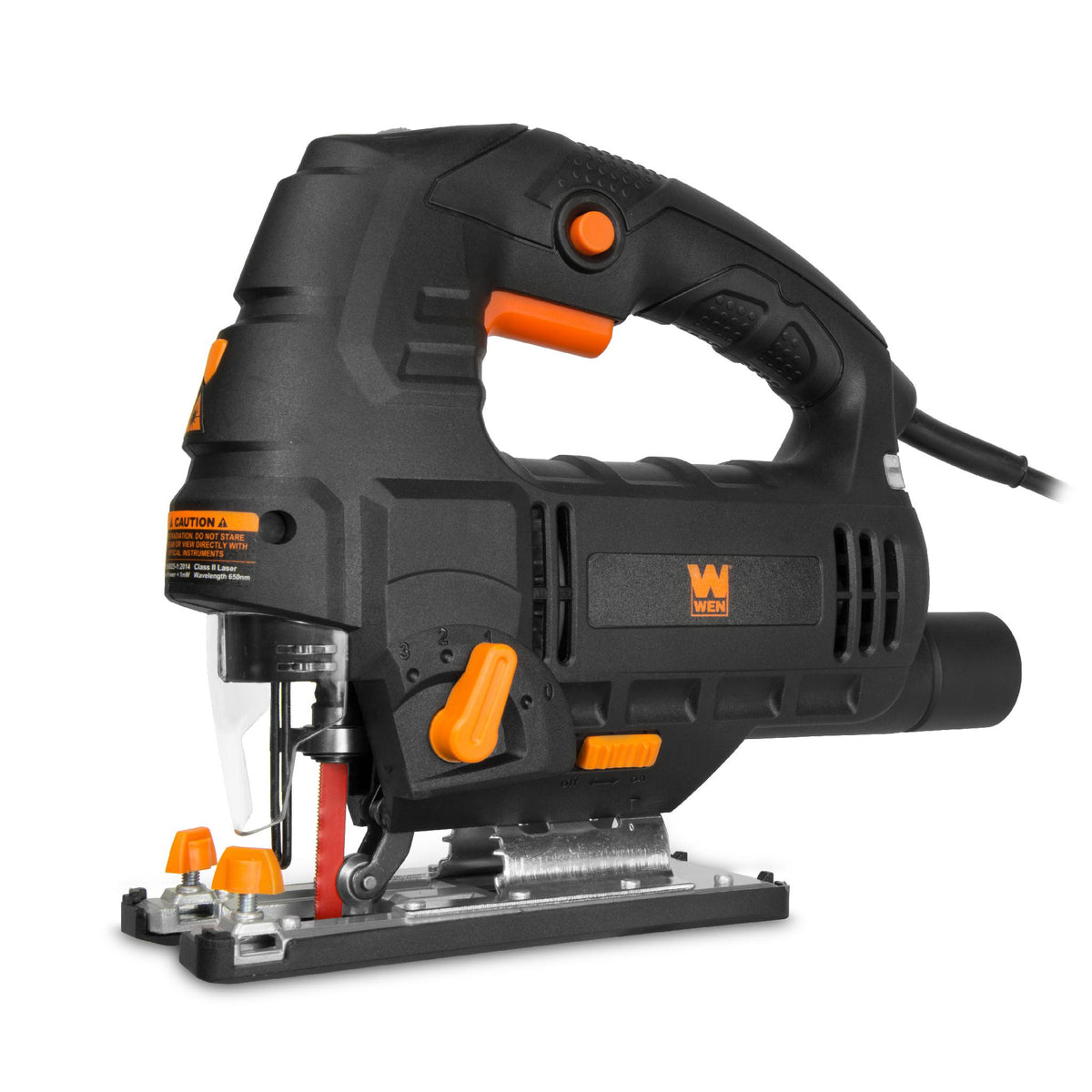
Your needs, this model
Does it fit your priorities?
Will the 33606 accept my U-shank blades?
No. WEN's 33606 manual says this model accepts T-shank blades and does not accept U-shank blades. The manual lists a wood blade and metal blade in the box; check the shank shape of your existing blades instead of assuming a brand name guarantees fit.
Explore this need in the finder →Can I connect a vacuum to the WEN 33606?
Yes, when the included dust-port adapter is attached to a suitable extractor: the manual says to switch the air-blowing function off for extraction and lists a 1-1/2-inch adapter outlet. The adapter is not a vacuum, and the manual presents blower and extraction as alternative settings.
Explore this need in the finder →Which orbital setting does the 33606 manual suggest for plastic?
WEN describes settings 2 and 3 for soft materials such as plastic: setting 2 favors cleaner cutting or delicate scrolling, while setting 3 favors faster, more aggressive cutting. It calls the chart guidance and recommends test cuts in scrap; pair the setting with a suitable blade and the actual plastic.
Explore this need in the finder →Is the WEN 33606 a fit for ceramic tile?
The exact 33606 product page and manual do not document ceramic cutting or a ceramic blade, so this assessment does not recommend it for that requirement. Use a saw and blade explicitly specified for the tile material rather than extending WEN's wood and metal capacity figures to ceramic.
Explore this need in the finder →The WEN 33606 is a corded, top-handle jigsaw whose appeal is the breadth of setup choices documented for one relatively simple package: a variable-speed dial, four blade-path positions, a cutline blower that can be switched off for dust extraction, and a shoe that tilts both ways. This is a source-based assessment of the exact U.S. model, not a hands-on review. The 120V, 6.6A motor and the stated capacities come from WEN's listing and manual; they do not establish how quickly or cleanly this saw will cut a particular board.
Speed and blade action are separate choices
WEN describes a variable-speed dial with six numbered settings. Its manual calls setting 6 the top setting at 3,300 strokes per minute; it does not publish a calibrated minimum for the lower dial positions. Choose a speed for the stock and blade rather than reading the highest number as a promise of cut quality. The manual advises slower strokes for denser material and suggests trial cuts in scrap.
The four-position orbit selector changes how the blade moves. Position 0 is the straight up-and-down path, which WEN describes for smooth cutting and identifies for metals or thin sheet. Position 1 is its guidance for medium-hard material such as hardwood or aluminum. Positions 2 and 3 are aimed at soft materials such as wood and plastic: the lower of those orbital settings favors a cleaner edge or delicate scrolling, while 3 is the faster, more aggressive choice. Those are the manufacturer's guidelines, not universal recipes. The actual species or plastic, blade tooth pattern, support under the work and feed still matter; WEN explicitly recommends testing scrap.
T-shank only, with two blades listed
The manual is unusually clear about compatibility: the quick-change clamp is for T-shank blades and does not accept U-shank blades. WEN lists a four-inch wood blade and a 3-3/8-inch metal blade with the saw, along with a parallel fence, dust-port adapter and hex wrench. Check the package suffix and the retailer's exact contents before buying; the manual's standard parts list is not proof that every reseller carton is identical. If you already own a blade assortment, verify the shank and select a blade rated for the material rather than relying on color or brand alone.
WEN publishes 4-1/4 inches for wood and 3/8 inch for metal. These are the maker's capacity figures, not measurements made for this assessment and not a guarantee that every blade or material at that thickness is suitable. The manual says to choose a blade for the application and notes that very fine teeth are appropriate for plastic, aluminum and steel. Its stated wood/metal limits should not be transferred to ceramic, cast iron, or another unlisted material.
Blower or vacuum, not both at once
The front air control selects between blowing chips away from the cutline and using the rear dust port for extraction. For the vacuum route, WEN includes an adapter with a listed 1-1/2-inch outer diameter; the manual says to switch the blower off and connect a dust collector. That adapter is not a vacuum, hose or dust extractor. This is useful flexibility for a workshop that already has compatible extraction, but it should not be mistaken for dust capture in the default blower position.
The manual also specifies a shoe bevel range of 45 degrees left and right, with marks at 0, 22.5 and 45 degrees. Adjustment uses the included hex wrench, so this is a setup step rather than a documented tool-free bevel release. The package's parallel fence helps with guided straight or circle work, but no guide attachment turns the jigsaw into a substitute for a saw designed for long, repeatable straight cuts.
Where the 33606 fits—and where it does not
This model makes sense to shortlist when a 120V cord is acceptable, you need a top-handle grip and T-shank system, and you want to choose between an air-blown cutline and an optional vacuum connection. Its selectable action is more useful than a one-mode saw only if you will match the setting and blade to the material. The cord, 5.4-pound manual-listed weight and wrench-adjusted shoe are practical trade-offs to check against your work area and handling preferences.
It is not a match for someone who needs cordless operation, U-shank compatibility, or a documented ceramic cutting plan. A vacuum must be supplied separately, and the manual presents blower and extraction modes as alternatives. The manual identifies the laser as Class 2 and includes specific laser-safety warnings; treat that as an accessory needing care, not as proof that the cut will be more accurate. For visual work, establish the line, clamp the workpiece and make a trial cut rather than expecting a laser or any published feature list to settle the finish question.
Package and evidence checks
Before comparing offers, confirm that the model is 33606, that the saw is supplied for the U.S. 120V/60Hz supply, and that the box includes the accessories you expect. Do not infer current price, stock, retailer bundles or buyer experience from the manufacturer's product page. The exact-name CPSC lookup returned no 33606 records on the check date, a bounded search rather than a guarantee about future notices or alternate naming.
This assessment uses WEN's exact 33606 product page, its 33606 instruction manual, and a bounded CPSC model-name lookup. No ownership, test cut, measured output, retailer stock, price, rating or ASIN is represented.
Key specifications
Key details at a glance
| Power source | Corded mains power |
|---|---|
| Grip format | Top handle |
| Blade interface | T-shank only |
| Cut-action settings | 0 / 1 / 2 / 3 |
| Maximum documented speed | 3300 SPM |
| Maximum documented bevel | 45° |
| Battery included | No |
| Charger included | No |
| Blade listed in package | Yes |
| Integrated cutline blower | Yes |
| Optional vacuum-extraction route documented | Yes |
| Rated motor current | 6.6 A |
| Maximum listed cutting capacity | 4.25 in |
Use the exact model’s instructions for operating limits, supplied equipment and version differences.
Sources for this review
Sources for this assessment
Make the next check about your project
Use the finder to combine material, blade interface, grip and operating setup. It matches documented capabilities, not guaranteed results.