
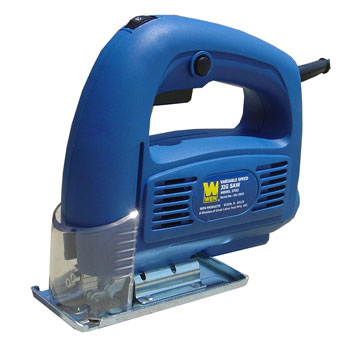
Your needs, this model
Does it fit your priorities?
Does the WEN 3702 documentation prove T- or U-shank blade support?
No. The WEN 3702 manual shows the blade inserted into a holder and tightened with two lock bolts using a hex key, but does not identify a T- or U-shank standard. The WEN legacy page's 'quick change' language is not enough to prove a shank format. Check the exact model-marked manual, blade and holder before buying replacements; the finder deliberately does not match either shank option from this evidence.
Explore this need in the finder →How far can the WEN 3702 shoe bevel?
The WEN model manual describes the base plate tilting up to 45 degrees left or right. It requires loosening the two shoe screws, repositioning the shoe and blade roller guide, then tightening the screws. The printed scale is described for 45° and 90°; the manual recommends a protractor for other angles. These instructions do not prove a particular blade, cut depth or material capacity.
Explore this need in the finder →What cut depths or workpiece materials does the WEN 3702 manual rate?
The exact 3702 manual lists electrical rating, 500–3,000 SPM, a 3/4-inch stroke and shoe angles, but the reviewed pages do not give a wood/metal cut-depth table or material-by-setting chart. Stroke length is not cut capacity. Do not borrow the 4-inch wood or 3/8-inch metal figures from the different WEN 3602; the 3702 manual also says not to cut hollow pipe.
Explore this need in the finder →The WEN 3702 is a historical corded jig saw documented in the company’s legacy U.S. product page and a WEN-authored model manual. That manual lists 120V, 60Hz and 3.5A, a six-position speed switch, a 3/4-inch stroke, a 4.2-pound weight and a shoe that tilts left or right up to 45 degrees. This is a document-based assessment, not a report from using or testing a surviving tool. The old page and manual identify the model, but do not establish what any current seller has in stock or what is inside a particular used box.
Speed is documented; a material chart is not
WEN’s manual gives the 3702 a 500–3,000-stroke-per-minute range, controlled by a six-position roll switch at the top front of the handle. Its advice is general: set the speed for the material, move more slowly for denser stock and faster for softer stock. It also cautions that running at low speed for an extended time can raise motor temperature because the internal cooling fan turns more slowly. That guidance is not a model-specific material chart. The sources I checked do not give the 3702 a wood, metal or plastic cut-depth rating, so there is no supported numeric workpiece-thickness match here.
The 3/4-inch stroke is the blade’s travel, not the maximum depth of a cut. WEN’s 3702 page and manual do not supply a cut-capacity table that would let a buyer turn the stroke number into a safe stock limit. The manual also says not to cut hollow pipe. That explicit restriction and the absence of material capacities make this a narrower recommendation than WEN’s 3602: do not borrow the 3602’s 4-inch wood or 3/8-inch metal ratings, or its orbital settings, for the 3702.
Confirm the blade holder instead of trusting a shorthand label
The legacy WEN page calls the 3702 clamp a quick-change design that needs no tools. The model manual’s blade-changing procedure, however, instructs the user to loosen two blade-lock bolts with a hex key, insert a blade into the holder and tighten both bolts. The manual’s parts list includes an L spanner and a blade as component references, but it is not a retail package list. Since those descriptions do not line up cleanly, this review does not call the clamp tool-free or assume an included blade. The manual also does not name T-shank or U-shank compatibility. Before buying replacement blades, compare the exact holder and the model-marked documentation; a generic “jigsaw blade” label is not enough.
The manual describes a blade guide roller and says to align it with the back of the blade, then lubricate it frequently when cutting metals. Those instructions explain an adjustment and maintenance point, but they do not establish that the 3702 is suitable for a particular metal, blade tooth count or thickness. A buyer examining an older example should inspect the clamp bolts, roller and shoe for wear or damage and confirm that any adjustment key is present.
The bevel shoe is useful but requires a deliberate setup
WEN’s manual says the base can tilt anywhere from zero to 45 degrees left or right. To make the adjustment, it directs the operator to loosen two shoe screws, shift the base plate, set the blade roller guide back in its proper position and retighten the screws. The printed scale is for 45-degree and 90-degree references; the manual recommends a protractor for other angles. This is a manual adjustment, not an advertised quick-stop system. The product diagram and manual do not establish positive intermediate detents, a dust port, a blower, a vacuum adapter or whether an external collector can be used with the shoe at an angle.
The 4.2-pound weight is a manufacturer figure, not a carry test. As with any older corded tool, a surviving unit’s cord, grounding plug, switch and housing condition matter more than the figure on the manual page. The manual says to unplug the saw before blade changes or adjustments and to secure the work rather than holding it by hand; follow the exact manual and inspect the actual tool before deciding it is safe to use.
How it compares with WEN 3602
The two models are separate evidence records, not suffix variants. WEN 3602 has a 6-amp rating, T-shank-only documentation, a four-position orbital control and manufacturer-stated wood/metal capacities. The 3702 manual instead gives a 3.5-amp motor, a lower 500-SPM minimum, a 3/4-inch stroke and bevel-adjustment instructions, while leaving blade shank, material capacities and orbital behavior unspecified in the reviewed documents. The legacy 3702 page’s no-tool quick-change wording also differs from the manual’s two-bolt procedure. Those are meaningful differences for a shopper: the 3702 should not be treated as a lower-powered 3602 with the same accessories or workpiece limits.
Consider the 3702 only when the exact model and condition can be verified and the job does not depend on an undocumented blade standard, material capacity, dust route or orbital setting. The legacy WEN page once pointed to online sellers, but that aged link is not proof of current stock, price, package contents or return rights. Ask for a clear image of the nameplate and clamp, the actual manual and exact box contents, and check the seller’s return terms. If those details cannot be confirmed, the evidence supports keeping the 3702 as a historical reference rather than guessing what a listing means.
Key specifications
Key details at a glance
| Power source | Corded mains power |
|---|---|
| Grip format | Top handle |
| Maximum documented speed | 3000 SPM |
| Maximum documented bevel | 45° |
| Rated motor current | 3.5 A |
| Stroke length | 0.75 in |
Use the exact model’s instructions for operating limits, supplied equipment and version differences.
Sources for this review
Sources for this assessment
Make the next check about your project
Use the finder to combine material, blade interface, grip and operating setup. It matches documented capabilities, not guaranteed results.