
Your needs, this model
Does it fit your priorities?
Can the JS451L accept a U-shank blade for a straight-action soft-metal setup?
Yes. The JS451L manual expressly says the rapid-change clamp accepts both T- and U-shank blades. For metal or conduit, it directs the operator to setting 0/no orbit and says a metal-cutting blade is not included. It names aluminum, brass and copper as soft metals in speed guidance, but supplies no metal-thickness rating.
Explore this need in the finder →What is the JS451L's maximum cutting depth?
The checked JS451L product page and manual do not give a maximum stock thickness or cut-depth rating. The manual's 3/4-inch figure is blade stroke length, not material capacity, so it should not be substituted as a depth limit.
Explore this need in the finder →Is a vacuum connection listed, and what else is needed?
The manual's packing list includes a vacuum attachment and its instructions call for a separate 1-1/4-inch hose connected to an external vacuum. Neither hose nor vacuum is on that list. The manual does not establish that the attachment can stay installed during bevel cutting.
Explore this need in the finder →Is the projected laser a substitute for checking the blade path?
No. The manual describes a red guide line that illuminates with the trigger and includes adjustment instructions for aligning it to a pencil line. It is a reference to calibrate, not a tested accuracy claim or a replacement for verifying the blade against the workpiece.
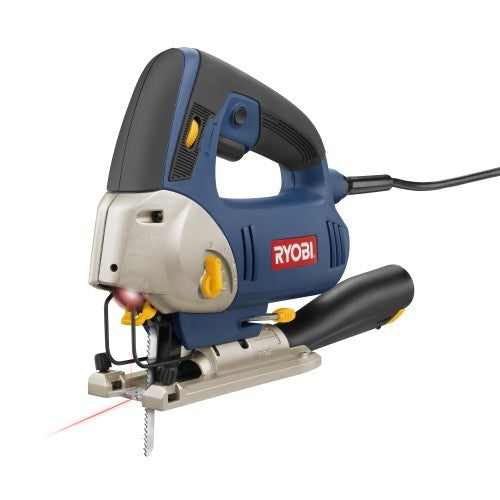
Explore this need in the finder →The JS451L is a discontinued corded jigsaw, not a cordless ONE+ tool. Its model-specific manual describes a 120-volt, 4.8-amp saw with variable speed, four orbital positions, and an unusual practical distinction among older jigsaws: the clamp is expressly designed for both T- and U-shank blades. This is a document-based assessment; no hands-on cut test or measured performance is claimed.
Four orbital positions, but not a species-by-species chart
RYOBI's manual gives a 600–2,600-strokes-per-minute no-load range and a 3/4-inch stroke. The latter is the blade's travel, not the maximum thickness the saw can cut. The checked product page and manual do not publish a maximum cut depth, so a buyer should not turn the stroke figure into a capacity claim.
The orbital selector has positions 0 through 3: position 0 turns orbital motion off, while 3 is maximum. The manual describes higher orbit as faster for soft material and lower orbit for material with more resistance. It does not give a hardwood-versus-softwood setting table. The manual does name wood products, plastics, laminates, thin sheet metal, and conduit as applications, but a suitable blade and conservative setup still matter. For metal and conduit it is specific: use position 0, do not force the saw, and use a separate metal-cutting blade. That blade is not on the manual's packing list. The sources do not establish hard-metal, cast-iron, ceramic, or material-thickness capability.
The blade clamp is the clearest buying distinction
The manual's blade-installation section says the JS451L is designed for both T-shank and U-shank blades, and its rapid-change clamp uses a lever rather than a separate blade-change tool. That broad connection is useful if a workshop already has both older U-shank and newer T-shank stock, but the included multi-purpose blade is not identified by shank in the packing list. Match each replacement blade to the holder and cut; clamp compatibility alone does not make every tooth pattern suitable for metal, plastic, or a particular wood job.
Compare this with the later, currently listed RYOBI JS481LG: its manual documents T-shank blades only. That does not make the discontinued JS451L a better saw overall, and the models' manuals should not be blended. The JS451L's verified advantage is simply that its own manual names both blade shank families.
Laser, light, bevel, and dust equipment
The laser projects a red reference line, and the LED light illuminates the work area. The manual says the laser turns on with the trigger and includes an alignment procedure against a pencil line. Treat the line as an aid to check—not as a guarantee of blade tracking or cut accuracy. Its laser guidance also cautions against aiming at reflective surfaces.
The base can bevel up to 45 degrees right or left, with marks at 15-degree intervals. The manual's packing list includes a vacuum attachment, an anti-splintering insert, one multi-purpose blade, and a tool bag. The dust instructions call for attaching a separate 1-1/4-inch hose to the accessory and connecting that hose to an external vacuum; the hose and vacuum are not on the listed contents. The manual does not establish that the attachment can stay installed during bevel adjustment, so do not assume an extraction-and-bevel setup without checking the exact accessory and instructions.
Who should consider an earlier JS451L?
On paper, it may suit someone seeking a corded top-handle jigsaw that accepts either T- or U-shank blades, offers a no-orbit metal route, and has an included vacuum adapter. The variable-speed selector and orbital adjustment are separate controls, so they address different parts of the setup. The manual's speed suggestions—low for starts, medium for harder metals, plastics, and laminates, and high where maximum power is wanted such as wood—are manufacturer guidance, not comparative test results.
The tradeoffs are substantial for a used or old-stock purchase: RYOBI marks the model discontinued; parts, condition, and seller support must be checked; no maximum cutting depth is published; and a metal blade, hose, and vacuum are not listed as included. The precise offer may also differ from the manual's packing list. Verify the label says JS451L, inspect the actual blade clamp and shoe, compare the seller's written contents with the manual, and confirm return terms before relying on it. These are sourcing checks, not a claim that any particular listing is available.
Key specifications
Key details at a glance
| Power source | Corded mains power |
|---|---|
| Grip format | Top handle |
| Blade interface | T- and u-shank |
| Cut-action settings | 0 / 1 / 2 / 3 |
| Maximum documented speed | 2600 SPM |
| Maximum documented bevel | 45° |
| Battery included | No |
| Charger included | No |
| Blade listed in package | Yes |
| Carry bag listed in package | Yes |
| Integrated cutline blower | No |
| Optional vacuum-extraction route documented | Yes |
| Rated motor current | 4.8 A |
| Stroke length | 0.75 in |
| Hard case listed in package | No |
Use the exact model’s instructions for operating limits, supplied equipment and version differences.
Sources for this review
Sources for this assessment
Make the next check about your project
Use the finder to combine material, blade interface, grip and operating setup. It matches documented capabilities, not guaranteed results.