
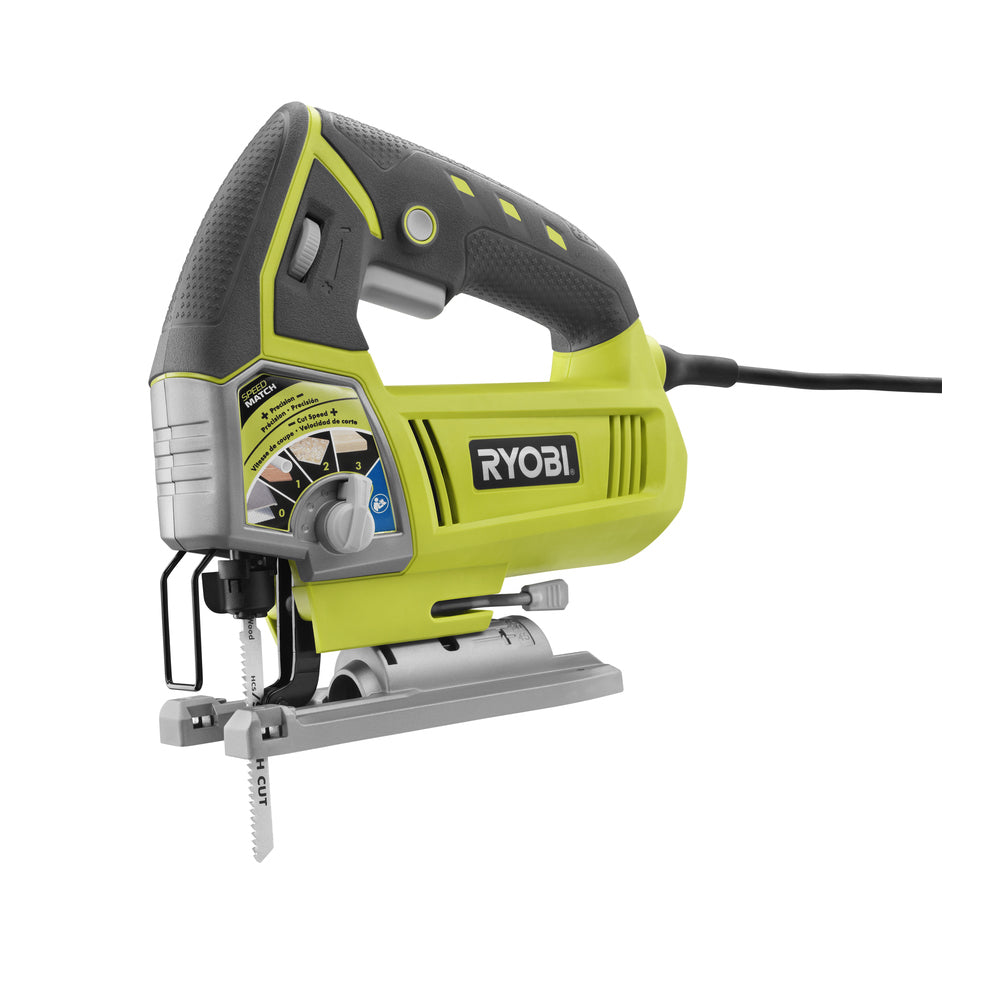
Your needs, this model
Does it fit your priorities?
Which JS481LG setting does RYOBI associate with hardwood and softwood?
The JS481L/JS481LG manual's Figure 6 assigns setting 2, medium orbit, to plywood, decking, and hardwood. It assigns setting 3, maximum orbit, to general lumber and soft wood. These are maker starting settings, not tested finish results or thickness ratings.
Explore this need in the finder →Does the JS481LG package include a blade for thin sheet metal?
No. The exact US page lists one wood-cutting blade, and the operator's manual says the metal-cutting blade is not included. The manual directs no-orbit action for metal and identifies a 14–24 TPI metal blade for thin sheet metal; choose a blade approved for the exact work and verify the package suffix.
Explore this need in the finder →Is the JS481LG dust port included and ready for an external vacuum?
The exact product page lists one wood-cutting blade, not a dust port. The manual lists a dust-port accessory and the repair sheet names an optional dust-port assembly, but the checked sources do not state the hose diameter or document vacuum-and-bevel compatibility. Verify the current accessory part and fit for the exact tool before relying on extraction.
Explore this need in the finder →The JS481LG is the corded RYOBI entry in this review set, and its most useful distinction is not a performance claim but a clearly divided material-and-motion chart. I checked the exact US product page, the JS481L/JS481LG operator manual and the JS481LG repair sheet. Those sources support a 120-volt, 4.8-amp top-handle saw with a T-shank-only clamp, a 3/4-inch stroke and four orbital positions. This is a document-based assessment, not a hands-on test; the published specifications do not tell us how quickly it will cut a particular board.
The exact JS481LG package and controls
RYOBI's exact US JS481LG page lists one wood-cutting blade and identifies a T-shank connection. The manual says the clamp is for T-shank blades only, so someone keeping U-shank blades should not assume that they will fit. The manual describes a variable-speed control and a separate orbital adjustment. It gives a no-load range of 350 to 3,000 strokes per minute, while the repair sheet identifies brush components and model-specific parts. Taken together, the evidence supports a brushed-motor classification, but it does not turn the current rating or stroke count into a measured cutting-speed comparison.
The package list is deliberately narrow: one wood blade is stated. The manual's metal-cutting chart calls for a separate 14–24 TPI metal blade and says that blade is not included. Do not infer a case, bag, dust port, edge guide or other accessory from a photo of the saw. When ordering, check that the offer is the JS481LG version and that the written contents agree with the exact manufacturer listing.
Four settings, with material boundaries
The operator manual's chart makes the four-position orbital selector more informative than a generic “orbital” feature label. Position 0 is the straight, no-orbit setting for countertop or laminate board and thin sheet metal. Metal work requires the separate metal blade; the manual specifically says to use no orbit on metal and conduit. At position 1, RYOBI pairs minimal orbit with plastics and PVC, and also with scrolling or curved wood cuts. Position 2, medium orbit, is charted for plywood, decking and hardwood. Position 3, maximum orbit, is assigned to general lumber and softwood.
Those are the manufacturer's starting recommendations, not results from testing. The manual says increased orbital movement can favor speed over a smoother cut, but it does not establish a finish grade or a safe thickness for a particular material. Choose a blade intended for the stock, follow its tooth-count and speed guidance, support the work securely, and make a cautious test cut when the result matters. The chart does not establish hard-metal/cast-iron or ceramic cutting, and the sources checked do not publish a maximum cut depth.
Bevels, dust and accessory checks
The family manual describes bevel adjustments from 0° to 45° to either side, with 15° marks, using a base-adjustment lever. That gives a useful documented angle boundary, but it is not a promise that every attachment remains compatible at every angle. The same manual says to remove an attached vacuum accessory before base adjustment. The optional Dust Port appears in the manual accessory list as part 039076001040; the exact JS481LG repair sheet lists an optional dust-port assembly under part 301009001. The different part numbers are a real fit-check issue, not a reason to guess which replacement is correct. Neither is listed among the exact product page's included items, and the reviewed sources do not state a hose diameter.
For matching purposes, the documented vacuum route is treated conservatively as an optional straight-action wood setup, with beveling left unknown while the attachment is fitted. Confirm the correct current dust-port assembly and hose connection for the unit label with RYOBI before counting on extraction. The manual does not confirm a vacuum-plus-bevel setup, and this review does not claim that the accessory is physically impossible to use with other settings.
Where it fits—and what to compare
The JS481LG is a reasonable research candidate for someone who wants mains power, a top handle, T-shank blades and manual-specific controls for wood, plastic, laminate and thin-sheet-metal tasks. The 4.8-amp label and 3/4-inch stroke distinguish it on paper from the corded RYOBI JS651L1, whose manual lists 6.1 amps and a one-inch stroke and whose exact page lists three blades, an edge guide, an Allen wrench and a tool bag. Those differences describe two distinct model/package records; they do not prove that the JS651L1 will cut faster or better. The JS651L1 manual also documents a rear port for a separate 1 1/4-inch hose, whereas JS481LG's optional port fit and hose size need confirmation.
Before choosing, verify that your outlet and cord path suit a corded tool; check the blade shank and blade type for the workpiece; use the setting chart rather than selecting orbit by habit; and confirm the dust accessory's current part and hose fit if vacuum extraction is essential. If your decision depends on material thickness, exact capacity, or a clean finish, the checked JS481LG sources leave those questions unanswered. This assessment therefore treats it as a specification-led option with useful mode guidance, not as a tested capacity or outcome recommendation.
Key specifications
Key details at a glance
| Power source | Corded mains power |
|---|---|
| Grip format | Top handle |
| Motor type | Brushed |
| Brushless motor | No |
| Blade interface | T shank |
| Cut-action settings | 0 / 1 / 2 / 3 |
| Maximum documented speed | 3000 SPM |
| Maximum documented bevel | 45° |
| Battery included | No |
| Charger included | No |
| Blade listed in package | Yes |
| Carry bag listed in package | No |
| Optional vacuum-extraction route documented | Yes |
| Rated motor current | 4.8 A |
| Stroke length | 0.75 in |
| Hard case listed in package | No |
Use the exact model’s instructions for operating limits, supplied equipment and version differences.
Sources for this review
Sources for this assessment
Make the next check about your project
Use the finder to combine material, blade interface, grip and operating setup. It matches documented capabilities, not guaranteed results.