
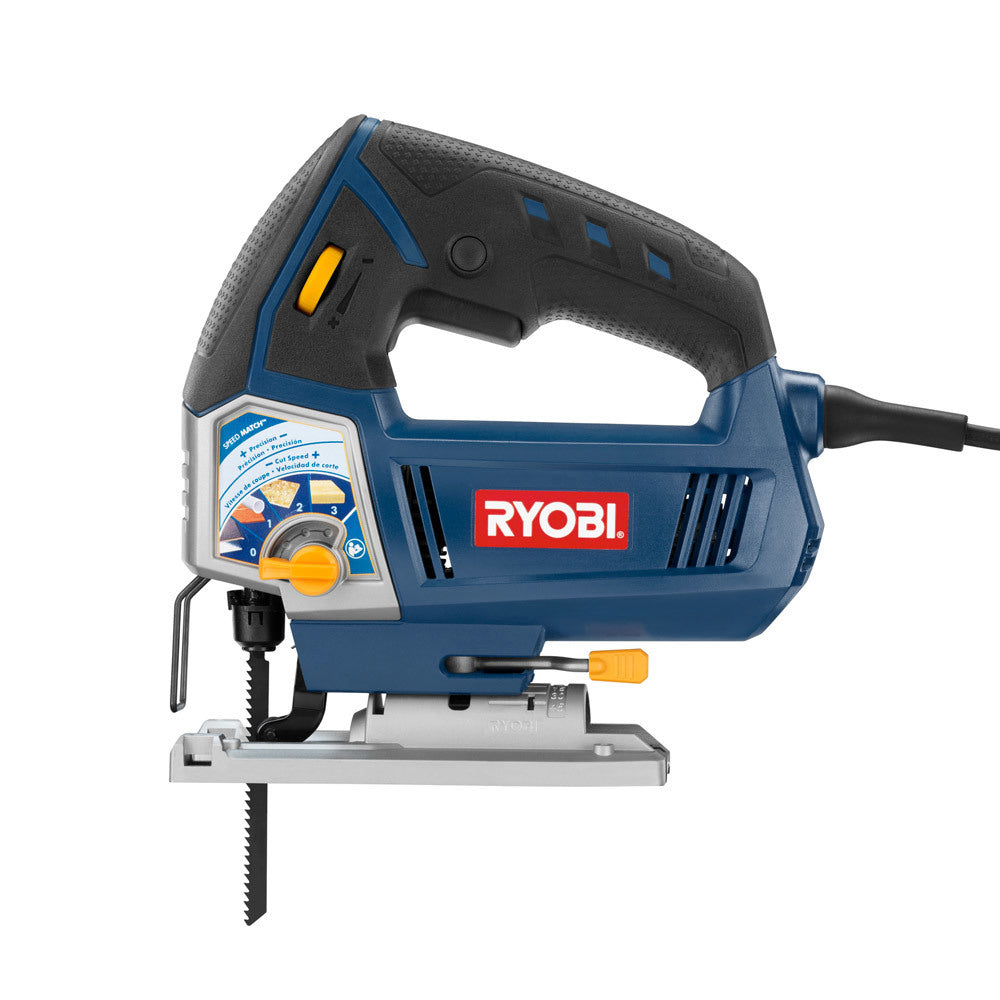
Your needs, this model
Does it fit your priorities?
What orbital position does the JS481L manual pair with hardwood and softwood?
The shared JS481L/JS481LG chart assigns position 2/medium orbit to plywood, decking, and hardwood, and position 3/maximum orbit to general lumber and softwood. The manual describes faster, rougher cutting at higher orbit, but this is a starting guide, not a tested result or thickness rating.
Explore this need in the finder →Can the JS481L be treated as U-shank compatible for thin sheet metal?
No. The operator manual explicitly says JS481L/JS481LG is designed for T-shank blades only. For thin sheet metal it calls for no orbit and a separate 14–24 TPI metal blade, which it says is not included. Do not transfer U-shank support from a different RYOBI model.
Explore this need in the finder →Is dust extraction included and compatible with beveling on JS481L?
The shared manual lists a dust port as an optional accessory, and the exact JS481L repair sheet lists an optional dust-port assembly under a different part number. The page does not itemize a retail package, no hose size is given, and no vacuum-plus-bevel arrangement is established; verify the exact accessory fit rather than assuming it is supplied.
Explore this need in the finder →RYOBI’s JS481L is an earlier corded top-handle jig saw with a separate variable-speed selector and orbital adjustment. The manufacturer’s exact U.S. page identifies the model and marks it discontinued; that is a lifecycle note, not evidence that a particular seller has stock or that a used unit works. I assessed the documentation and images, not a saw in hand, so this is not a hands-on test.
An exact JS481L assessment, not a package guess
The model-specific JS481L repair sheet and RYOBI’s exact JS481L page support an individual assessment. The operator’s manual is shared with JS481LG, but RYOBI lists JS481LG as a distinct model and gives it a separate product page. I use that family manual only for information it expressly assigns to both models. The JS481L page’s “Includes” area does not provide a package list, so I do not carry over JS481LG’s listed wood blade or infer a case, edge guide, or vacuum part for JS481L. The exact JS481L photograph shows a blue-and-gray body and its SpeedMatch panel; the photo identifies the depicted model, not a seller’s carton.
The manual specifies a 120-volt AC, 60-hertz, 4.8-amp saw, a 3/4-inch stroke and a 350–3,000 no-load strokes-per-minute range. It lists four orbital positions. Those are maker figures: stroke length is not maximum cutting depth, and the sources reviewed publish neither a cut-depth rating nor a material-thickness limit.
SpeedMatch is a material-and-action chart
The useful distinction is not simply “orbital” versus “straight.” The shared manual’s chart pairs position 0, no orbit, with countertop or laminate board and with thin sheet metal. It calls for a separate 14–24 teeth-per-inch metal blade for thin sheet and says that blade is not included. For plastics and PVC, and for scrolling or curved wood cuts, it assigns position 1 with minimal orbit. Position 2 is charted for plywood, decking and hardwood; position 3 is charted for general lumber and softwood. Those descriptions are starting guidance in a manual, not results from my own cut tests.
The manual says greater orbit can make cutting faster but rougher, while reducing orbit favors a smoother cut at a slower pace. Speed and orbital action have separate controls. For metal or conduit, the manual directs users to no-orbit mode; its material chart and advice do not establish a rated thickness, suitability for cast iron, or a guaranteed edge. Choose a blade for the actual stock and follow the instructions rather than assuming the saw’s included blade—unknown on the JS481L page—covers every material.
Check the blade interface before shopping for blades
The JS481L/JS481LG operator’s manual says this clamp is designed for T-shank blades only. The exact JS481L repair sheet helps tie the older model identity to its own parts and wiring diagram; it does not override the family manual’s T-shank limit. Do not confuse a blade listed in a service-parts diagram with a blade included in a retail package, and do not transfer U-shank compatibility from another RYOBI saw. If a listing is important to you, verify both the model label and the supplied blade shank.
Optional dust collection is not a package feature
RYOBI’s family manual lists a dust port as an accessory, while the JS481L repair sheet calls out an optional dust-port assembly under a different part number. I preserve that discrepancy rather than claiming they are interchangeable replacement numbers. Neither source gives a hose diameter, and the exact JS481L page does not itemize included accessories. Verify current fit against the tool’s label before counting on external extraction. The manual describes a base that bevels up to 45 degrees left or right, marked in 15-degree steps, but the reviewed sources do not establish simultaneous vacuum-and-bevel clearance or operation. Treat that combination as unconfirmed.
Who should consider this earlier model?
JS481L is relevant when identifying or evaluating this exact older corded saw, particularly if its top-handle format and documented T-shank-only interface fit the buyer’s blade plan. The shared manual gives a more useful decision aid than the model name alone: position 0 for its thin-sheet-metal setup with a separate blade, position 1 for plastic/PVC or scrolling wood, position 2 for hardwood and position 3 for softwood/general lumber. Keep the supplied equipment, maximum capacity, current availability and used condition as separate checks. For a different RYOBI version, compare the separate JS481LG assessment rather than assuming its page or package applies to JS481L; the JS451L is another distinct earlier saw with its own manual and blade guidance.
Bottom line: JS481L’s strongest documented case is a corded, four-position saw with explicit material/action advice, not an advertised depth rating or ready-made dust kit. Check the actual model plate, blades, accessory fit, package list and seller terms before relying on any particular offer.
Key specifications
Key details at a glance
| Power source | Corded mains power |
|---|---|
| Grip format | Top handle |
| Motor type | Brushed |
| Brushless motor | No |
| Blade interface | T shank |
| Cut-action settings | 0 / 1 / 2 / 3 |
| Maximum documented speed | 3000 SPM |
| Maximum documented bevel | 45° |
| Battery included | No |
| Charger included | No |
| Optional vacuum-extraction route documented | Yes |
| Rated motor current | 4.8 A |
| Stroke length | 0.75 in |
Use the exact model’s instructions for operating limits, supplied equipment and version differences.
Sources for this review
Sources for this assessment
Make the next check about your project
Use the finder to combine material, blade interface, grip and operating setup. It matches documented capabilities, not guaranteed results.